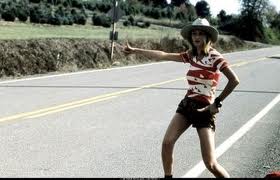
My “date” with Mihai?

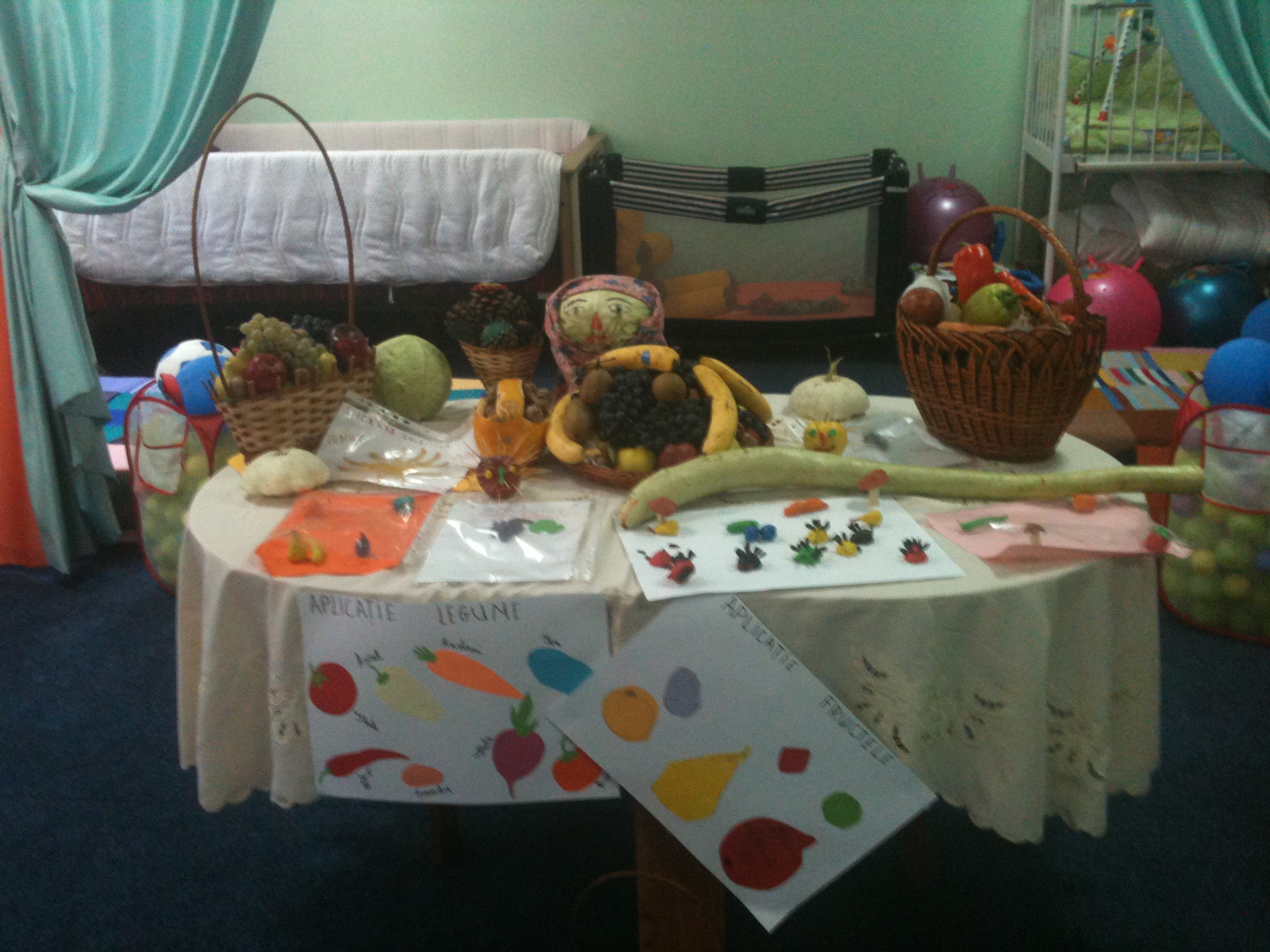
Vegetable display…what a nifty centerpiece

I may have relayed that Nina invited Andrei and Mihai to my birthday masa last Wednesday night (Andrei and Mihai are the two gentleman that figured largely in my blog post about attending a celebration in Boghocieni though I didn’t know their names at the time.  MIhai is the man who guided me through the hitching process, Andrei the man who emerged in his bathrobe…)  So a couple of hours into the party, and several bottles of wine later, either Andrei or Mihai brings up the Agricultural Expo taking place this weekend at the Moldexpo in Chișinău.  They want me and the other three volunteers present – Matt, Lindsey and Patty Harlan – to come with them.  At least this is what I understood at the time. Both Lindsey and Matt refuse the invitation, citing other plans, and it is my initial impulse to do likewise.  After all, I truly am a city mouse and have no penetrating interest in farm implements, combines, and animal husbandry techniques. However, I pause and consider the fact that this would present a real opportunity for integration and show me a side of Moldova that I don’t have easy access to, living in a raoin center like I do.  And, admittedly, the wine has painted the world friendly and fun and I think “what the heck, I’ll go!” I then talk Patty into joining us, though this involves her rearranging a language lesson and pulling herself out of the heavily tread routine she’s dug for herself in Hîncești. (I think she may be the only M27 who remained at site for a record two months after PST.  She ventured into Chisinau a mere week ago on an excursion with fellow Moldovan teachers on a hired bus to the opera – which doesn’t really count as far as I’m concerned.)

Come Friday, however, Patty has a chance to view an apartment for rent that morning and has decided that this is more important to her overall happiness than accompanying me to Agrofest.  So now it’s me and the two Moldovan men.  While this causes a stir of apprehension within me, I console myself with the knowledge that these are two good friends of Nina and it would be impossible for them to perpetrate some indiscretion upon my person without her finding out and making mincemeat of them (Nina is traveling to her village for the weekend – like usual – and cannot  join us.)  So I  hold off on canceling out – I don’t have their contact info and probably couldn’t make myself understood over the phone anyway – and wait for the knock upon the door.  Which, in typical Moldovan fashion, comes precisely 51 minutes after the agreed upon time of 9:00am.
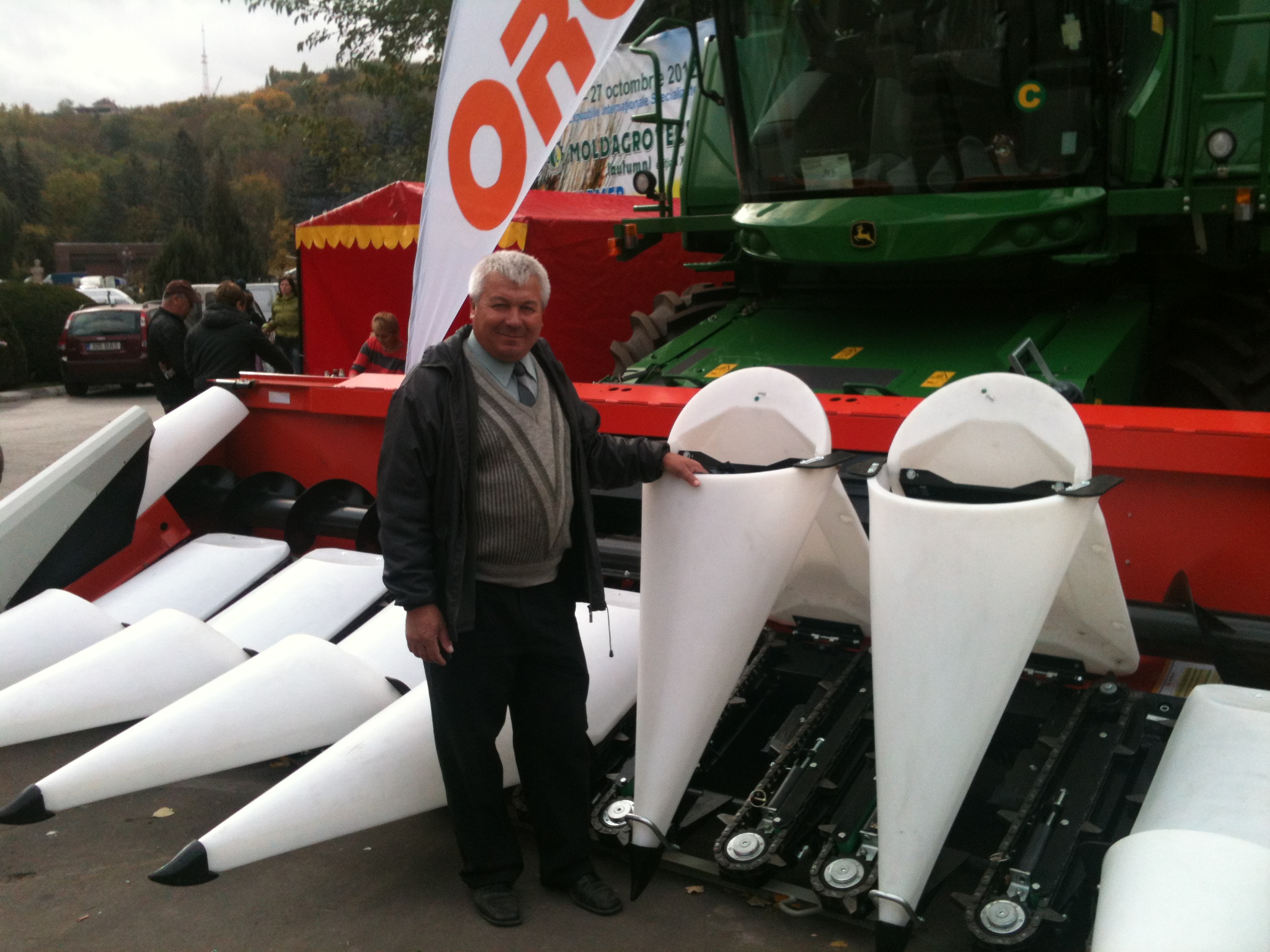
Mihai

 Surprisingly, when I answer the door, there is Mihai, alone, in suit and tie, smelling faintly of cologne, no Andrei in sight. Well, perhaps he is waiting out in the car? Again, will I ever learn?  No car, no Andrei, and off Mihai and I trek to the bus headed into Chișinău.  At least it’s a bus this time and we’re not standing on the side of the road trying to negotiate a ride with a truck driver, I think.  Which should have been my first inkling that perhaps this little excursion held a bit more significance than I – with my casual American attitude regarding cross-gender friendships – might be initially aware.  As Mihai held my arm crossing the street – a feat I accomplish with no assistance several times a day – and guided me onto to the bus midst the teeming throng – again, a negotiation I have successfully managed without fear or trouble many, many times in Moldova – something began tickling the underside of my brain, like the feeling you get when you might have left the iron on at home or forgot to turn off a burner on the stove.   Then, I realize that he has paid the driver for my ticket as we have boarded after the moment when the driver walks down the aisle collecting the money.  I try to repay him the money for my fare, but he refuses to take it.  Then, after we are seated, he turns and (tenderly) brushes away hair that had caught in my eyelash, and suddenly an alarm bell begins to ring, loud, clear and insistent, in my head.  OH MY GOD – this is what PC warned us about!!! Any excursion comprised of a man and a woman – especially if you are beyond the naivety of youth – constitutes a date in Moldova, no matter how innocently you might have accepted said invitation.  Oh shit, shit, shit!!!  I’m on a f***ing date!  

 When Mihai reaches across the back of my shoulder to open up the curtain so I can see the view, I descend into a brief panic.  Thankfully, his arm retreats back to his side and we resume a halting conversation about the beauty of the countryside (autumn – so far – presents Moldova in her very best light), the whereabouts of his apartment, the times I have previously traveled to Chișinău, the number and gender of his children and grandchildren, etc.  I am still holding out hope that perhaps we are meeting Andrei at the expo and I begin to relax a bit.  Silence ensues and I zone out watch the passing rust and mauve-tinged vineyards and brilliant blue sky outside my window.   However, once we arrive at the Gara de Sud and he again grabs my arm (even though I have purposefully paced myself to walk two feet behind him,) and again pays the driver for my ticket (despite me having my fare in my hand) and proceeds to kick a young woman out of her seat so I can sit down (causing me great consternation and embarrassment) and then smiles at me every time I look up and see him watching me, I realize that I need to make the status of this little divertissement as clear as I possibly can.

Nina’s farm is in Bassarabeasca, where this honey was made.

Once we arrive at Moldexpo and it is clear that Andrei is not, indeed, joining us and the conversation lands on the distance marriage that Nina and her husband have contrived (him living full time on the farm in their village and her residing in the city because of her work with Avon) I realize this is the perfect opportunity for a brief segue into my personal circumstances.  I remind Mihai about my own marital status, the fact that my husband does not like to travel like me, that he has an important, well-paying job in America, and that I am here because of a desire to live and work in a different county for a time, but that I will be returning after two years.  (All information that I have shared before, but I figured that revisiting it couldn’t hurt.)  This was the best I could manage, given my limited range of Romanian and the intricate complexities required to convey conflicting emotions and delayed dreams and the deep insights into mortality that mid-life birthdays seem to convey for us first-worlders.  Suffice it to say that he was quiet for awhile after this, but I may be flattering myself unduly.  I have no idea if I embarrassed him by implying that his intentions were anything other than friendship, if he was confused by why I needed to insert previously established biographical data during an excursion to Agrofest, or if he was busily re-organizing our activities for the day to accommodate my (hopefully) clear lack of intention to pursue a more intimate angle.  I could have been wrong about the whole thing, given my absence from the universe of courtship for almost a quarter century now.  Oh well. Better safe than sorry.

John Deere makes it to Moldova

 By the time we enter the gates to the expo, small talk has resumed, the sun is peeking out from glorious, white-feathered clouds and a brisk breeze periodically floats women’s brightly colored scarves about their necks and hair.  The day is beautiful and it is interesting to see the range of equipment on display, from micro-tractors built in Japan designed for the private farmer to gigantic, towering combines from Russia looming far above our heads that, Mihai tells me, are only affordable – maybe – for ‘associations’ – to group purchase in Moldova. (These machines-on-steroids continually elicit disgust from him as flagrant reminders of Russia’s ‘abandonment’ of the Moldovan economy – he is one of a certain segment of Moldovans that thinks returning to the fold of the Soviet Union to be its only hope for a brighter future.)

Mihai exhibits a preternatural ability to pick foreigners out from the crowd and everytime he sees one he drags me over and excitedly announces that I am an American that speaks English.  This provokes some puzzled looks (he, after all, is not speaking English) until I open my mouth and say, “Hello, where are you from?” and we establish that, indeed, Mihai correctly assessed that they were from Germany or Holland or England or Bulgaria and – as never fails to astound me – speak almost perfect English.  (Americans remain stubbornly parochial in our language limitations largely because we can.) He even announces this to Moldovans, finding a handful that also speak perfect English which results in me exchanging phone numbers with the daughter of the Moldovan Minister of Foreign Affairs (a great PC connection, if I can figure out how to use it) and a woman who conducts tours throughout Moldova in her own private vehicle (an exciting expansion of my travel capabilities.)  I meet several who have gone to school in the US in such varied states as North Carolina, Virginia, and New Mexico.  I share with them that last year at this time I was traveling through those very states. We exclaim mutual surprise at the relative smallest of the world.

 Mihai, meanwhile, has been gathering every piece of literature offered by the vendors. He has a bag filled with twin, sometimes even quadruple, copies of every brochure, catalog, pamphlet, magazine, flyer, newsletter, and booklet that was offered.  And every time he picks one up, he looks slyly around and carefully slips it into the bag as if he is in a covert operation collecting evidence for some sort of political intrigue.  I think that he is naively unaware that these articles are provided without charge and assumes he is getting away with something in obtaining this wealth of information for free. I convey to him, as politely as possible, several times, that I really have no use for this literature but he continues to collect it, stating that we will give my portion to Nina’s husband for wintertime reading on the farm.  By the time we reach the end of the exhibition I swear the bag must weigh twenty pounds. (I hope Nina’s husband will appreciate this effort, but it seems like a yawn-inducing compilation to me…)

Gear for whiskey-making, always an important addition to an agricultural fair…

 After the exhibitors begin to dismantle their wares, Mihai has me call his sister for him (he doesn’t own a mobile phone, remember, an antediluvian idiosyncrasy even in Moldova.)   I hand the phone to him and then wonder why I can’t understand anything he says until I realize he’s speaking Russian – ah, yes, the Russian connection – and he tells me afterwards that we are now going to his sister’s in Buiucani, a fancier section of Chișinău that is home, amongst other institutions, to the University of Moldova and the American Embassy.  Great – now I’m being taken to meet the family? crosses my mind briefly but I let go the thought; the day has been fun and his manners impeccable and there has been nothing to concern me since I made my awkward little speech.

Yes, that’s the bottle of wine.

 Julia’s apartment is spacious and modern, though a little disordered from renovations she appears to be committing on the wrought iron that laces the outside of her windows. Our visit is made instantly convivial by a large bottle of homemade wine and it is from his sister that I learn of Mihai’s wife, Nina, who has been living in Israel for the past five years working as a nanny.  (This information surfaces in the midst of a comic ridicule of Israeli dependence on American aid and a somewhat skewed notion of Putsin’s character strength in refusing to provide money to spoiled nations.)  I am more than a little surprised that the existence of said wife has not been proffered in previous conversation, either by Mihai or my host sister, Nina.  Such biographical data seems integral to me to basic, introductory phases of communication.  This leaves me worried – just a bit – of perhaps not having misinterpreted Mihai’s intentions, after all. And my Nina is fully capable of aiding and abetting such deceptions.  She is one of a certain demographic of independent Moldovan women who appear to have a more casual, European view of marriage and conjugal relations, stating on more than a few occasions that I should remain open to entertaining the attentions of a “barbat” while I’m in Moldova.
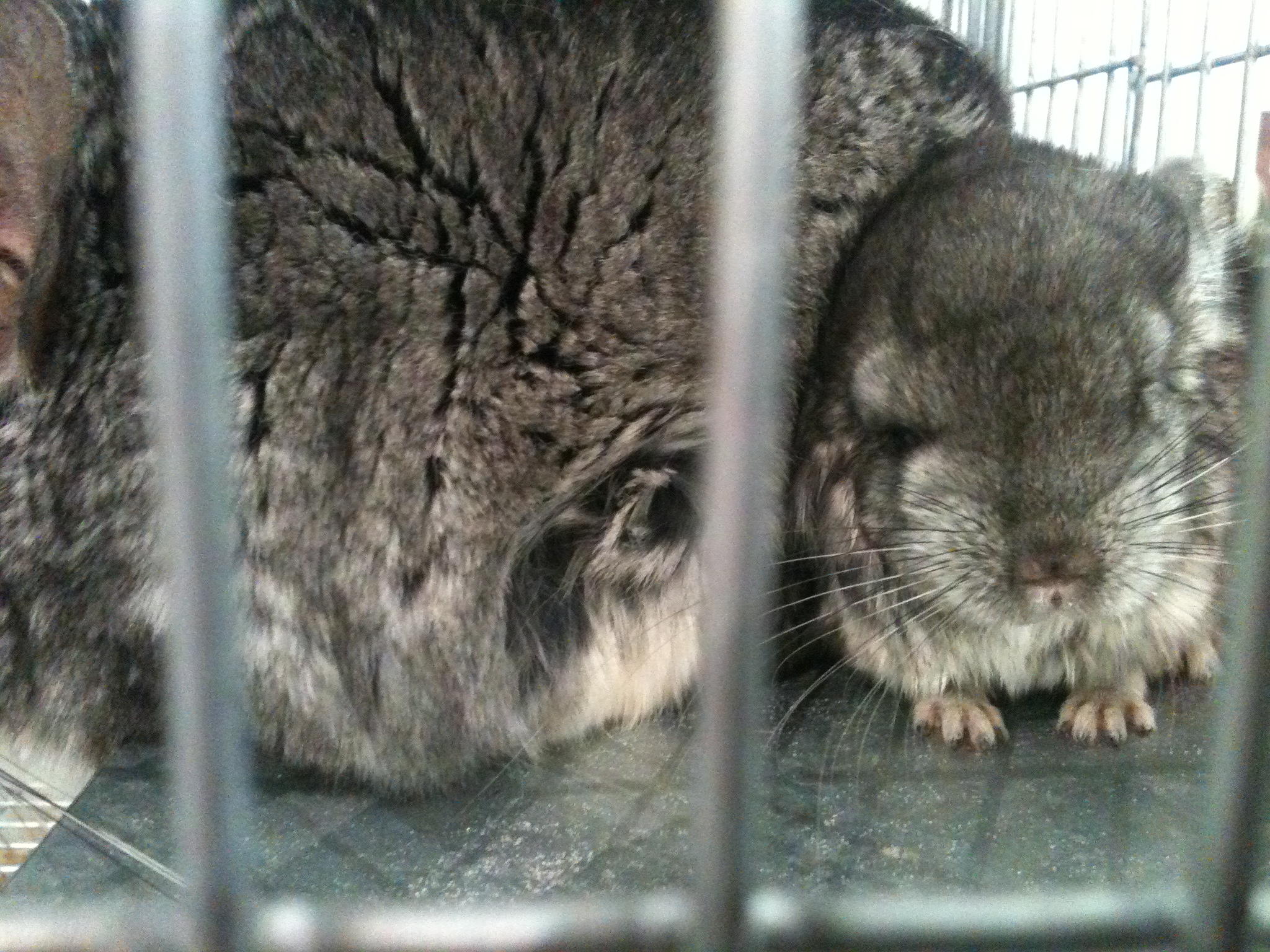
Adorable chinchillas destined, sadly, for women’s coats

So when Julia forcing the unopened bottle of beer Mihai has brought with him back on us is coupled with his stated attention to accompany me home purportedly to divide the literature loot between us, and then I find the apartment still empty of Nina, I quickly pull out my phone and call Patty.  Like an angel, she appears after a mere half glass of beer has been consumed between us and all social discomfort – imaginary or actual – is resoundingly diverted by her presence. We sustain 30 minutes or so of trivial conversation, but it is only after I yawn repeatedly and repeat “obisita” (tired) several times that Mihai begins to gather his booklets and turn his attention to departure.  Observing traditional Moldovan etiquette, I accompany him to the door, where he pulls a final, fast one that confirms for me that my long-dormant instinct is still operating correctly.  In Moldova, it is common for women to kiss each other on either cheek when greeting or saying goodbye. For men, however, it is more customary to either take a woman’s hand and feign kissing it or, if one is particularly gallant, to actually place his lips lightly upon it.  Relatives and particularly close friends – i.e., Nina and Mihai, say – will allow a kiss on the cheek from the man to the woman.  When Mihai started toward my face, I flinched, and then was horrified when he kissed me smack on the lips and then giggled mischievously. I was so shocked I just stood there with my mouth agape before gathering my befuddled brain to shout “rau!” (bad!) at his departing back as his disappeared down the stairs.
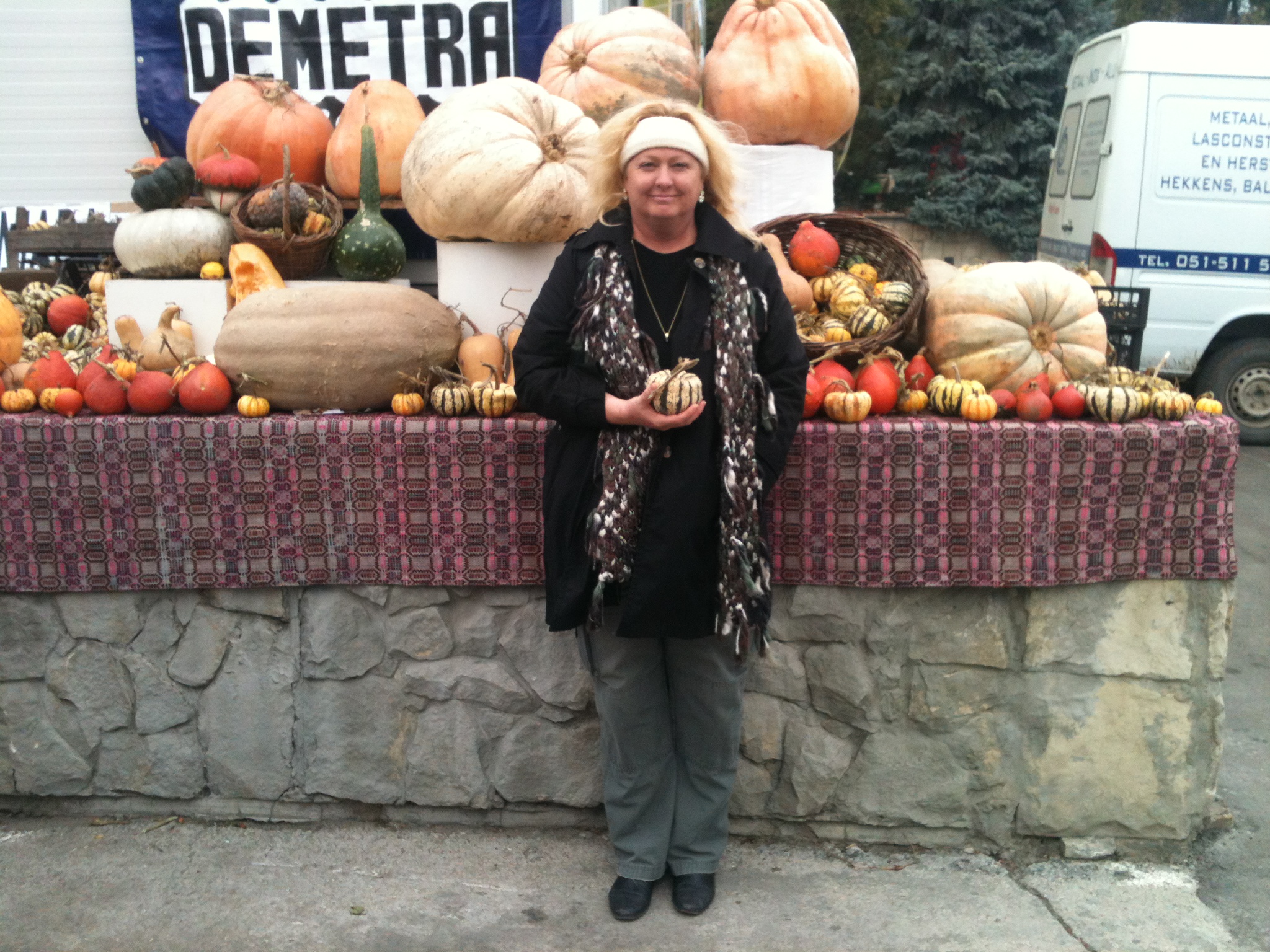
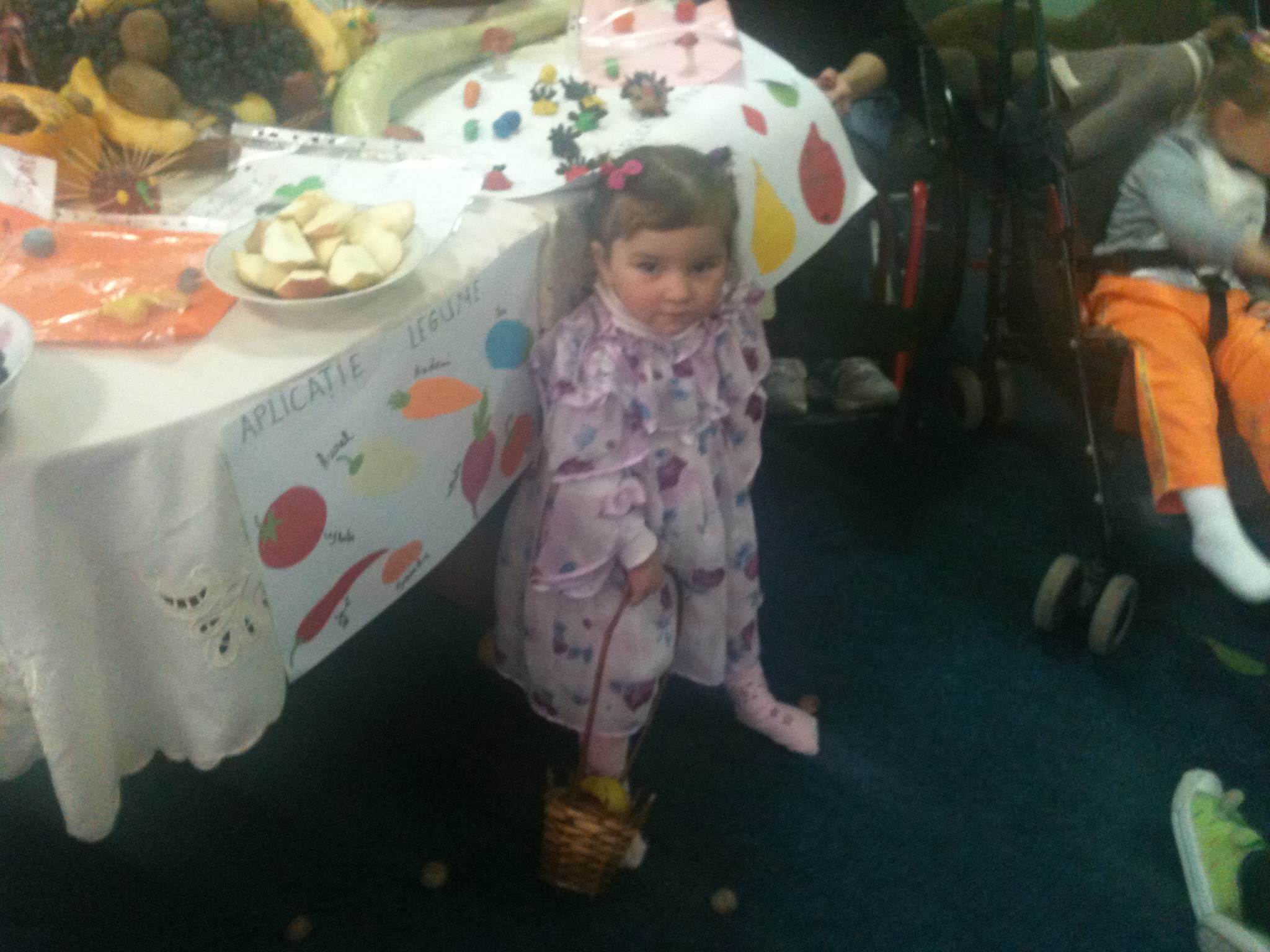
Me, with pumpkin

Another lesson stumbled through about the nuances of Moldovan culture and the difficulties of communicating clearly without a better command of language. Perhaps it was just a teasing gesture on the part of a lonely man who welcomes female company of any sort in the prolonged absence of a wife (dear me, does that mean my husband is kissing neighbors?) but I will need to establish much firmer boundaries if I ever decide to accept such an invitation again.  These are the aspects of Peace Corps service that one just doesn’t anticipate. Really.

And the question is: why there, not here?

I hope I have been abundantly clear to all of you who have taken the time to leave a comment on one of my posts how much they are appreciated. Writing a blog is a little like standing up on stage (sitting at my desk) alone staring out into the blinding white lights that effectively erase the audience (the blinding white page on the monitor) and floating a monologue (pressing “publish”) that may or may not hit a resonant chord with my readers (comment/no comment.) Actually, I myself read many blogs that I think are wonderful but all too often I don’t take the time to comment as I’m not really sure I have anything pertinent to say. That’s bad etiquette on my part, given my first hand knowledge of what a boost it gives the writer to see that someone was moved enough to join the conversation.
Anyway, I received a comment on my last post – 9-5 – that posed a very incisive question, one that I’m pretty sure must have bounced through the minds of more than a few people who know me, but was never actually put to me in person: So why are you there providing volunteer services in a foreign land rather than here helping your own community/country/people? As the commenter truthfully pointed out, there are many poverty stricken, marginalized, under-served communities in the United States. And if all of us just focused on taking care of our own, perhaps there wouldn’t be the perceived need to fly halfway across the world to provide meaningful service to humanity?
This comment definitely made me sit back and go “hmmm.” Initially, I was impelled to react and, fingers poised above the keyboard, I sifted through the myriad arguments tumbling through my brain in an effort to decide which one to put first. But then I stopped. I realized that this was an important question that deserved thoughtful consideration, as (I confess) there have been more than a few times that I have asked myself the very same thing. So I’ve been mulling it over all day. And here’s where I’ve landed:
The Peace Corps’ mission has three simple goals:
1. Helping the people of interested countries in meeting their need for trained men and women.
2. Helping promote a better understanding of Americans on the part of the peoples served.
3. Helping promote a better understanding of other peoples on the part of Americans.

Perhaps because of their simplicity and clarity, these goals have not changed in the 51 years since the Peace Corps inception. They wholly contain the very essence of a volunteer’s service and manage to embody – for me, at least – the reason why our government (and we taxpayers) see fit to continue funding this seemingly idealistic enterprise through administrations of both persuasions and times of dearth as well as plenty. There is a method to this madness. Let me explain.

1. Helping the people of interested countries in meeting their need for trained men and women.

Yes, I highlighted that word for a reason. If a country or a people are ever going to progress beyond the perilous escarpment of hand-to-mouth survival, they must be able to realize the benefits of critical thinking.

“Critical thinking is the intellectually disciplined process of actively and skillfully conceptualizing, applying, analyzing, synthesizing, and/or evaluating information gathered from, or generated by, observation, experience, reflection, reasoning, or communication, as a guide to belief and action. In its exemplary form, it is based on universal intellectual values that transcend subject matter divisions: clarity, accuracy, precision, consistency, relevance, sound evidence, good reasons, depth, breadth, and fairness.”*

Surprise, surprise: critical thinking is not a universal entitlement conferred on all people at the moment of their birth. Rather, it is a hard won skill, usually gained through many years of exposure to a broad range of circumstances and/or – for a lucky and infinitesimally small percentage of the world’s population – through enlightened public education. Despite what for many appears to be a dismal state of the public school system in the USA, we still do promote the value of critical thinking. One learns that by experiencing the stark contrast with educational institutions elsewhere (a nod to you Patty.) As expensive as it is increasingly becoming, an American university education is still a world-class vehicle for learning to think critically if one applies oneself firmly to that goal. And it is precisely that kind of training that poverty stricken, marginalized, under-served populations throughout the world desperately need.

I subscribe to ten or twelve Peace Corps Volunteer blogs; I drop in on at least that many from time to time. One universal theme that runs in common through them all is a general surprise/disbelief/incomprehension/frustration/sadness about the “superstitions” that dictate so much of their host communities’ decisions, choices, and development. Couple those with a pervasive lack of comprehensive schooling, the afflictions of diasporas, warfare, governmental instability, and disease and you have a set of circumstances that Americans have not had to deal with since the aftermath of the Civil War.

I am not denying that desperate people exist in the USA. But I will proffer the argument that they have easier, more immediate access to meaningful, long-term assistance: there are a multitude of investigators, journalists, educators, attorneys, laboratories, foundations, government agencies, research institutions, think tanks and charities that have the resources to at least posit resolutions for problems within our borders. That is not the case in many other countries where Peace Corps Volunteers serve because those aforementioned resolutions are most often the expression of critical thought, a skill which many of them sorely lack and determinedly seek.

The first goal speaks to our commitment to partner with interested countries (they have to ask for our assistance – we don’t invade or force ourselves upon them) in creating those resources which can help them help themselves. This is the quality that my commenter assumes that all peoples possess but which, in fact, they don’t. However impoverished various American communities, neighborhoods, or individuals might be, they have the distinctive, enviable quality of being American – a benefit whose worth we don’t usually recognize until it’s put into stark contrast with alternative nationalities. I left America in a state of perturbed disgust; I am beginning now to acknowledge and appreciate many aspects of its intrinsic value which I patently assumed to be a universal entitlement.

2. Helping promote a better understanding of Americans on the part of the peoples served.

This is a loaded one. Really. Because many of us PCVs here in Moldova appreciate, having recently taken up residence in a former Soviet state, the implications of providing an alternative viewpoint to the one which was sanctioned and forced down Moldovans throats for many a decade. It is – literally – a battle between east and west to win the hearts and minds of a psychologically distressed population which has been traded back and forth like a pawn in a global chess game for centuries.
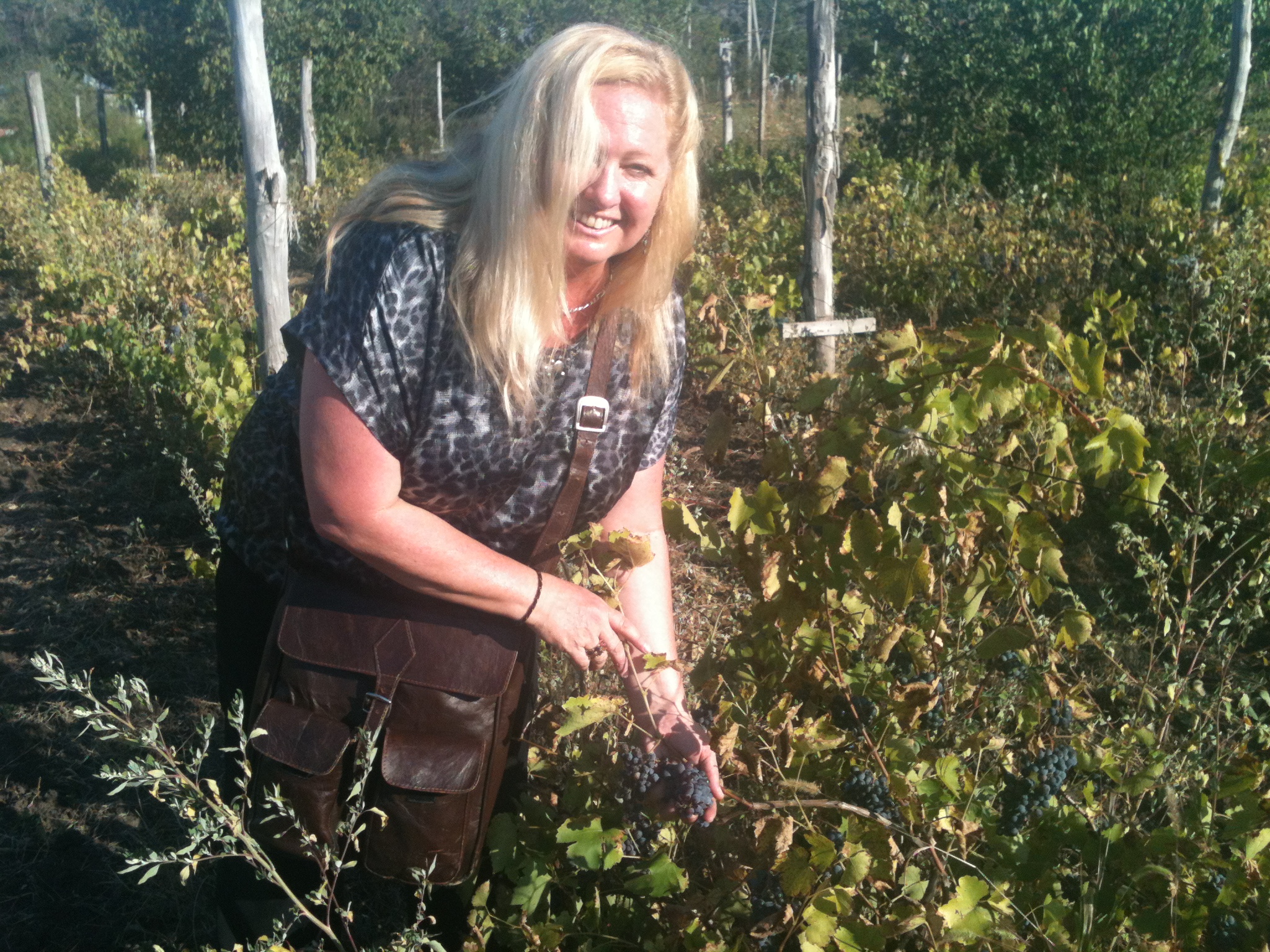
Have you ever really pondered the image of America that is most constantly, loudly, persistently, pervasively portrayed overseas? For starters, most everyone in Moldova thinks Americans are fat, gluttonous, greedy, obnoxious, loud, rich, lazy, surgically-enhanced pigs. Because that is what our media messages convey through all their various platforms: movies, television, magazines, advertisements, YouTube, games, Facebook, news and entertainment sites. We are not blanketing the world with love. Rather than creating bonds of similitude and friendship, we typically seed notions of competition and self-consciousness, which usually serve to distance people both from each other and themselves. We are not the caped-crusaders we like to picture ourselves to be. Actually, unfortunately, we have a distinctly evil grimace from most angles.

On top of that, we currently represent approximately 4.6% of the world’s population while consuming almost 25% of its energy. AND we export the inculcation of insatiability – we have it all and so the rest of the world should have it too. Never mind that there is not enough stuff (energy) to satisfy 6 billion individual desires for more meat and plastic and timber and gas and electricity and coal and steel and gold and caviar and diamonds and platinum and ……we could – and do, mind you – go on and on. We have fostered the concept that the world’s resources are infinite, rather than finite. We have role modeled wastefulness and ingratitude and greed. We have not paused even once to consider the larger implications of the “American dream.”

We may be heroic at home but increasingly, and unfortunately, we have squandered that reputation abroad. Considered as a portion of the nation’s economy, or of its federal expenditures, the U.S. is actually among the smallest donors of international aid among the world’s developed countries. Yet we boast the largest military expenditures by far, we have a president who has ordered the assassination of American citizens living abroad and we have yet to officially acknowledge the ravages of global warming, which are having far more detrimental effects on third world countries than on us.

Do you see why we might need friendly, altruistic ambassadors doing good deeds in foreign lands?

3. Helping promote a better understanding of other peoples on the part of Americans.

Interestingly, one does not relinquish the title, or responsibilities, of being a Peace Corps Volunteer once service overseas concludes. I will be known as an “RPCV” or a Returned Peace Corps Volunteer for the remainder of my life. And I will be expected to continue my service – to a greater or lesser degree, the choice is mine – by mindfully promoting a better understanding of the country of Moldova and its people through talking about my experiences to other Americans (watch out world – you might find me somewhat tedious at social gatherings after this!)
Joking aside, it is truly unfortunate that most Americans have little experience of cultures outside of our own. It is why terrorists are so successful in inducing fear and our own government is able to slowly chip away at our privacy and civil rights in response. It is why the preponderance of people (myself included) who learned I was going to Moldova had to Google it to find out where it was. The numbers tell the story: Of the 308 million-plus citizens in the United States, only 30% have passports. And most of those passports are not being used to gain access to third world communities for extended periods, I’m pretty darn sure.

Every single blog I’ve read from current and past volunteers who have served in such “scary” countries as Afghanistan, Albania, Azerbaijan, Columbia, Iran, Libya, Nicaragua, Turkmenistan, and Uganda have all sung hallelujahs to the hospitality, generosity, warmth, and caring of the communities that hosted them. Our current interim Country Director, along with all serving PCVs, was just pulled out of Tunisia for safety and security reasons. Despite this, he said that his partners and agency staff were “regular people just like us” who abhorred the violence being perpetrated in their towns and neighborhoods. Just like every single American isn’t a gangster, not every single person born to the Muslim faith or a tyrannical government is a terrorist. We have to get beyond our incestuous self-righteousness and really see and feel in our bones that most people have the same wants, needs, desires, and emotions as us if we are all going to make it into the next century.

So there is one long-winded, but definitely pondered response to the question of why I have chosen to serve in the Peace Corps overseas at this point in my life.

And, as a sidebar, I do wish to point out that for 20 years – until I was forced out – I worked in the non-profit sector making substantially less (as my husband and father would tirelessly remind me) than I could have working in the corporate arena. I have done my part for some of the underserved people in my own community. Have you?

*A statement by Michael Scriven & Richard Paul for the National Council for Excellence in Critical Thinking Instruction

9-5

Entrance to Pasărea Albastră

It really is time to write about what I’m actually doing here for Peace Corps Moldova. I know anyone reading my blogs might come away with the notion that I only traveled here on a cultural exchange mission – I don’t seem to have any substantive work filling my day. And the truth is that I really don’t. Sure I get up each morning and load my computer into my sturdy backpack (thanks mom!) and trudge up the hill to the “office.” I then unload my computer and sit at my desk and mostly study Romanian all day. That is, when I’m not seated in the dining room with the staff and kids eating a meal. Which I do 2-3 times daily. For 30-45 minutes each time. I get to hear a lot of Romanian being spoken and sometimes (not as often as I should) I try to jump in and join the conversation.

Table set for Harvest Day celebration

I know all about these women’s children and husbands and parents and siblings and favorite foods and sleep habits and even whether or not they wear pajamas to bed at night (that was a funny conversation.) I know the deals they get on cartofi and pâine at the piața and where the best place is in Hîncești to buy a torta. I hear about their frustrations with wages and government and the transportation system and the dismal prospects for finding affordable apartments in town. What is still hazy and ambiguous to me, however, is the details relating to the work I am supposed to be doing at the center and how I can really be of service to these people and their organization.

Daria has the wisest smile

When we were in PST, we received a lot of training on how to be a good Community Organizational Development Advisor. And all of it looked good on paper and made in sense at the time, in theory. But once you get to site and actually are faced with the bureaucratic complexities and inherent dysfunction of the NGO landscape in Moldova, it all becomes a bit overwhelming. Funding, operating, and sustaining a non-profit in Moldova relies on a set of circumstances much different than those I was accustomed to in the states. There, one generally seeks grants for “startup costs” either to begin a new NGO or to implement a new program within an existing one. And for that grant to be funded, one usually needs to have a pretty solid plan for making the NGO or program self-sustaining by the time the start-up money is spent, from government contracts or insurance revenue or corporate support from businesses attempting to burnish their image with consumers. It makes a lot of sense and generally works (at least when times are good and the economy is doing well.)
In Moldova, it doesn’t work this way. There are no government contracts or insurance companies or big businesses seeking positive public relations. I am still too new and unschooled in the realities of the post-Soviet economy and governance here to analyze the specifics of the problems, but it is pretty easy to discern from just looking around that there is little investment being made in any sort of commonwealth. Whether this is because of a lack of available revenue or because people don’t see the value in putting money aside for the public good, I don’t know. But I am getting firsthand experience of life in the sort of environment that results from not funding a social safety net or wanting to invest in public infrastructure. And let me tell you, it’s not pretty folks.

Staff, kids, parents, and volunteers!

So far, I am helping primarily through smiling a lot and being cheerful. This seems to bolster everyone’s spirits and keep them hopeful for the future. Because come January 1, we have no funds for salaries. My partner is currently applying for a grant being offered by a Swiss organization; this is round two of keeping the organization afloat. There are no prospects, at least for now, of the city providing funds or of being able to charge a reasonable amount for our services. However, if we can increase the client base and reach out to more communities, there is a possibility of being able to generate enough income to make the center sustainable.

Dining room mural, which speaks of the joy and hope children bring to our lives

This will depend on whether there are enough parents with disabled children able to find jobs and work, and make enough money to pay a fee for their children to receive services. It is a big IF in this country. Most families with disabled children have had to put them in orphanages in order to be able to work in the first place; keeping them at home is a relatively new concept for Moldovans. Traditionally, disabled persons are viewed as a liability and are discriminated against in civil society. There have not been many incentives or strategies formulated for families to care for them at home.

My partner Ana with Ion

Meanwhile, take a walk across town and try to avoid getting hit by one of the many late model BMWs or Mercedes Benz flying down the streets. Stroll by the McMansions behind wrought iron fences at the top of monument hill. Notice the kids chatting on iPhones in the seat in front of you on the bus into Chișinau. And see the D&G sunglasses that the young women display conspicuously atop their heads on even the cloudiest day.
My, my, my, my, my. I’m not really as far from America as I might think. Perhaps our values – at least some of them – are not that difficult to adopt, after all. And providing a different perspective on those values is something that I plan to make a BIG part of my Peace Corps service in Moldova.

And finally – one for you mom! Me in my office.

Life in Retrospect

Sunrise Great Bend Kansas

Last year at this time, Mike and I were in the middle of a cross country trip across America, an impetuous odyssey we embarked upon like a pair of draft horses suddenly finding themselves loosed from reins, harness, and dray.  We were giddy, light, unencumbered, reminiscent of nineteen, only this time we had a late model vehicle and plenty of cash to fuel the experience.  As I remember it, it was four months of almost uninterrupted bliss.  I loved sleeping in tent, having no kitchen to keep, no floors to scrub, no schedule to mind.  We were free to travel the little chicken scratch roadways off the main arteries whenever the mood would strike us or stay for an extra day in a particularly picturesque local on a whim.  We walked miles and miles of trails, listening to water run over rock and birds cry in bottomless sky.  We cooked under trees and brushed our teeth beside lakes and stood silently before Technicolor sunsets.  We met interesting characters, treated ourselves to expensive restaurant dinners once or twice, and spent countless quiet nights huddled in camp chairs watching movies on a computer perched atop an ice chest set between us.  We lived for a month in a creaky cottage perched behind the dunes of a tiny beach town on Chesapeake Bay.  I have a multitude of pictures from that trip and I keep returning to them again and again and again these days, longing for the gratuitous expanses of America that taunted us just beyond the windshield for a magic season in our lives.

Our tent in Shenandoah on this same day last year
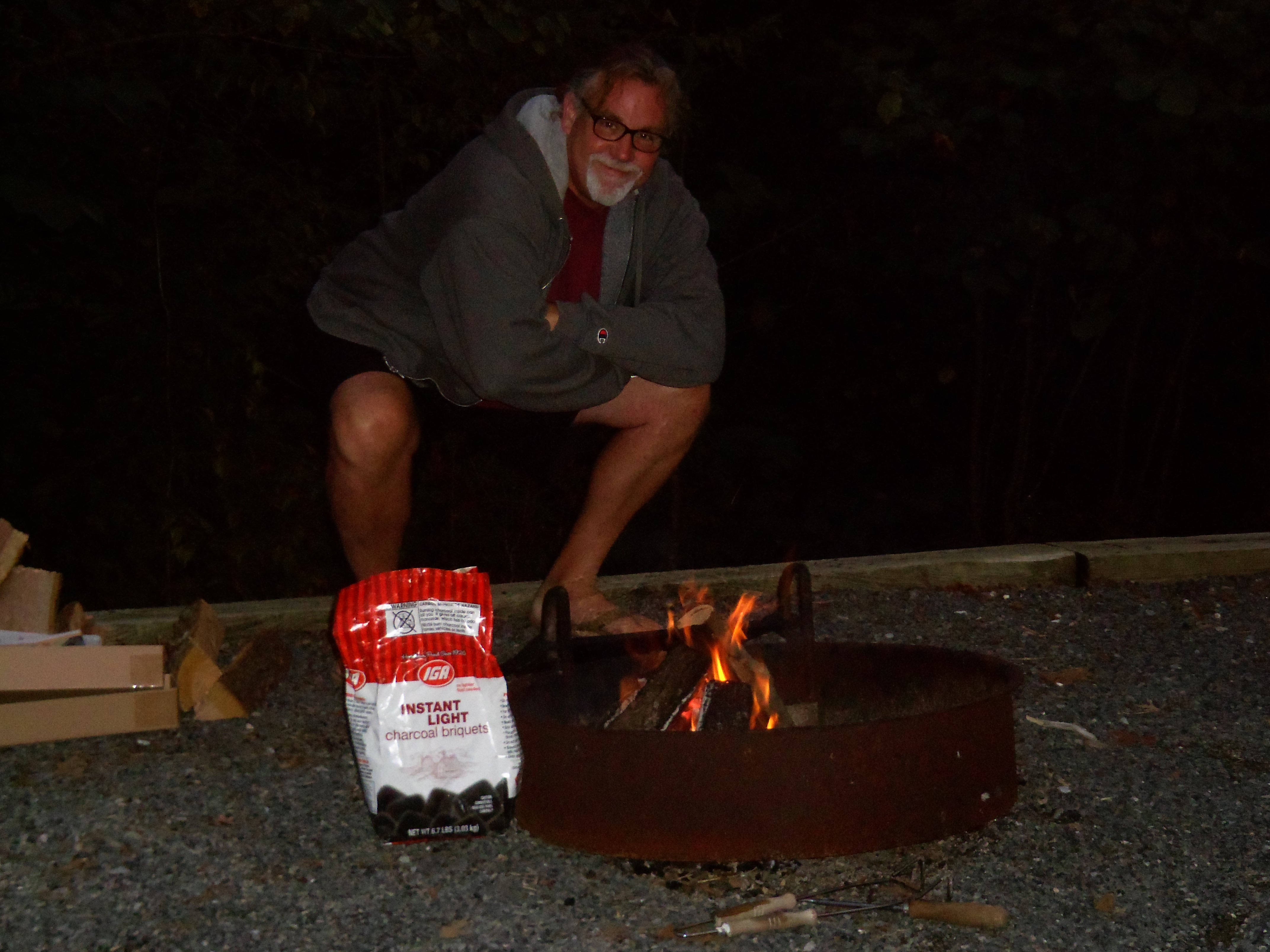
Mike makes fire!


Why is life so much kinder to us in retrospect? How artfully it soothes us by softly tinting and blurring our memories, embellishing and erasing as needed to make the captured occasion coyly play to our looping hunger for dramatic fulfillment. Life seems fuller, grander, more satisfying in retrospect, whereas our daily life in the present often seems fraught with cotton balls and mush. The soporific of ennui is so pervasive, pernicious, and stultifying, it dulls our senses and makes now less preferable to then.  We don’t know how to engage our boredom, where to find its chokepoint, how to lay our fists about its bland face.  We only feel ourselves increasingly short of breath, narrowed down, pinned in, suddenly beige and unsatisfied.  And that’s when we clutch about spastically, searching for a lifeline somewhere amidst the photographs forever bobbing in our wake, little pincushion reminders that every once in awhile we are granted a reprieve, jolted alive and awake for a period of time when it all made sense and environment, emotion, and intellect were all knit together in a warm and recognizable pattern that comforts us to look upon later.

Pensacola west

I shored up some more of these life savers again during the last two weeks – capturing scenes and freezing impulsive actions that will serve as nourishment over the long, lonely months ahead.  I could not explain to you why people I met four months ago have become so large and significant in my life.  Perhaps because those photos of America are receding now on the horizon, despite my desperate attempts to anchor them vividly in my mindscape.  The human mind searches for purpose, endlessly trying to trace patterns, establish significance, imprint meaning into experience.  This is the mechanism of memory – the why of remembering one thing over another.  Perhaps it is also why the memory of something tends to be so much richer sometimes than the actual experience was when it occurred: it has the opportunity to soak in and establish connections with other memories and become embellished by subsequent experiences and tie together all the loose, unarticulated longings that reminiscing can evoke.

America may be out of reach for awhile, but it is good to know that other memories are being formed right where I am now.

ET (Going Home)

Picnic in Cricova with Roberto, Patty, Elsa, Carl, and Jenn

No, I will not be announcing here that extraterrestrials have set up camp in my dulap de heine in Stauceni. Nor have I been transported to another world by way of Moldova’s unconventional transportation system. In Peace Corps lingo “ET” stands for ‘early termination,’ which means that a PCV’s service ends – for whatever reason – prior to the standard 27 month commitment we all make. In the last week, three COD PCVs from the M26 group voluntarily ET’d for personal reasons. It happens so quickly that it takes your breath away and has left the collective mouth of our little group of temporarily reunited COD M27s slightly agape.

It is not my intention to name names or describe the specifics of these three PCVs’ circumstances. I was fortunate to have spent extended time with two of them and all three were significantly involved with the M27s as trainers and mentors. Through accidental circumstance, I had the opportunity to talk with all three as they were contemplating their respective decisions; I witnessed the intense, drawn out deliberation in which they each, in their own way, engaged. It was definitely not an impulsive or reactive move for any of them. However, most of the other volunteers in my group did not get that window into their motives and were left shocked and awed when their departure was announced by our program director at the start of a training the other day.

In some ways, I don’t know if it has made it harder for me to have talked with them about what they were thinking and feeling prior to deciding to throw in the towel. They all had very legitimate, substantial issues that fed their ultimate conclusions. Two of them had significant others that were waiting patiently for them at home. One of them had chronic health issues that had plagued her throughout her entire service; one had recently developed a puzzling problem with her heart. One had gone without water in her village for almost three months during the height of the summer heat. (She had to buy water to wash her dishes – needless to say she was NOT getting regular bucket baths or hair washings.) There were issues with partners not participating in partnership, organizations that had drifted without purpose, communities that were disengaged or insular and unwelcoming.

Romy and Lindsey – Warren in back

But despite this, these women (they were all female) kept trying. For 15 months they gave it their all. They greeted the M27s with enthusiasm and verve. They put their best foot forward every time they saw us, not wanting to mar our experience or influence our perception of what Peace Corps service can be. They were so successful at accomplishing this that many of the M27s were left a bit bruised by their sudden disappearance from our lives: how could they have fooled us so completely? How did we not see it coming? If it could happen to them, the tenure of anyone of us becomes a legitimate question mark for the future.

The Peace Corps is surprisingly, almost cathartically efficient, with early terminations. Once you announce your intention to quit, you are sent packing within three days. There is little time to say goodbye, to have “closure” with people, to tie up all the loose ends you will be leaving behind. Perhaps they are smart to do it this way. Once you realize that “ETing” is possible, it is suddenly a presence in your day to day life, looming off your shoulder like some doppelganger Grim Reaper, threatening to undermine your determination and snatch you out of the small circle of routines that you have managed to draw around yourself which sustain the illusion of purposeful, progressive action.

Coming together again for PST III has dealt an unplanned, somewhat unwelcome, blow to the burgeoning stoicism of many of us. We were just beginning to tread a groove, incorporating the small tricks of successful integration – greeting the vendors at the piața, learning the names of the children in our apartment block, familiarizing ourselves with the drivers of our local matrushkas, preparing American meals for our host families, recognizing the intonations of our coworkers’ speech patterns. Then – bang – we’re suddenly back at the beginning again, returned to the families and locals where we first landed as naifs in Moldova, faced with the discomfort of knowing we’re not the same people anymore, that time moves on without us, seasons change, relationships stretch and sometimes sour, and even those that remain are tinged with bittersweet. This is transitory. And now three seemingly permanent fixtures of our experience here have evaporated overnight. Nothing can be counted on, really.

Tamara (Moldovan neighbor) and Patty with puppy

One thing I am coming to understand is that – despite over 200,000 people having served in the Peace Corps to date – there is no standard “Peace Corps experience.”  Even within the environs of a tiny village, two volunteers will have two very different experiences, comprised of a unique amalgam of program, host family make-up, counterpart investment, health issues, relationship and family circumstances back in the States, purpose in being here, age, emotional proclivities…I could go on and on.  There is no way to pick out the qualities of a “successful” volunteer or predict who will make it through 27 months of service and who will decide to leave prematurely.

It used to drive us crazy when we would ask our mentors for specific advice during PST for integrating successfully or making it through the winters or motivating our partners or learning the language or adapting to the different foods, or coping with the lack of adequate sanitation and the inevitable response was ALWAYS prefaced by “It depends….”  Everything depends here.

Georgie and Romy

One of the ET’ing PCVs sent all of the M27s an email just before she departed from the Peace Corps offices to board her plane back home.  It was very long and heartfelt; one sentiment stood out for me:

“You each will likely face challenges and moments when you want to scream, laugh, cry, dance, give up, sing, and push like you’ve never pushed before. When you feel those emotions, follow them. The most important part about my Peace Corps experience was getting to know myself better and learning my limits, despite how well I thought I already knew them. I encourage you all to be open to all the adventures you will face and not to be discouraged by anyone else’s Peace Corps experience, including my own. At the same time, knowing yourself is also knowing when it’s time to walk away so if and when you ever feel like you’re time as a volunteer is done, I encourage you to see past the guilt and appreciate your experience for what it was.

I had never contemplated, before now, the idea that my service could be successful if I did not make it the entire two years.  That is part of the challenge that I posed for myself in joining.  And I still fully intend to see it through.  But it is unnerving to realize that very strong, dedicated, and capable people have chosen otherwise.  Many of them, in fact – the statistics are about 30% of any given group does not make it to the end of service.  I had read this before I came to Moldova, but I didn’t understand the full impact of what it meant when you actually know the people leaving and understand their reasons, when you can feel their reasons beginning to take hold within your very bones some days.

Peace Corps service is hard, but it’s hard for each person for a different reason.  So while we serve together, we are also alone on our own separate journeys, testing our own limits, stretching to surmount our own barriers, defining our successes in a very personal way.  Somewhat like running a marathon with a team, each person’s ability to go the distance is his or hers alone.  I cannot lend strength, or fortitude, or persistence, or happiness, or the ability to ignore a crushing pain to someone else, no matter how hard I wish for them to succeed.

So being together again in Stauceni and knowing that these one or more of these eight people that have shared this absolutely unforgettable and unrepeatable experience with me may not be here next year is a sobering reality check.  And they may be looking at me and wondering the same thing.

Me and Elsa

The Ice Cometh

My personal, unofficial transition into fall happened today (the ‘official’ one being tomorrow, the autumnal equinox.)  It has rained on and off all day – not the kind of blustery squall that would blow through like a manic cleaning woman in the scorch of mid-afternoon in July, trailing a host of billowing white clouds like freshly cleaned sheets snapping on a summer clothesline.   This was a desultory but persistent rain, brought in by a sodden heap of wet gray blanket flung across the sky and left to leak its grey water upon everything below.  By afternoon a stiff wind was throwing its weight around and umbrellas were trudging along the streets at an angle.  Summer disappeared overnight, sweeping her dusty skirts behind her.

Now it’s 5:30 and the sun has slid behind the huddled row of derelict buildings lurking curbside across the street outside my window.   This weather fits Moldova, kind of like a well worn hoodie.  It doesn’t bear up well under the harsh glare of sunlight.  This country needs some weathery camouflage to bury its dust in mud and drape its crumbling facades under a lacy veil of mist.  It almost looks good in steely gray, like it’s finally taken off the summer togs that were just not appropriate and frankly looked rather ridiculous and gotten down to the business of revealing its true character.  Gloom and doom.

In fact, the looming portent of winter crops up in many of our conversations lately.  There are no snow plows here.  No municipal trucks to spread salt on the road.  We will be contending with ice-shellacked crooked, concrete stairways with no handrails.  Frosted roads with no sidewalks.  And branch loads of snow dropping from the trees that surround the buildings and line the streets.   And mud.  Where there was once dirt there will be mud. Lots and lots and lots of mud.

My parents sent me two large packages containing all my winter gear on August 27.  The packages cleared Moldovan customs on September 7.  Then they apparently went undercover.  No sign of them at Peace Corps office.  A forlorn email inquiry to the PC office manager, who handles all the mail, has thus far gone unanswered.  (Luckily, I brought a raincoat with a fur lining and some rain boots with me.)  The chill here is decidedly different than the cool and breezy, sun dappled relief of Southern California’s ”winters.” (I use that term oh so loosely.) Last week it was in the high 70’s here; today it didn’t get above 54 degrees.  I have a feeling I’m about to discover what winter really means.

Poftă bună

my surprising fantasy…

So I guess when I find myself lingering over an internet news story illustrated with a picture of a Big Mac, it’s time to start to talking about food.  I’ve managed to steer clear of the subject pretty handily for the last three months, other than giving sidebar compliments to my Stauceni host mom for her “healthy cooking.”  It was healthy, primarily, for being composed almost entirely (other than a tablespoon of oil here and there) from items plucked directly from the ground outside her kitchen door.   I ate soup (or ciorba, as they call it) for breakfast, lunch, and dinner.  Cold, lukewarm, and sometimes hot.  This had nothing to do with the weather, but rather when she might have prepared it and how long it had been sitting in the beci since then.

Honey, I Shrunk the Plates

You’ve all heard of Super-sizing your meal, right? That’s what we do in America – take reasonably sized things and inflate them to gigantic proportions: cars, houses, airplanes, hamburgers, sodas, boobs, lips, waistlines.  Well in Moldova, they haven’t quite caught up yet.  Everything is micro-sized. Or maybe it’s actually normal-sized and I’m just myopic in registering things on this scale.  Honest to god, their plates are six inches across.  They look like saucers.  I thought they were saucers when I first arrived and I kept searching through the cupboards for the dinnerware.

Moldovan plate only slightly smaller than actual size

Small plates actually equate to small portions – who would’ve thunk?  Dietetic problems solved – bingo!  One starts to realize how much was being previously consumed after finishing the micro-sized portion and not yearning for more.  Now, this can be partially attributed to the relative blandness of the composite ingredients – there are not a lot of fat/carb combinations stimulating the production of insulin and keeping the engine of fork to mouth churning.  But I think, for me, the very act of having a smaller portion in front of me (and not being the one in control of the portions or distribution) has changed my experience of eating altogether.  Since I actually eat more slowly (the food is just not that exciting) there is time for my brain to register that my stomach is full and I can blithely refuse the second helping that Moldovans are seemingly obligated to offer (probably because their plates are so small.)

What’s Cooking

While Moldovan cuisine isn’t bad by any means, it isn’t built on a distinctive melding of complex flavors.  There doesn’t seem to be the potential for artistry or creativity that propel some other ethnic foods to world-renown status (the French and Italians pop immediately to mind.)  I know some of my fellow PCVs would argue this point, but to me one cook’s placintă tastes pretty much the same as the next person’s.  I like sarmale, but it’s comprised of basic ingredients –  meat of choice (usually pork,) rice, onions, tomatoes, broth, with some dill and bay leaves stewed on the stove for a couple of hours, then wrapped in grape leaves and steamed for an hour or so.  Tada.

Lunch

Their cheese (brinza) is made, oftentimes, from sheep or goat milk and has a very distinctive, shall we say pungent, taste.  It doesn’t melt well. Butter is expensive and used sparingly – primarily as a spread (along with mayonnaise and ketchup – yuk!) on white bread.   Their herbal potpourri is limited (but maybe that’s because I can’t read all the Russian labels?) Meats – the ones cured from their farm-grown ducks, chickens, pigs and rabbits – are VER Y lean and spare.  (These aren’t animals that’ve enjoyed a pharmaceutically-enhanced, hormone stimulated, grain fed existence. A whole chicken here doesn’t contain near the amount of meat that’s in a two-piece lunch meal from El Pollo Loco.)  There is no brown/wild /jasmine rice, quinoa, barley, bulgur, faro, millet, or wheat berries to be had.  There is white rice, corn meal, and buckwheat, white flour and semolina pasta.  And plenty of grapes, pears, plums, potatoes, green beans, cabbage, carrots, onions, eggplant, tomatoes, and cucumbers (tons and tons of cucumbers.)  No lettuce, or spinach, or bok choy, or radishes, or radicchio, or leeks, or broccoli, or Brussels sprouts, or fennel. Occasional mushroom of the standard white capped variety.

I guess what I’m trying to convey is that the cook’s palette is very circumscribed.  You eat locally here.  And you also eat they what they’ve eaten for the last two centuries.   There isn’t much imagination or variance that goes into the pot.  Mostly it’s some combination of vegetables in a broth or sauce with a bit of meat added (sometimes) as a flavor enhancer.  Some cooks rely on pasta and rice to fill up the saucer/plate (my first Nina shunned these staples, but my new Nina is a fan. I don’t eat with her much.)  Putting cabbage and potatoes in a pastry (placintă) is a national favorite.  So is wrapping rice/meat fillings in grape leaves (sarmale.)  Zeama or ciorba de pui (sour chicken soup) is eaten two to three times a week.  Cold, for breakfast.

Anyway.  I have found my lifelong gusto for all things culinary has abated here.  Food is fuel.  That’s about it.  Mostly, it bores me.  I do get a brief frisson when I know the kitchen is clear and I can go in and wield a knife on the cutting board, but the dearth of stimulating ingredients when I open up the refrigerator soon quells it.  How many ways can one slice and dice vegetables?  Without an oven or food processor or crock pot, I’m kind of running thin on ideas.

Poftă Bună

With all the aforementioned now said, I must emphasize that Moldovans – like most cultures – use food as a primary mechanism for displaying graciousness, appreciation, inclusion, and nurturance.  They want to feed you.  PST devotes an inordinate amount of hours to discussions about food.  Yes, they tell which  foods to avoid and instruct on boiling water and sanitizing cooking implements and warn about checking label dates.  But they also provide guidance on how to politely refuse a third helping (customary politeness dictates acceptance of the second one, but not all of us are polite.)  They suggest tactful means of explaining that one doesn’t need to ALL the food that has been prepared in order to convey one’s appreciation to the cook.

I think this treatment of food as a bounteous expression is most beautifully illustrated by the Moldovan phrase “poftă bună.”  The word loosely translates as „bon appetit,” however, in other idioms the word poftă can also mean to lust for or after.  (And ”poftim” is an interjection with a variety of useful applications, from ”here you go” to ”pardon me” or ”Wtf?” – my interpretation, not the dictionary’s.)

In America, we enjoy our food with the best of them.  But we don’t regularly wish anyone sitting down to a meal “eat with lust!” or “Go for the gusto!”  But Moldovans do.  If any Moldovan, from five to seventy, walks into a room where someone is eating they say “poftă bună.” When someone hands you a plate of food, he says “poftă bună.”  When a server delivers you a bag of potato chips – “poftă bună.”  When a newly arrived guest joins the dinner table, be prepared for the refrain.  It’s ingrained in them, just like “gesundheit” or “god bless you” after a sneeze is for others.

Chai

Anytime I bring a friend into the apartment, Nina immediately prompts me to offer them chai.  When I try to tell her it’s not necessary, the person either doesn’t like chai or has only swung by to pick something up, she conveys a grudging but reluctant understanding through a barely tempered glare of disapproval.  I am not acting graciously in her mind. Moldovans will offer you chai if you look in their front gate as you’re passing by.

Perhaps it’s a good thing that I’m just not that into their cuisine.  Otherwise I might weigh 50 pounds more at the end of my service.  And that is definitely NOT on my Peace Corps agenda.

Hitching a Ride

Matsura

So this past Saturday I am cornered into attending baby Alexandru’s 5 month birth day party.  As mentioned in a previous blog, my host sister Nina is the nona for a delightful young couple who have three boys, the youngest one for whom Nina is the „matsura.”  This is akin to a godmother, though it doesn’t appear to have as much to do with religion as it does with providing presents each month on the anniversary day of his birth. (I am beginning to wonder if I will have to be in attendance for the next 7 months, until he turns one.)

The celebration is again in Boghaceni but – since it is not raining this time – I feel a bit less trepidation regarding the logistics of the journey.  That was before I figured out that Nina would be traveling at a different time than me, so had arranged for me to accompany a male friend of hers that had been by the apartment a week or so ago for lunch.  (Nina has quite a little harem of male friends whose relationship to/with her I am not able to absorb with any real degree of understanding.)  This particular friend is a „profesor de mașina școala” (a driving school instructor) and purportedly has his own vehicle in which he conducts his lessons.

So I’m thinking: Cool, my own chauffer again – ala Therry .  Only this time it’s an actual driving instructor so he probably drives a whole lot better.  And, as I wait on the street in front of the apartment building for him to appear, I actually begin to have little fantasies about the car he drives: Perhaps it has door handles that work from the inside…maybe even seatbelts… air vents…maybe it will be one of those Landcruisers I see all over town with leather seats and leg room… crap! It might even have air conditioning OMG!!! 

Then suddenly, he’s in front of me, smiling and lifting my bag and motioning for me to cross the street.  Huh?  Where’s the car?  Maybe he parked across the street…  Hey wait a minute!  I realize this is not the driving instructor, but his side kick, the one that kept asking me if I had a daughter in SUA and whether she was married (dude, gross, you’re my age!)  As I am busily trying form topics for conversation that don’t involve my daughter we stop at the corner amidst the crowds waiting for a ride out of town.  Hmmm.  Is he trying to solicit a passenger before we even get in the car? I’ve never seen this done before, but okay. 

It takes me a full minute to realize that, in fact, there is no car, we have no ride, and we are among a haphazard hoard coalesced on this corn attempting to flag down some sort of vehicle to transport us into the hinterlands.  Ok.  I can do this.  I can get into a car with a veritable stranger driven by another stranger to go to a strange village to celebrate a strange event with strangers.  I am in the Peace Corps. And I have equipped myself suitably, this time, with a bottle of wine and a bag of candy.  I am integrated.  Can’t wait to get there.

It takes maybe 10 to 15 minutes, during which time my friend – let’s call him Andrei, I never did get his name, because, after spending as much time in close quarters with someone as I did him, you just can’t figure out the tactful way to ask his name  – approached a variety of vehicles, from luxury SUVs to something sporting four wheels that was just barely above a horse cart, before he finally found us a ride on a plumbers? Electricians? Construction suppliers? van headed for the Romanian border.  It had room enough for a multitude of us and that’s indeed what boarded….maybe 8 to 10 people.  My friend Andrei seemed to immediately adopt the cruise director role – he is inviting others aboard and negotiating prices and storing baggage and helping old ladies board.  Everybody instantly adores him.

We sit in the front with the driver and I am instantly in the middle of a lively repartee.  Jokes are flying back and forth and words I’ve never heard, punctuated by loud guffaws, are exchanged (everyone in back is strangely silent – I think it best not to ask.)  I clutch my bag, managing not to land on the dashboard or Andrei’s lap through interminable miles of bumpy, pothole punctuated road.  Two times the van/truck pulls over and Andrei  negotiates prices with the people congregated on the side of the road (why he is suddenly anointed part of the bargaining team, I could not for the life of me figure out.)  He also gets out to help another bunică (grandmother) onto the truck.  She apparently gets to ride for free.

After about 45 minutes we are dropped off at the side of the highway at a place I vaguely recognize to be near the road I turned down the last time I visited the baby Alexander.  Only we’re some 100 yards afield ( kilometers?) from the turnoff and Andrei doesn’t appear to be the least bit interested in heading that way.  Instead, he motions me to pull out my phone (it seems he doesn’t have one – what?) and we make a call to Nina, who shouts something rapidly, and all but unintelligibly, to me and then hangs up.  We try several other phone numbers with no answer.  We call back Nina and I hand the phone quickly to Andrei.  He speaks for awhile and I gather that the car that is supposed to retrieve us is not working and we will have to walk.  Oh really.  Here we go again.  (Me and my diva knee.)

So we walk.  Down a road in the opposite direction of the road I took before.  (Andrei?  I don’t think this is the road…no cred acest este drumul…) And we walk.  But – oh  my lord above, and now I hear the angels singing, – a rutiera goes by and dear Andrei flags it down.  Some words are exchanged.  Things aren’t perfect I can tell – this is a rural road going nowhere and this rutiera cannot be the final solution, but we board.  And drive about a hundred feet (meters?) And then stop.  In front of a gate to a house.  And someone comes out.  And I dare to think: oh, we are here!  Even though this wasn’t the road I took before and this isn’t the house I went to before, perhaps we are here!  And Andrei is back slapping the dude and they are talking and laughing and he invites us in and then we’re in a courtyard where some 20 people are seated around a table with a pile of food and wine. And a glass of wine is poured, for both me and Andrei.  And the standard “Noroc” is hailed and we clink glasses and drink.  But I don’t see Nina…unde este Nina? I ask. Andrei looks at me funny.  Mergem…(we go.)

To continue walking.  A mile of country road. Goats. Geese. Silence.  Unde vom merge? (Where are we going?)  Another quizzical look from Andrei.  (Like, why is this so hard to understand, you dimwitted American?) Then there is a man standing on a corner.  Andrei engages him in animated conversation.  The man takes my bag. He begins to walk with us down another road.  (Is he a guide, sent to find us? An angel affirming our path? A beggar looking for a handout? I have not a clue.  I never will find out.)   Some twenty or so minutes later we enter another gate.  No one appears to be around.  Andrei calls out.  A man emerges from one of the houses in a bathrobe.  It is the original driving school instructor.  He is naked beneath a bathrobe that barely hits his knees.  The man carrying my bag returns it to me, gives us a salute and departs.  I guess we don’t know him, after all. (Just like we didn’t know the people at the first house, where the rutiera dropped us, and they offered us wine.)

The driving school instructor returns to the house.  I accompany Andrei into the extensive garden out back, where I spend a half hour admiring the plushly plump grapes and dead yellowed corn.  We return to the house when we hear Nina’s voice.  She is really here.  I am not a victim of an eastern European human trafficking ring, after all.

Thence commences a three hour interlude in which I am fed wonderfully roasted meats, fresh vegetables, homemade bread, and watermelon, washed down by a not insignificant number of glasses of homemade wine.  I must confess that I spend most of the time with the six year old, who is completely and all too easily enamored by the games I’ve previously downloaded onto my iPad ( I do think ahead, folks.) Romanian chatter surrounds me.  I understand a smattering.  A mere smattering.  I am blissfully happy not having to respond, caught up in play with the six-year-old ( never mind that it isn’t me he wants, it’s the iPad doing all the engagement.)

And then it’s time to leave (after the dancing part, but I don’t think I could really do that justice, so I’ll just leave it out for now.)  We’ve made the obligatory trip to the beci (the underground cave where Moldovan’s store their wine and jars of peppers and probably conduct all their dirty deeds) and I have been offered, and drank, the requisite cupful of 200 proof alcohol.  My head is reeling.  Now we need to find our way home, the three of us (thank God,) Nina, Andrei, and me.

Alexandru’s father gives us a ride to the highway. We disgorge from the car a laughing, rollicking mess – all three of us are drunk beyond our extended years.   We’re much too old for this. Now we find ourselves standing by the side of deserted highway. Not a car in sight.

But- what’s this?  There are hummingbirds.  Yes.  Hummingbirds, feeding on flowers by the side of the highway.  And I am, of course, enamored.  Hummingbirds!!  I say.  (This in English.)  Andrei and Nina don’t speak English.  I MUST find the words to communicate.  BBBBRRRRRR, I say, and flap my arms.  I point to the hummingbirds. “Pasarea mica”  (Little birds) BBBBBRRRRZZZZ.   Nina grimaces.  “Insecte!” she says, very clearly.  Huh?  Insect?  NO, IT’S A HUMMINGBIRD!  BBBBRRRRZZZZZ.

And then they start laughing, Andrei and Nina.  And laughing.  And laughing. And laughing.   “Nu vorbești Engleza, nu vorbești Română.”  (you can’t speak English, you can’tspeak Romanian.”  They think I am making buzzing noises because I am drunk.  They are falling down by the side of the road; laughing at me.  I laugh along.  I WILL integrate, I will!!!

And then a huge truck is pulling up, right alongside of us, as we are rolling about on the road.  Andrei springs to action, garnering us a ride.  And then I am heaving myself after Nina, 10 feet (meters?) up in the air.  The seat is dented, crooked ( like so much of Moldova) and I spend the entire 45 minute ride trying not to roll onto Andrei’s lap as he braces himself against the dashboard.  Jokes are flying, along with our bags, as we careen down the road at a high rate of speed, accompanied by a mishmash of Russian/Ukranian rap inexplicably punctuated with American love ballads. By this time of night I should be asleep, only I am too conscious of how close I am brushing up against anonymous death.  I should be remembering this moment, I think.

And it seems that I did.


(Were they really hummingbirds, I try to recall the next day?  Or giant scary insects?  Who is right, I think?  Who really cares…)

The Sissy Hankshaw Reprise

When I was 21 years old I lived with April on the beach at Mussel Shoals, just north of Ventura, California.  I can’t remember why we decided we were going to walk up Highway 1 all the way to her parents’ home in Sacramento – as I remember neither one of us had a car or very much money – but it didn’t take many miles to abandon any notion of completing the journey on foot.  (I think she developed a terrible toothache and it became imperative that we reach our destination quickly.)  Anyway, roundabout San Luis Obispo we stuck out our thumbs and it didn’t take long for a nice man to pull over and invite us into his van.

Now this was the early 80’s, when serial killers like William Bonin, the Zodiac Killer, Richard Ramirez, and Randy Kraft were out and about, conducting their grisly business.  The public was just becoming aware of the “dangers of hitchhiking,” but it was still a common enough practice that one didn’t need a cardboard sign, a camp chair, and two liters of water to wait out a lift.  Generally, if a female stuck out her thumb, she was going to get picked up.  And – lucky for us – the nice man took us home, let us shower, fed us, and refrained from assaulting us with anything more than a fatherly lecture on the potential pitfalls of two girls accepting rides in vans from strangers.  He then drove us to the southern terminal of BART where we bought tickets for the remainder of our journey.

And that was the last time I had hitchhiked.  Until I came to live in Moldova, that is, where hitchhiking is an integral and absolutely necessary aspect of the national transportation system.  I thought it was rather odd that – while PST was chock full of dire warnings about walking home alone after dark, or leaving a fellow volunteer alone in a bar, or smiling openly at men passing by – not much was said about the “dangers of hitchhiking.”  It was if there was a tacit understanding that anything said about it was useless and gratuitous.   Volunteers, just like everyone else in Moldova, are going to end up hitchhiking to get around; it’s a fact of life.

People in Moldova hitchhike because most of them don’t have cars, the rutieras are invariably jam packed, they stop every block to pick up and discharge passengers,  and they quit running  altogether between most points by 6:00 or 6:30 every evening.  If you don’t have two hours to waste making the 35 kilometer trip between Chișinău and Hîncești on a bus then you join the crowd standing out on the highway in front of the Gara de Sud and flag down a passing car to negotiate a ride.  Actually, you don’t even need to flag them down – cars pull up almost every minute offering empty seats to interested parties.

And what are the details of the transaction?

Well, strangely enough (for Americans at least) they aren’t worked out beforehand.  If a car stops and the driver is heading to the same destination you are, then you get in.  End of story.  Many times, not another word is exchanged.  (I know this from because Therry has picked up many a stray passenger during my various trips with him.)  When you reach your destination, you offer the driver some money.  The „acceptable” rate equates to what you would have paid on a rutiera.  But most people offer 1.5 to 2 times that amount.  Sometimes the driver accepts the entire amount, sometimes *he only accepts a portion, and sometimes he doesn’t accept any money (what????)

I have no clue what the subtext of the transaction might be.  Do some drivers never accept money?  Or do they accept it from people that seem like they have money and not from those who don’t?  Do they take it from men, but not from women?  Do they charge more for young people and less for old?  Perhaps they only take it when they’re low on petrol?  I will have to be better integrated to figure out this particular cultural puzzle, I guess.

What I do know is that it is a system that works and supplements the public transportation suprisingly well.  It makes not having a car a much more viable choice.  And Sissy Hankshaw was a damn fine character, after all.  America, you might want to rethink this option.  Really, serial killers are not that prevelant in the population and gas is not getting any cheaper…

And there are times when it can be a whole lot of fun.  Next post: last weekend’s rides with long distance truck drivers…..

*Note the use of the pronoun „he” – I have ridden once in a car with a female driver (the wife of the English ambassador) and have seen exactly NO female rutiera drivers.  About one in 15 or 20 drivers on the street is female.  I think this is probably because driving is such an aggressive and extreme risk-taking endeavor here.  Most women are not in favor of causing gratuitous multi-vehicle pile ups and needless deaths just to establish their hormonal merits.

Rethinking the Peace Corps Experience


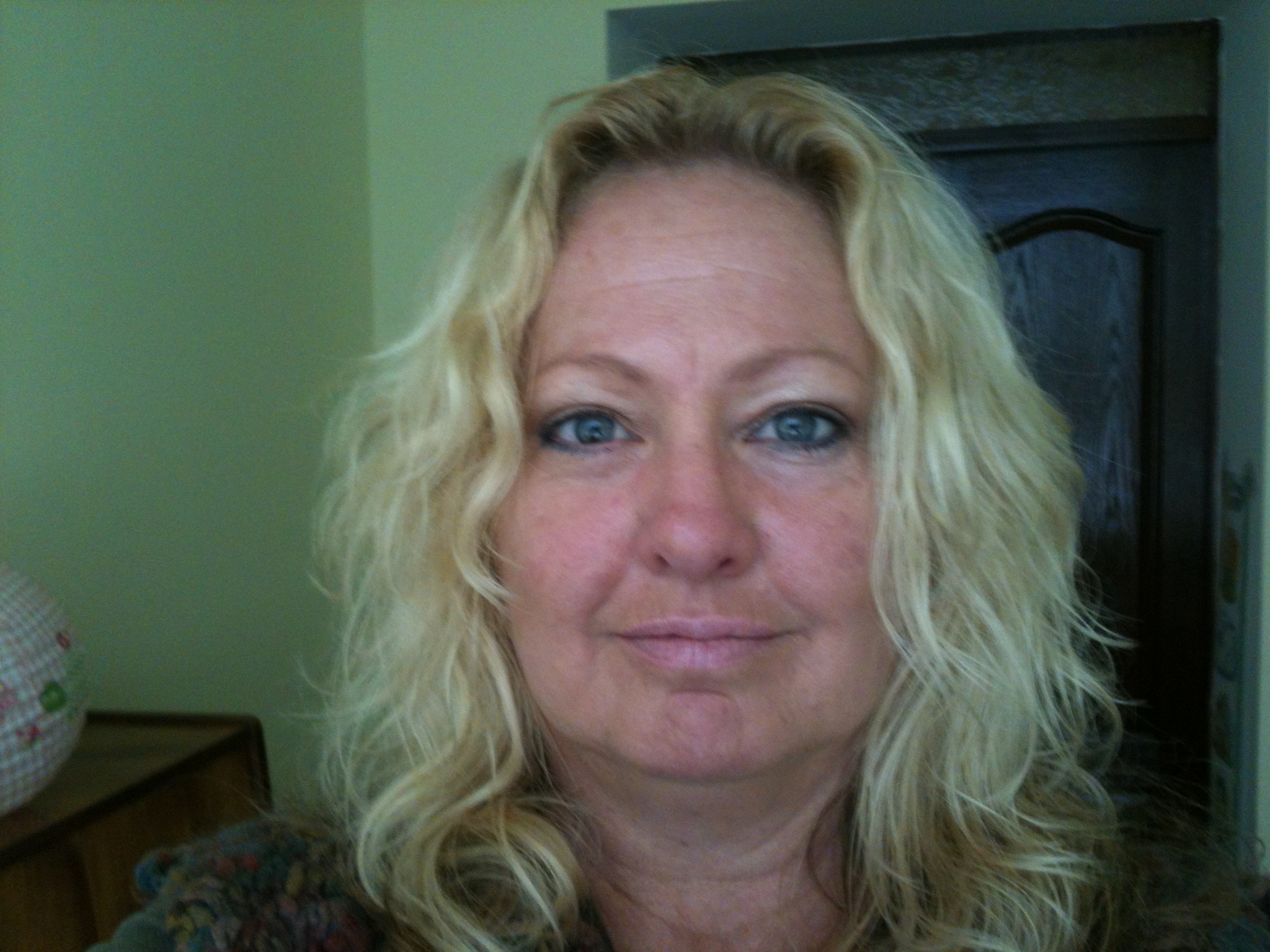
Picture of me unrelated to this post but provided for the benefit of my grandma and father. You’re welcome.

My postings are shifting from frantic, nearly daily hand wringings when I first arrived in Moldova to a more leisurely drop-in visit once a week or so, I have realized.  I attribute this both to becoming more acclimated to my surroundings – successful integration – and to having beat a retreat into a state of meditative contemplation, which is a really a westernized, acceptable way of admitting I have a remarkably empty mind these days.

For so long I had been preparing to leave overseas, having to think about applications and essays and medical visits and disbursing twenty years’ worth of accumulated possessions and packing clothing and selling the condo and tying up financial matters; and then I was here, in Pre-Service Training, meeting herds of people, hearing and speaking a new language, familiarizing myself with a new culture and geography and transportation system, eating different foods, establishing routines of boiling and filtering water and hand washing clothes, setting up a new bank account and telephone…it was so much novelty coming at me my head was like to burst at times and I had to get it all down  and out of me.

Now, I live in Moldova.  And life is becoming routine.  Funny how three months changes things.

Last Tuesday, I began going to the “office” everyday.  I started Tuesday because Monday was the 21st anniversary of Moldova declaring its independence from Russia and I only worked through Thursday, because Friday is their national language day.

Political/cultural segue – skip if you’re not into history.

Going to the office as a Peace Corps Volunteer is very different from going to the office as an executive administrator, I am finding.  People only darken my doorway to ask, “Ați dori sa mancați?” (Would you like to eat?)  I am not responsible for anything related to day to day operations and – obviously, with my language being as juvenile as it is at this point – am not an abundant source of pertinent information (or gossip, for that matter.)  Other than Ana, my partner, stopping by to struggle through our (pathetic) attempts to plot her management strategies, I am mostly left alone to translate documents, peruse online funding resources, study Romanian, or surf the web as the whim takes me.

The Peace Corps drills into us, over and over and over again, that it will take months and most likely all of our first year to become sufficiently proficient in the language to be of any real use to our partners.  This is the primary reason Peace Corps service lasts for two years and why volunteers who extend to a third year are so valued and effective. Though we accept this conceptually, in practice it is simultaneously anxiety-provoking and stultifying.  Who wants to spend a year confined within a little tower of Babel, unable to begin a satisfying – much less challenging – task because one cannot communicate with one’s compatriots?  There is a buzz of activity and purpose in the air but you cannot participate in or contribute to it because your ears and tongue are not set to the same station.

I think it is doubly hard for Americans, as our culture is built on the precept that activity equals  Purpose and Purpose defines Meaning, from which all notions of success derive.  Sitting at a desk madly trying to imprint the squawking hieroglyphics of a foreign language into one’s reluctant brain does not feed one’s longing for Purpose, let me tell you.  So the most mentally satisfying practice I’ve found at this point is to cultivate an empty mind.  Think about nothing. Or rather, quit thinking about the things that formally filled up one’s brain and open it up to new content.

With the result that I (and most other PCVs here) flee to the comfortable filler of the Internet when the afore-mentioned empty mind’s echoes begin to reverberate too loudly.

Silly but informative segue: OMG!  The wealth of free entertainment available on the internet!!! PCVs and their cohorts are scrappy treasure hunters that regularly unearth and proclaim the bounteous pleasure of sites like Project Free TV, which is currently providing me with every episode of How I Met Your Mother (the Friends of the 21st century.)  Or Grooveshark, where for the first time ever I found an uploaded copy of Buckingham Nicks (orgasm!)  And Brain Pickings, where the inimitable Maria Popova, an Atlantic Montly writer and MIT Futures of Entertainment Fellow, curates a delectable sampling of cross-pollinated tidbits from the writings of Anais Nin to the science of Michio Kaku. Or the delightful and stimulating Big Think, where some fascinating thinkers propose tantalizing ideas in a series of video monologues.

Honestly, I think the Peace Corps would be a substantially different experience without access to the Internet.  My fellow PCVs and I talk all the time about our dependency on its encyclopedic information and divertissements.   When one is ready to pull one’s hair out from hearing Romanian ad naseum, there is always English to be heard on the internet.  When one has a need to build a white board from scratch, check the internet.  Question about substitutions for ricotta (impossible to find in Moldova) in lasagna?  It’s on the internet.  Need to translate that indecipherable Russian label on a hygiene product?  Internet. Hopelessly confused by the unfathomable melancholy many Moldovans display for aristocratic and/or authoritarian forms of government? Wait for it…..Internet!

We reluctantly admit that we cannot claim to be having the “authentic Peace Corps experience” that by now has attained mythic status amongst us.  What would it be like to be serving in Thailand, for example, in a mud hut with no electricity?  Or Timbuktu, in a yurt at 40 below?  Or in Birkina Faso, helping to deliver babies with traditional midwives with no plumbing, sanitation, or medical safety nets?  There are PCVs right now living in conditions that far exceed Moldova’s (the ‘Posh Corps’) in hardship, isolation, depravation, and cultural displacement.  Moldova is too much like a younger, poorer, distant cousin of the United States to make it feel as if we’ve been kicked out of our universe.  And we have the internet.

A couple of us were speculating yesterday on why the Peace Corps is still in Moldova.  They feel so close sometimes to having attained a foothold into western-style economic capitalism – see the McMansions and BMWs and Victoria Secret fashions and cell phone towers cluttering the landscape – that we are often puzzled by what the substance of their need might truly be.  One of the answers we posited relies most heavily on the last two of the three main goals of the Peace Corps:

  1. Helping the people of interested countries in meeting their need for trained men and women.
  2. Helping promote a better understanding of Americans on the part of the peoples served.
  3. Helping promote a better understanding of other peoples on the part of Americans.

Just by being here, we help foster an important political and cultural dialogue for the Moldovans as they continue to struggle with the lingering, sugar-coated memories of the Soviet system of minimum entitlement while concurrently suffering from democratic capitalism’s imperfect success in bridging economic, social and educational barriers within their country.

And by having access to the internet, and sharing our experiences, perceptions, and thoughts, perhaps we PCVs are contributing to the emerging discussion in American about our hardwired cultural precepts, blindfolded nationalism, and rampant materialism.  And we run across fresh takes on why the juxtaposition of post-soviet mentality with 21st century EU aspirations of consumerism are so confusing, yet potentially stimulating and fruitful.

Slavoj Žižek is a Slovenian philosopher and cultural critic who is a professor at the European Graduate School, International Director of the Birkbeck Institute for the Humanities, Birkbeck College, University of London, and a senior researcher at the Institute of Sociology, University of Ljubljana, Slovenia.  He proposes an extremely interesting take on what our global mission should be at this particular point in civilized history.  After reminding us of the horrible failure that communism in practice turned out to be, he turns to the would-be capitalism reformists:

This is why, as I always repeat, with all my sympathy for Occupy Wall Street movement, its result was . . . I call it a Bartleby lesson. Bartleby, of course, Herman Melville’s Bartleby, you know, who always answered with his favorite “I would prefer not to” . . . The message of Occupy Wall Street is, I would prefer not to play the existing game. There is something fundamentally wrong with the system and the existing forms of institutionalized democracy are not strong enough to deal with problems. Beyond this, they don’t have an answer and neither do I. For me, Occupy Wall Street is just a signal. It’s like clearing the table. Time to start thinking…

My advice would be–because I don’t have simple answers… precisely to start thinking. Don’t get caught into this pseudo-activist pressure:”Do something. Let’s do it, and so on”. .. [T]he time is to think. I even provoked some of the leftist friends when I told them that if the famous Marxist formula was, “Philosophers have only interpreted the world; the time is to change it” . . . thesis 11 . . . , that maybe today we should say, “In the twentieth century, we maybe tried to change the world too quickly. The time is to interpret it again, to start thinking.” (emphasis mine)

And actually, the internet provides a very effective means for sustaining and building this strategy.   Especially for Peace Corps Volunteers.  We have cleared our metaphorical tables, so to speak.  Our minds have become empty.  Now we can begin filling them again with impressions, perceptions, and interpretations formulated through exposure to a people striving to follow our journey, but with a much more complex web of cultural, linguistic, political and economic circumstances to untangle.  (If you actually clicked the link on Moldovan history above, this would make more sense.)

Our dialogue is potentially fruitful and enlightening for both parties.  We can learn from each other’s histories.  Knock ourselves out of repeat mode. Think rather than mindlessly do.

Perhaps by me living and working with Moldovans, and them puzzling over the discordant picture I represent of Western-style success (You left your family why?  They pay you what?), and both sides spreading stories through emails and blogs and Skype sessions and Facebook and Tumblr and tweets, we are – each of us – reframing, reinterpreting, rethinking our world.

And, while we’re at it, that enduring myth of the “Peace Corps experience.”