When I was 21 years old I lived with April on the beach at Mussel Shoals, just north of Ventura, California. I can’t remember why we decided we were going to walk up Highway 1 all the way to her parents’ home in Sacramento – as I remember neither one of us had a car or very much money – but it didn’t take many miles to abandon any notion of completing the journey on foot. (I think she developed a terrible toothache and it became imperative that we reach our destination quickly.) Anyway, roundabout San Luis Obispo we stuck out our thumbs and it didn’t take long for a nice man to pull over and invite us into his van.
Now this was the early 80’s, when serial killers like William Bonin, the Zodiac Killer, Richard Ramirez, and Randy Kraft were out and about, conducting their grisly business. The public was just becoming aware of the “dangers of hitchhiking,” but it was still a common enough practice that one didn’t need a cardboard sign, a camp chair, and two liters of water to wait out a lift. Generally, if a female stuck out her thumb, she was going to get picked up. And – lucky for us – the nice man took us home, let us shower, fed us, and refrained from assaulting us with anything more than a fatherly lecture on the potential pitfalls of two girls accepting rides in vans from strangers. He then drove us to the southern terminal of BART where we bought tickets for the remainder of our journey.
And that was the last time I had hitchhiked. Until I came to live in Moldova, that is, where hitchhiking is an integral and absolutely necessary aspect of the national transportation system. I thought it was rather odd that – while PST was chock full of dire warnings about walking home alone after dark, or leaving a fellow volunteer alone in a bar, or smiling openly at men passing by – not much was said about the “dangers of hitchhiking.” It was if there was a tacit understanding that anything said about it was useless and gratuitous. Volunteers, just like everyone else in Moldova, are going to end up hitchhiking to get around; it’s a fact of life.
People in Moldova hitchhike because most of them don’t have cars, the rutieras are invariably jam packed, they stop every block to pick up and discharge passengers, and they quit running altogether between most points by 6:00 or 6:30 every evening. If you don’t have two hours to waste making the 35 kilometer trip between Chișinău and Hîncești on a bus then you join the crowd standing out on the highway in front of the Gara de Sud and flag down a passing car to negotiate a ride. Actually, you don’t even need to flag them down – cars pull up almost every minute offering empty seats to interested parties.
And what are the details of the transaction?
Well, strangely enough (for Americans at least) they aren’t worked out beforehand. If a car stops and the driver is heading to the same destination you are, then you get in. End of story. Many times, not another word is exchanged. (I know this from because Therry has picked up many a stray passenger during my various trips with him.) When you reach your destination, you offer the driver some money. The „acceptable” rate equates to what you would have paid on a rutiera. But most people offer 1.5 to 2 times that amount. Sometimes the driver accepts the entire amount, sometimes *he only accepts a portion, and sometimes he doesn’t accept any money (what????)
I have no clue what the subtext of the transaction might be. Do some drivers never accept money? Or do they accept it from people that seem like they have money and not from those who don’t? Do they take it from men, but not from women? Do they charge more for young people and less for old? Perhaps they only take it when they’re low on petrol? I will have to be better integrated to figure out this particular cultural puzzle, I guess.
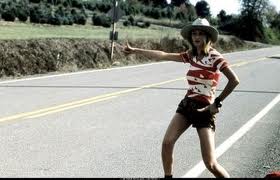
What I do know is that it is a system that works and supplements the public transportation suprisingly well. It makes not having a car a much more viable choice. And Sissy Hankshaw was a damn fine character, after all. America, you might want to rethink this option. Really, serial killers are not that prevelant in the population and gas is not getting any cheaper…
And there are times when it can be a whole lot of fun. Next post: last weekend’s rides with long distance truck drivers…..
*Note the use of the pronoun „he” – I have ridden once in a car with a female driver (the wife of the English ambassador) and have seen exactly NO female rutiera drivers. About one in 15 or 20 drivers on the street is female. I think this is probably because driving is such an aggressive and extreme risk-taking endeavor here. Most women are not in favor of causing gratuitous multi-vehicle pile ups and needless deaths just to establish their hormonal merits.
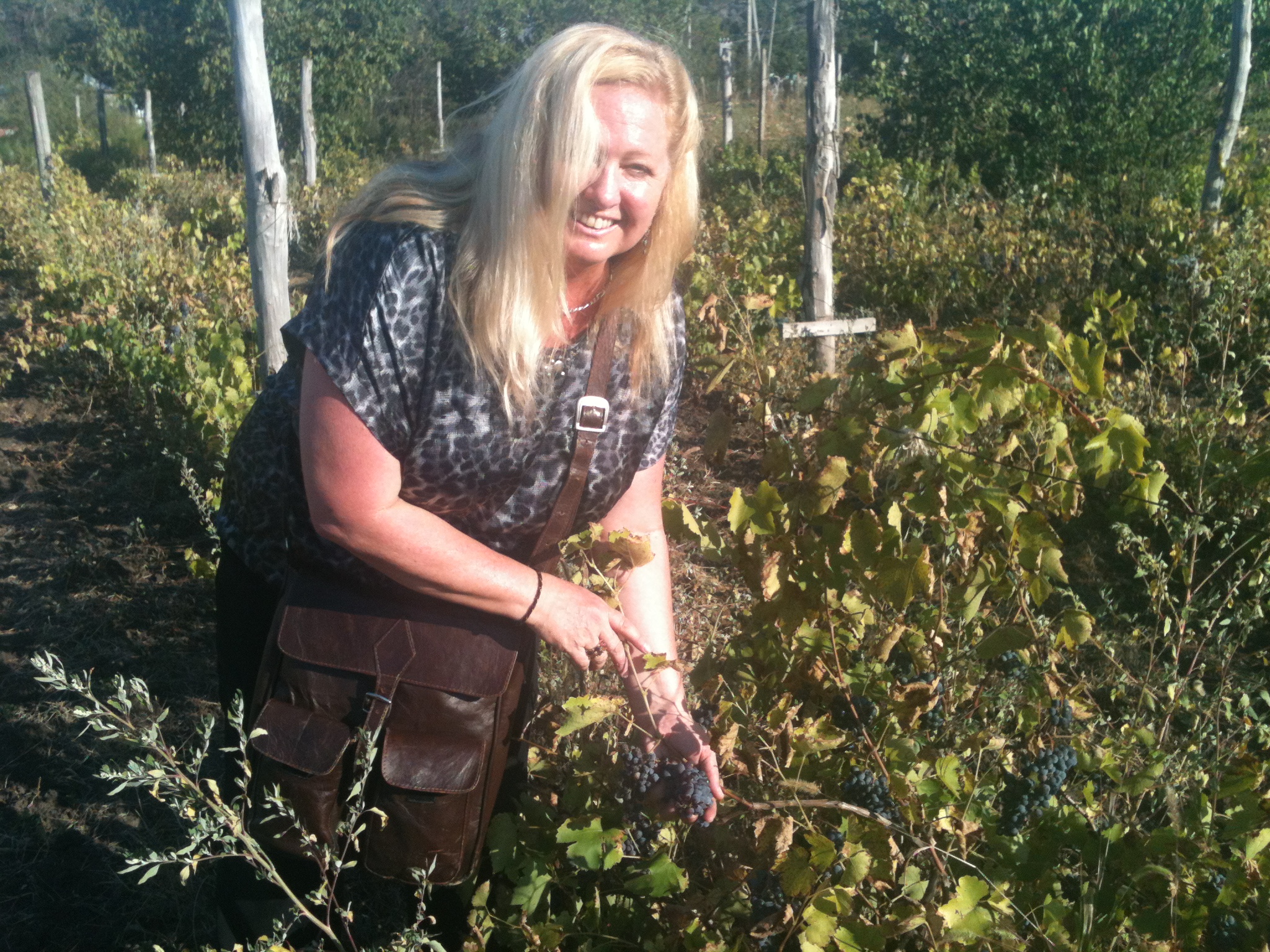
Picture of me unrelated to this post but provided for the benefit of my grandma and father. You’re welcome.
My postings are shifting from frantic, nearly daily hand wringings when I first arrived in Moldova to a more leisurely drop-in visit once a week or so, I have realized. I attribute this both to becoming more acclimated to my surroundings – successful integration – and to having beat a retreat into a state of meditative contemplation, which is a really a westernized, acceptable way of admitting I have a remarkably empty mind these days.
For so long I had been preparing to leave overseas, having to think about applications and essays and medical visits and disbursing twenty years’ worth of accumulated possessions and packing clothing and selling the condo and tying up financial matters; and then I was here, in Pre-Service Training, meeting herds of people, hearing and speaking a new language, familiarizing myself with a new culture and geography and transportation system, eating different foods, establishing routines of boiling and filtering water and hand washing clothes, setting up a new bank account and telephone…it was so much novelty coming at me my head was like to burst at times and I had to get it all down and out of me.
Now, I live in Moldova. And life is becoming routine. Funny how three months changes things.
Last Tuesday, I began going to the “office” everyday. I started Tuesday because Monday was the 21st anniversary of Moldova declaring its independence from Russia and I only worked through Thursday, because Friday is their national language day.
Going to the office as a Peace Corps Volunteer is very different from going to the office as an executive administrator, I am finding. People only darken my doorway to ask, “Ați dori sa mancați?” (Would you like to eat?) I am not responsible for anything related to day to day operations and – obviously, with my language being as juvenile as it is at this point – am not an abundant source of pertinent information (or gossip, for that matter.) Other than Ana, my partner, stopping by to struggle through our (pathetic) attempts to plot her management strategies, I am mostly left alone to translate documents, peruse online funding resources, study Romanian, or surf the web as the whim takes me.
The Peace Corps drills into us, over and over and over again, that it will take months and most likely all of our first year to become sufficiently proficient in the language to be of any real use to our partners. This is the primary reason Peace Corps service lasts for two years and why volunteers who extend to a third year are so valued and effective. Though we accept this conceptually, in practice it is simultaneously anxiety-provoking and stultifying. Who wants to spend a year confined within a little tower of Babel, unable to begin a satisfying – much less challenging – task because one cannot communicate with one’s compatriots? There is a buzz of activity and purpose in the air but you cannot participate in or contribute to it because your ears and tongue are not set to the same station.
I think it is doubly hard for Americans, as our culture is built on the precept that activity equals Purpose and Purpose defines Meaning, from which all notions of success derive. Sitting at a desk madly trying to imprint the squawking hieroglyphics of a foreign language into one’s reluctant brain does not feed one’s longing for Purpose, let me tell you. So the most mentally satisfying practice I’ve found at this point is to cultivate an empty mind. Think about nothing. Or rather, quit thinking about the things that formally filled up one’s brain and open it up to new content.
With the result that I (and most other PCVs here) flee to the comfortable filler of the Internet when the afore-mentioned empty mind’s echoes begin to reverberate too loudly.
Silly but informative segue: OMG! The wealth of free entertainment available on the internet!!! PCVs and their cohorts are scrappy treasure hunters that regularly unearth and proclaim the bounteous pleasure of sites like Project Free TV, which is currently providing me with every episode of How I Met Your Mother (the Friends of the 21st century.) Or Grooveshark, where for the first time ever I found an uploaded copy of Buckingham Nicks (orgasm!) And Brain Pickings, where the inimitable Maria Popova, an Atlantic Montly writer and MIT Futures of Entertainment Fellow, curates a delectable sampling of cross-pollinated tidbits from the writings of Anais Nin to the science of Michio Kaku. Or the delightful and stimulating Big Think, where some fascinating thinkers propose tantalizing ideas in a series of video monologues.
Honestly, I think the Peace Corps would be a substantially different experience without access to the Internet. My fellow PCVs and I talk all the time about our dependency on its encyclopedic information and divertissements. When one is ready to pull one’s hair out from hearing Romanian ad naseum, there is always English to be heard on the internet. When one has a need to build a white board from scratch, check the internet. Question about substitutions for ricotta (impossible to find in Moldova) in lasagna? It’s on the internet. Need to translate that indecipherable Russian label on a hygiene product? Internet. Hopelessly confused by the unfathomable melancholy many Moldovans display for aristocratic and/or authoritarian forms of government? Wait for it…..Internet!
We reluctantly admit that we cannot claim to be having the “authentic Peace Corps experience” that by now has attained mythic status amongst us. What would it be like to be serving in Thailand, for example, in a mud hut with no electricity? Or Timbuktu, in a yurt at 40 below? Or in Birkina Faso, helping to deliver babies with traditional midwives with no plumbing, sanitation, or medical safety nets? There are PCVs right now living in conditions that far exceed Moldova’s (the ‘Posh Corps’) in hardship, isolation, depravation, and cultural displacement. Moldova is too much like a younger, poorer, distant cousin of the United States to make it feel as if we’ve been kicked out of our universe. And we have the internet.
A couple of us were speculating yesterday on why the Peace Corps is still in Moldova. They feel so close sometimes to having attained a foothold into western-style economic capitalism – see the McMansions and BMWs and Victoria Secret fashions and cell phone towers cluttering the landscape – that we are often puzzled by what the substance of their need might truly be. One of the answers we posited relies most heavily on the last two of the three main goals of the Peace Corps:
Helping the people of interested countries in meeting their need for trained men and women.
Helping promote a better understanding of Americans on the part of the peoples served.
Helping promote a better understanding of other peoples on the part of Americans.
Just by being here, we help foster an important political and cultural dialogue for the Moldovans as they continue to struggle with the lingering, sugar-coated memories of the Soviet system of minimum entitlement while concurrently suffering from democratic capitalism’s imperfect success in bridging economic, social and educational barriers within their country.
And by having access to the internet, and sharing our experiences, perceptions, and thoughts, perhaps we PCVs are contributing to the emerging discussion in American about our hardwired cultural precepts, blindfolded nationalism, and rampant materialism. And we run across fresh takes on why the juxtaposition of post-soviet mentality with 21st century EU aspirations of consumerism are so confusing, yet potentially stimulating and fruitful.
Slavoj Žižek is a Slovenian philosopher and cultural critic who is a professor at the European Graduate School, International Director of the Birkbeck Institute for the Humanities, Birkbeck College, University of London, and a senior researcher at the Institute of Sociology, University of Ljubljana, Slovenia. He proposes an extremely interesting take on what our global mission should be at this particular point in civilized history. After reminding us of the horrible failure that communism in practice turned out to be, he turns to the would-be capitalism reformists:
This is why, as I always repeat, with all my sympathy for Occupy Wall Street movement, its result was . . . I call it a Bartleby lesson. Bartleby, of course, Herman Melville’s Bartleby, you know, who always answered with his favorite “I would prefer not to” . . . The message of Occupy Wall Street is, I would prefer not to play the existing game. There is something fundamentally wrong with the system and the existing forms of institutionalized democracy are not strong enough to deal with problems. Beyond this, they don’t have an answer and neither do I. For me, Occupy Wall Street is just a signal. It’s like clearing the table. Time to start thinking…
My advice would be–because I don’t have simple answers… precisely to start thinking. Don’t get caught into this pseudo-activist pressure:”Do something. Let’s do it, and so on”. .. [T]he time is to think. I even provoked some of the leftist friends when I told them that if the famous Marxist formula was, “Philosophers have only interpreted the world; the time is to change it” . . . thesis 11 . . . , that maybe today we should say, “In the twentieth century, we maybe tried to change the world too quickly. The time is to interpret it again, to start thinking.” (emphasis mine)
And actually, the internet provides a very effective means for sustaining and building this strategy. Especially for Peace Corps Volunteers. We have cleared our metaphorical tables, so to speak. Our minds have become empty. Now we can begin filling them again with impressions, perceptions, and interpretations formulated through exposure to a people striving to follow our journey, but with a much more complex web of cultural, linguistic, political and economic circumstances to untangle. (If you actually clicked the link on Moldovan history above, this would make more sense.)
Our dialogue is potentially fruitful and enlightening for both parties. We can learn from each other’s histories. Knock ourselves out of repeat mode. Think rather than mindlessly do.
Perhaps by me living and working with Moldovans, and them puzzling over the discordant picture I represent of Western-style success (You left your family why? They pay you what?), and both sides spreading stories through emails and blogs and Skype sessions and Facebook and Tumblr and tweets, we are – each of us – reframing, reinterpreting, rethinking our world.
And, while we’re at it, that enduring myth of the “Peace Corps experience.”
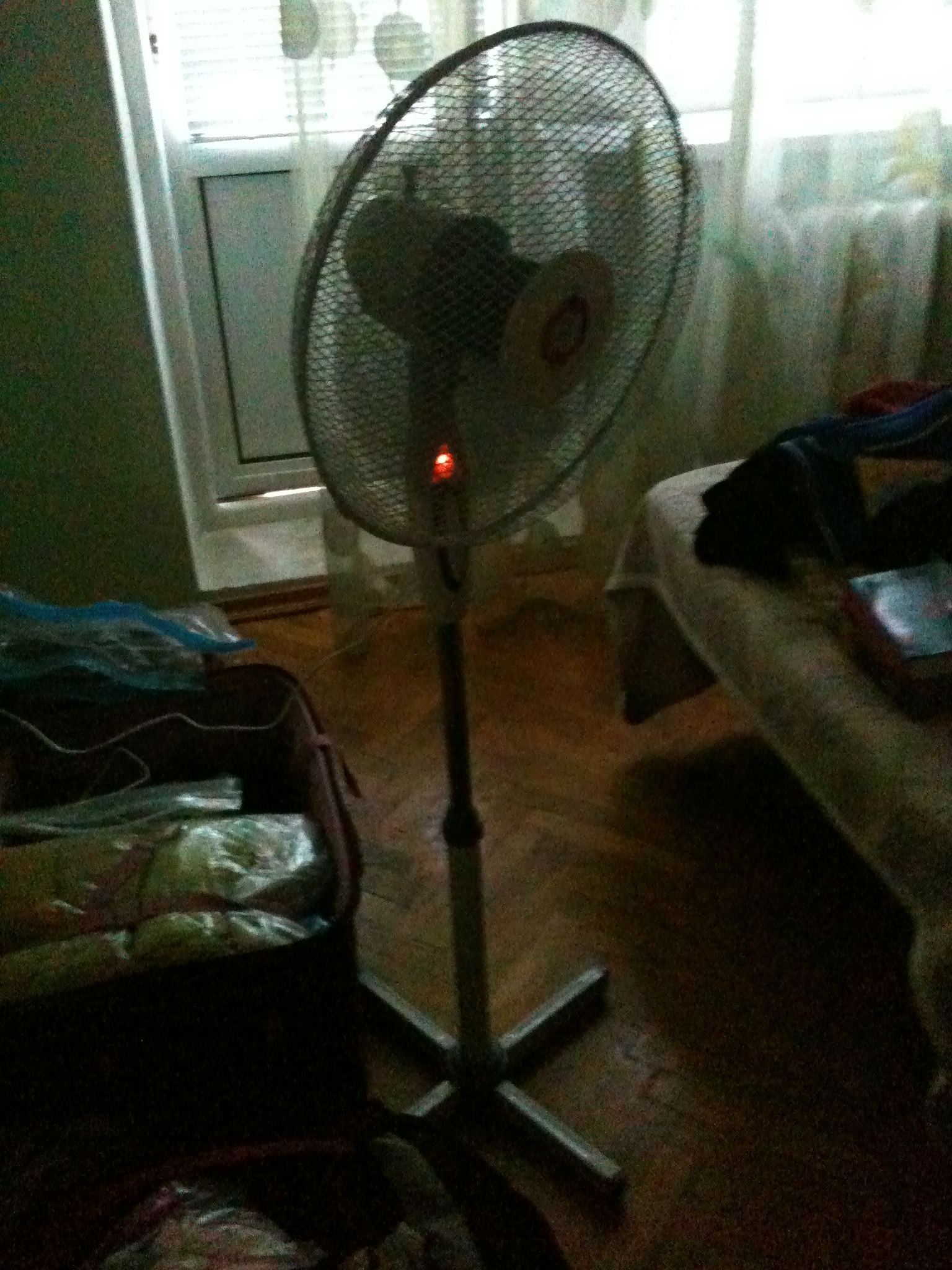
Well, today I did it. I bought a fan. For the merest outlay of 160 lei (just under $13) I now sit blissful before it while it blows upon me with all of its third button, top speed, non-rotating, full blast force. I am not sweating. There is no sticky film upon my skin. Hair, no longer weighed down by leaden droplets of perspiration, wafts pleasantly about my head. I need not hold at bay the physical exhaustion that comes of plying one’s limbs through a thick batter of humid, heavy air. My tee-shirt is dry, not glued to my back, stomach, and chest with an amalgam of water, salt, and the body lotion I habitually (stupidly) apply after showering. And unlike the only other fan I have met in Moldova – in the school room where five of us studied Romanian all day – I don’t have to share it. It is my personal fan, all mine, blowing solely upon me.
One would imagine – erroneously, of course, but then I would venture to say that one’s imagination has not had the opportunity to visit Moldova – that Moldovans would be eager consumers of those cheap-ass wire mesh rotating fans that grace every college dorm room, strip mall retail establishment, Chinese food take-out, double-wide trailer living room, and even some outdoor campsites (in Texas) across America. After all, their inexpensive and great at performing the function they’re specifically designed for – COOLING PEOPLE OFF IN HOT WEATHER, PEOPLE!!!
One might imagine that there would be lines of stalls in the piața selling fans – small fans for your table, hand held, battery-powered fans for the microbus, monster fans for the kitchen, ceiling fans for the bedroom, perhaps even weather-proof fans for the garden. Canny vendors would set up shop at the rutiera stop, capitalizing on the freshly boiled meat continuously exiting those stewpot infernos. Fans would beckon forth from the ubiquitous corner alimentare: Come within, get cool (and buy some bere while you’re here!)
But no. No fans. There are a few for sale – maybe four or five vendors in the entire piața offer them, the piața being a swap meet, trading post derivative which surely boasts several hundred thousand types of product, at the very least. The vendors that do sell them have only one or two on hand. They don’t sell very many to Moldovans, you see.
Perhaps they only think to stock them when the newest batch of Peace Corps Volunteers wanders through mid-summer, wilting and pitiful, mopping their faces with baby wipes and bleating out “Ventilator, vreau sa cumpar ventilator, va rog!” The sweet gentleman who sold mine to me was careful to demonstrate all of her features, depressing each of her three buttons, pulling up the lever that set her head a wagging, turning the one that tilted her head up and down. He wasn’t quite sure I had ever encountered one of these odd contraptions which manufactured its own breeze. It wasn’t a popular item in his inventory, I guess. And why not, you might logically cry? Why don’t they sell a million ventilators when Moldovan summers simulate the conditions inside a wool sweater worn over a wet suit wrapped in a down parka baked in a pizza oven somewhere in Death Valley in the middle of August?
Because of The Current, they will answer.
The Current. That mysterious force that inhabits any flow of air, most particularly as it passes over and around the human form. The Current. Responsible for aching backs, stiff joints, raspy lungs, sore throats, throbbing heads, and achy eardrums. The Current. A viral laden beast that permeates one’s orifices with its sly wisps, seeding the body with illness, debilitating one’s muscles and sapping one’s strength. (Perhaps it was The Current that made ill my knee.)
Once, in July, my LTI walked into class with saggy bags weighing down her eyes, her arms drooping listlessly, her feet dragging invisible anchors behind her. “What’s wrong?” I queried. “You look so tired.” She told me that she and her husband had been up all night with their 18-month old baby, who was so sweaty and miserable and tormented by heat that she spent the entire night thrashing and sobbing. They had opened all the windows and doors, removed their clothing, and laid down on the floor with her seeking some relief. “Don’t you have a fan?” I asked, dumbly. Well, yes, she said, somewhat puzzled, but you could never expose a baby that young to The Current, you know. She then dragged herself from the room, oblivous to my stupification.
Well, all I can say at this moment is The Current is a seductive little Circe, her silky arms slipping mistily about me, whispering dreams of air-conditioned lobbies leading to refrigerated rooms stocked with cool tubs of ice where winter maidens brush frost crystals from their hair. We have all the curtains pulled, she and I. The room is a cool cave, hovering just outside a glacier. Her whirring blades mesmerize me, spinning my head and swirling the memory of weeks of blazing heat until they evaporate into nothingness. The Current carries me into thinness and lilting steps and clarified air and breezy sighs.
The Current is my friend and my little Circe is her medium. To hell with my knee.
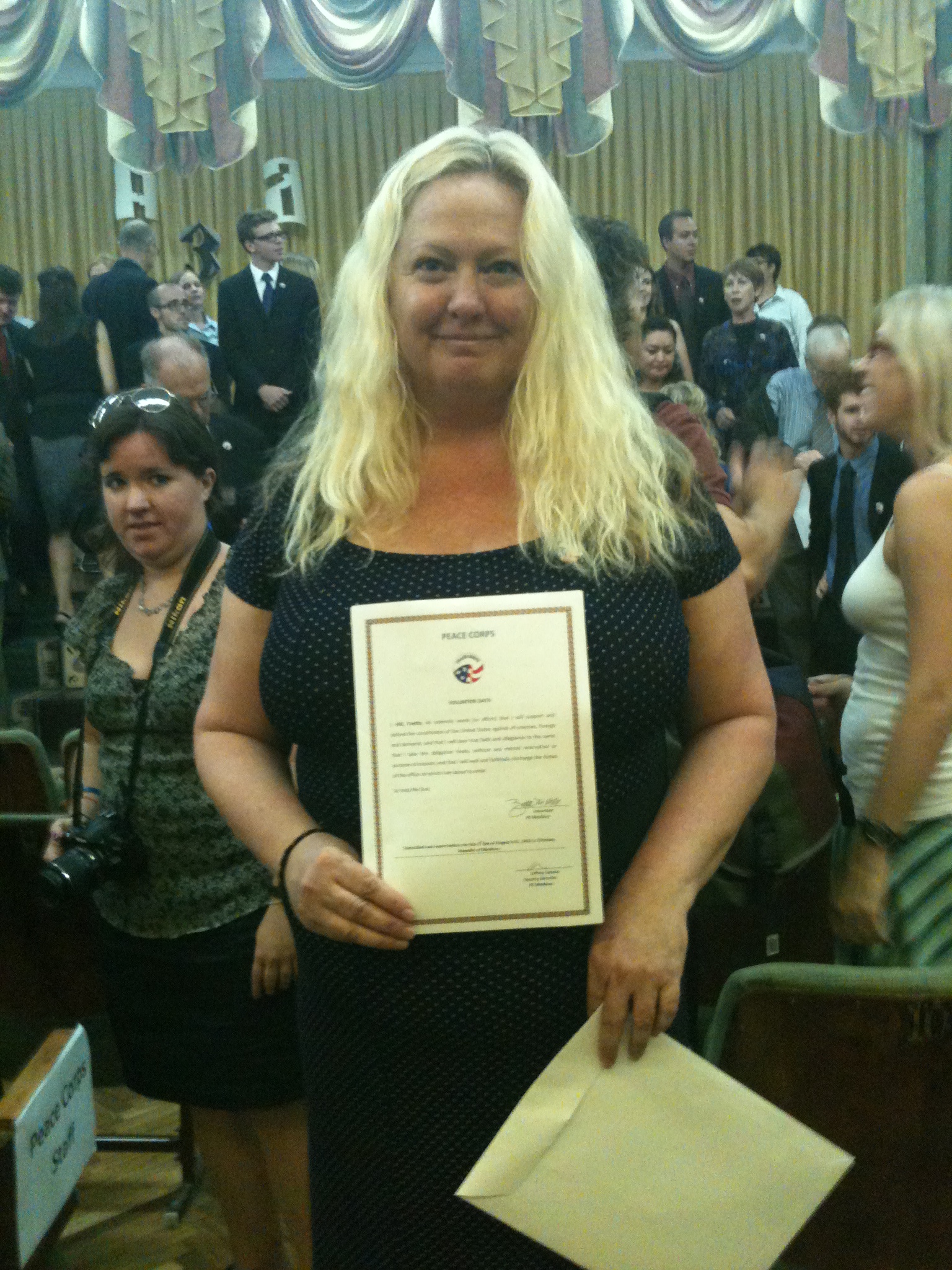
Holding my Oath of Office – I am a Peace Corps Volunteer!Today, in a suitably serious and solemn ceremony, I and 37 members of my colleagues in the M27 Moldova group were sworn in as Peace Corps Volunteers. (The rest of our group, Health and English Education Trainees, have 7 more days of “practice teaching” sessions remaining in their training.)
I confess that, as we repeated the same oath that – in various permutations – thousands of other Americans serving in the military, diplomatic service, political office and other agencies of government have taken, I did tear up. Being an American is a insoluble paradox for me. I left the country partly because I am so tired of its politics, its materialism, its narcissistic patriotism, its inability to transcend its own mythos. Yet it is America that brought me here, that sustains my work and the Peace Corps mission throughout the world, that continues to believe in “promoting peace and friendship” abroad through the voluntary service of over 200,000 of its citizens to date. As the Ambassador to Moldova William H. Moser said in addressing our group, we are the most effective ambassadors of the American people in 137 countries around the world.
In searching for a YouTube video of my new site, Hîncești, I came across the following video. Made, of course, by a Peace Corps volunteer. Because I challenge you to search YouTube for a video made of ANY country in the last five years and not come up with one made by a PCV. This is what we do. We bring laughter, creativity, camraderie, esprit de corps, hope, friendship, diplomacy, and good will wherever we have been. And we share it with the world.
[Disclaimer: I apologize in advance for the inexcusable length of this posting. I pretty much vomited up a week’s worth of internal angst here. Feel free to subdivide into chapters if necessary.]
Insert funny picture to entice potential reader…
You’ve probably noticed that the fountain of blogging clogged up somewhere last week. We were warned by the M26s (the group of PCVs who have been here for a year now) that these last couple of weeks of PST could prove to be difficult and tedious and we shouldn’t be surprised if we felt “depressed” or “homesick” or “disappointed” right before our actual Peace Corps journey is set to commence; I heretofore acknowledge their wisdom and experience in identifying the precise time period when exactly this would occur for me. I am not adept at recognizing some of the less desirable emotions I experience; I tend to paint every self-portrait in happy colors, populate the background with balloons and sunshine, and frame it all in gold stars and smiley faces. That I can’t manage this all the time now is one of the (unplanned) lessons I have been given to learn.
I have been considering why this is so (the lack of sunshine and balloons) for a couple of days now: is it just me or is there something in my environment that I am reacting to? Is it this big change, in general, that has thrown me off balance or is Moldova a unique impetus for eliciting a certain, complex set of emotions within me? Or is it merely just the end of PST, when I will depart from my established routine in Stauceni and all my American cohorts? So, given my propensity for over-thinking every last detail of my life and experience, my analysis traced the following path:
Is this the scariest/most challenging/potentially life altering experience that I have ever had?
The short answer to this, I believe, is no. It is a ‘short’ answer because the other experiences that I might consider to be relatively scarier, more challenging, or life-altering lasted for 15 hours and about 5 minutes, respectively. The first was the time that my friend and I were lost in the Angeles National Forest overnight and were ultimately rescued by a Marine Search and Rescue helicopter. The second was a personal epiphany that I had while speeding along the edge of an escarpment in a rickety bus through the Andes. (Though it was a life altering experience for me, I have never effectively conveyed its mind-blowing impact to anyone else who’s suffered through the details, which I will omit here.)
At this juncture I am forced to acknowledge that – duh – the scariest, most challenging, potentially (and actually) life altering experience I have had was becoming (accidentally) pregnant at 23 and choosing to go through with it, keep my beautiful child, and raise her – if I had to – alone. Thankfully, the abundance of life provided us with everything we could ever have wanted or needed. But my life DEFINITELY followed a different path than I would have tread had I not encountered this fork in the road. And I was terrified, often and thoroughly, during her first two or three years of life.
Is there something about Moldova that is eliciting these feelings in me?
The answer here is a (qualified) yes, though truly this question requires a book-length explication to actually do it justice. In fact, I did just read a book – The Lost Province: Adventures in a Moldovan Family by Stephen Henighan – that did much to clarify for me the tumultuous impressions I am juggling vis-à-vis Moldava, its denizens and the realities of twenty-first century trans-national capitalism. Though I realized it has been a mere 21 years since Moldava gained its independence from Russia, I didn’t have an appreciation for the dregs of history that boil and ferment just beneath the surface of a culturally suppressed and economically-raped population. Henighan came to Moldova to teach English in 1993-94; his experience of Moldovans was largely delineated by their seeming inability to cope with the catastrophic changes being forced upon them by the advent of a “democracy” and “freedom” heavily subsidized by rampant consumer materialism. The particular anxieties delineated by their ever-shifting borders, the complexity of their linguistic history and the historic artifacts it denies them, the tension that keeps them culturally, economically, and politically suspended between Western Europe and Russia are all integral to their national identity (or lack thereof) and make for an interesting read. (If you are lacking a good book for the beach this summer, I highly recommend Jonathan Sacks The Dignity of Diversity. He is much, much better than I at drawing out the intricacies of cultural identity and how it defines and shapes the human experience.)
Let me just excoriate here for a bit my favorite demon, transnational corporations: From 1991 on the Moldovans have been relentlessly saturated by the corrosive infiltration of first world media and products while trapped in a netherworld between the tantalizing but vagarious rewards of capitalism and the stultifying, pseudo-security promised by the communist state. They can no longer rely on their agricultural products and the rural lifestyle it (more or less) supported for centuries to sustain them. Embargos and tariffs are placed on their exports by various countries seeking their allegiance and/or to co-opt their borders. Virtually their entire industrial sector has been cordoned off in the separatist, unrecognized “state” of Transnistra. Their governmental ministries and officials struggle to integrate diametrically opposed political parties and philosophies. Meanwhile, the likes of Mercedes Benz and Apple and McDonalds tantalize them with seductive advertisements carefully calculated to whet their burgeoning appetites, You Tube proffers hypnotic music videos replete with heavy-lidded, long-legged beauty queens draped in gangsta bling, cinder block McMansions are sprouting in the suburbs Chișinău, and speaking a foreign language is de rigueur for any ambitious youth seeking gainful employment in an increasingly globalized economy. They are not far enough removed, resource-depleted, nor education-deprived to be ignored by the ravenous maw of consumer-dependent corporations. Yet they lack the political stability, economic base, and cultural cohesiveness to collectively harness the engine of capitalism and make it enrich, rather than drain, their bank accounts.
Most of the adults between the ages of twenty five and fifty are what is popularly referred to as “departe” – far away. They work, usually far beyond their allotted visa period, in places like Italy, Germany, Moscow, and Canada, to be able to save and send money home for their families. They are forced to leave parents, children, spouses, and siblings for decades in order to earn the money needed to afford the necessities that life in the twenty-first century increasingly demands. Families are torn asunder, children are orphaned, seniors work well past retirement age, half-built houses crouch in weedy lots, and an entire generation of Moldovans is denied the opportunity to influence or preserve their political system, cultural institutions, or dwindling national identity.
I think when I pictured the “Peace Corps,” I imagined a challenge that would involve enforced abstinence from common conveniences enriched by adventurous encounters within tribal enclaves: no running water or electricity, scarce or no access to conventional medicine or hygiene products or retail establishments, no Internet access, telephones, television, etc., all offset by a teeming social beehive of sustenance activity that would serve to distract me from the privation. That is far from the case here in Moldova. All of those conveniences that were supposed to be inaccessible are here, relatively affordable (at least for me) and attainable. Many Moldovans have them. Yet they are, for the most part, so busy, distracted, anxiety-ridden, and stressed by attaining/retaining the ability to grasp and keep hold of these things that the social fabric that binds them is noticeably affected. Kind of like America.
And so perhaps, I am disappointed at being ‘denied’ the opportunity to live out the atavistic fantasy I had built around my service within my head. Instead, I am being asked to integrate into a community of people just embarking on a seemingly inevitable march into the consumer lifestyle the ultimate consequences of which I (and many others like me) am attempting to flee. The causes, implications, ramifications, and veracity of this line of analysis are far too complex for me to explore here. But I am consumed with these details all the time; I just can’t work my way out of the maze within which my nationality, economic status, education, opportunities, personal predilections and consumption patterns conspire to entrap me.
Anyway, enough of that.
Another funny picture to re-engage the bored reader
3. Is it the end of Pre-service Training, my imminent departure from the relative familiarity and comfort of my fellow American volunteers and the English language, esprit de corps, and common cultural referents they represent, that is unsettling me? (In other words, am I finally being forced to leave home?)
Undoubtedly, this is a loaded question, one that is not at all comfortable to contemplate. After all, isn’t this one of the reasons I so doggedly spouted for joining the Peace Corps in the first place? What does it mean if I don’t really want to leave America, after all?
It means that I am a product of my culture influences, like it or not. And I now have a eminently valuable opportunity to truly see and appreciate the aspects of Americanism that are deeply embedded within me, that shape my perspective and way of being in the world, and that I don’t want to lose:
Americans are preternaturally optimistic. We believe, generally speaking, that we can do anything. We are not subdued by the hand of fate, nor do we cede the trajectory of our biography to some unfathomable plotline drafted by forces outside our ken or influence.
We tend to believe that most people like us. While this characteristic has had some unfortunate implications on a global scale, within neighborhoods, families, work environments, and public places it generates a great deal of shared laughter, social cohesion, and a predilection for including the people around us in our circle of perception.
We lean towards the adventurous and are more likely to embrace challenge and opt for change. We like to explore, question, debate, pinch, poke, and prod. We can be (for the most part) persuaded to abandon traditions and historic influences in favor of scientifically-backed theories that have generated a wealth of technology and increased affluence for our country.
Granted the aforementioned constitute a gross generalization of what it is to be American. And I don’t have the space nor my readers, most likely, the inclination to embark on a dialectic about what is accurate and bona fide about this generalization. All I can say at this point is that I feel I am letting go of these qualities when I say goodbye to PST. Of course, I can continue to nurture them within myself. Many ex-pats are quite successful at maintaining their national/cultural integrity for years in foreign climes. But I am going to feel the dearth of these characteristics in my day to day environment.
How and why Moldovans differ from Americans is part of what I am here to experience. And, ultimately, to be able to understand, share, and celebrate. The multi-faceted aspects of actualized cultural diversity are more complicated, potentially fractious and alienating than I was able to truly understand within my generative environment. But it is an experience that we are being forced to grapple with, like it or not, comfortable or no, in our suddenly interconnected, transnational, globally networked world. I feel like a baseball player on a soccer team; I keep using the wrong limbs and skills and all my moves are predicated by a different set of rules. And I definitely don’t get the jargon. I am a fish out water, flailing about, pining for contextual familiarities. I miss being comfortably at home in my own head. Above all else, I did not appreciate how much language defines the contours, dimensions, and palette of my reality. It is like living in a science fiction story: this world shares much of the same surface characteristics as mine, but it is ineffably, maddeningly different.
Will I ever feel at home here? And is that the challenge that will define my Peace Corps experience? Or just one of the many ahead of me that I can’t even hope to identify this early on?
In my perusal of myriad Peace Corps volunteer blogs, I read many posts describing puzzling cultural differences people encounter that are not serious enough to be explained in tech classes but still reinforce the gaps in experience and practice that exist between Americans and everyone else. I find them interesting – and many times entertaining – so I thought I would start a list of my own.
Just to put this in context, here are some examples of generic cultural differences that are explained to us in tech classes:
American View
Moldovan View
Time is valued. It should be used productively. Schedules are kept and followed. It is rude to be late for an appointment. Deadlines are expected to be met.
Time is flexible. Schedules may be made but not followed. Meetings are often planned or canceled at the last minute. People often arrive late for appointments. Deadlines are a suggestion.
Change is seen as a positive challenge. Initiative and free enterprise are encouraged. Mobility is commonplace. People travel miles to work, change jobs often. Living or moving a lengthy distance from one’s family is not unusual.
Change is often seen as risky and stressful. New things are regarded with suspicion and uncertainty. Traditions are positive and celebrated. Moving far from one’s family is only done when required to obtain work.
The “American Dream” is defined by the ability to affect one’s destiny.
Events in one’s life are often linked to fate and superstition.
Social and business environments tend to be informal and relaxed. People usually address each other by first name.
Directness and informality are highly dependent on context and familiarity. In business and educational environments, people are usually addressed by title.
Independence is highly regarded. Most young adults and families establish their own households as soon as they can afford to do so.
Family is centralized when possible. Many young families live with parents and the youngest child usually stays with them all of his or her life.
People’s sense of identity comes from their accomplishments.
People’s sense of identity comes primarily from the group/s to which they belong. (Ethnic, religious, class, education, economic, etc.)
Privacy is a positive condition and personal space is valued.
Isolation indicates depression. People prefer to spend time in one another’s company.
So the above is probably relatively self-evident to anyone with a passing knowledge of Soviet-era mentality and ethnic groups that have tended to live in agrarian communities. But then there are things that one runs across that are not so easily understood or maybe they relate to the above attitudes and views but one must dig through the surface oddity to grasp the connection.
So here’s one:
Everyone uses these brooms in Moldova. Both women and men use them in the city, in the villages, in their homes and offices and schools to sweep the floors, inside and out. I watched a woman at the center I will be working at spend an hour – literally – hunched over like a peripatetic question mark sweeping the grounds where the children would play. My question? Why oh why wouldn’t one lengthen the stalk so it would be possible to sweep in an erect position? Why bend over in a way that must become uncomfortable after 10 or 15 minutes when you sweep the floor every day? I wanted to grab the damn thing and tie it to a branch or pole and show her how much easier the task could be. Someone could make a fortune marketing American brooms here.
Or not. Perhaps this fits in with their keeping with “tradition” and “change is suspicious” view. This is the broom that their grandmothers (bunica) and grandfathers (bunici,) and theirs before them, used. But I just can’t help but think that if I had an Aerican broom, I could SHOW them how pleasurable (relatively speaking) an activity sweeping could be. And the job would get done much faster. Leaving them more time to spend in each other’s company and perhaps the ability to get to the meeting on time…





 From Now On I Live Mad