Those of you who have seen me in the last year know that I have become a HUGE fan of Vibram Five Fingers footwear. In fact, “Those Toe Shoes” are all I wore during the last year in the USA. And I have confirmed what I swore by at the time – they are the cure for back and knee problems caused by modern shoes. I stopped wearing my Vibram’s during my initial weeks in Moldova, not wanting to stand out or cause undue concern in my village that some alien visitor had ported in to conduct genomic splicing experiments on their feet. Boy, have I paid the price.
My left knee began aching dully a week or so ago, progressing – after a two mile hike in heeled sandals through downtown Chisinau a couple of days ago – into full blown pain. I’ve been downing aspirin like candy and contemplating suicide before I recalled my lifesaving Vibrams (three pair) tucked into the side pocket of a suitcase. I have sworn off shoes for as long as I can get away with it and lined up my lovely toe shoes for immediate implementation. Between them and Nina’s garden pharmacopeia, I should be just fine.
What? Nina has a pharmacy??? (I can see a few ears pricking up and sense a few of you quivering…) Actually, amongst her many and varied interests, she seems to know quite a bit about “natural” remedies. I’ve already blogged about the raspberry masks; additionally there have been teas, and soups, and herbal rinses. Last night, I got the leaf wrap.
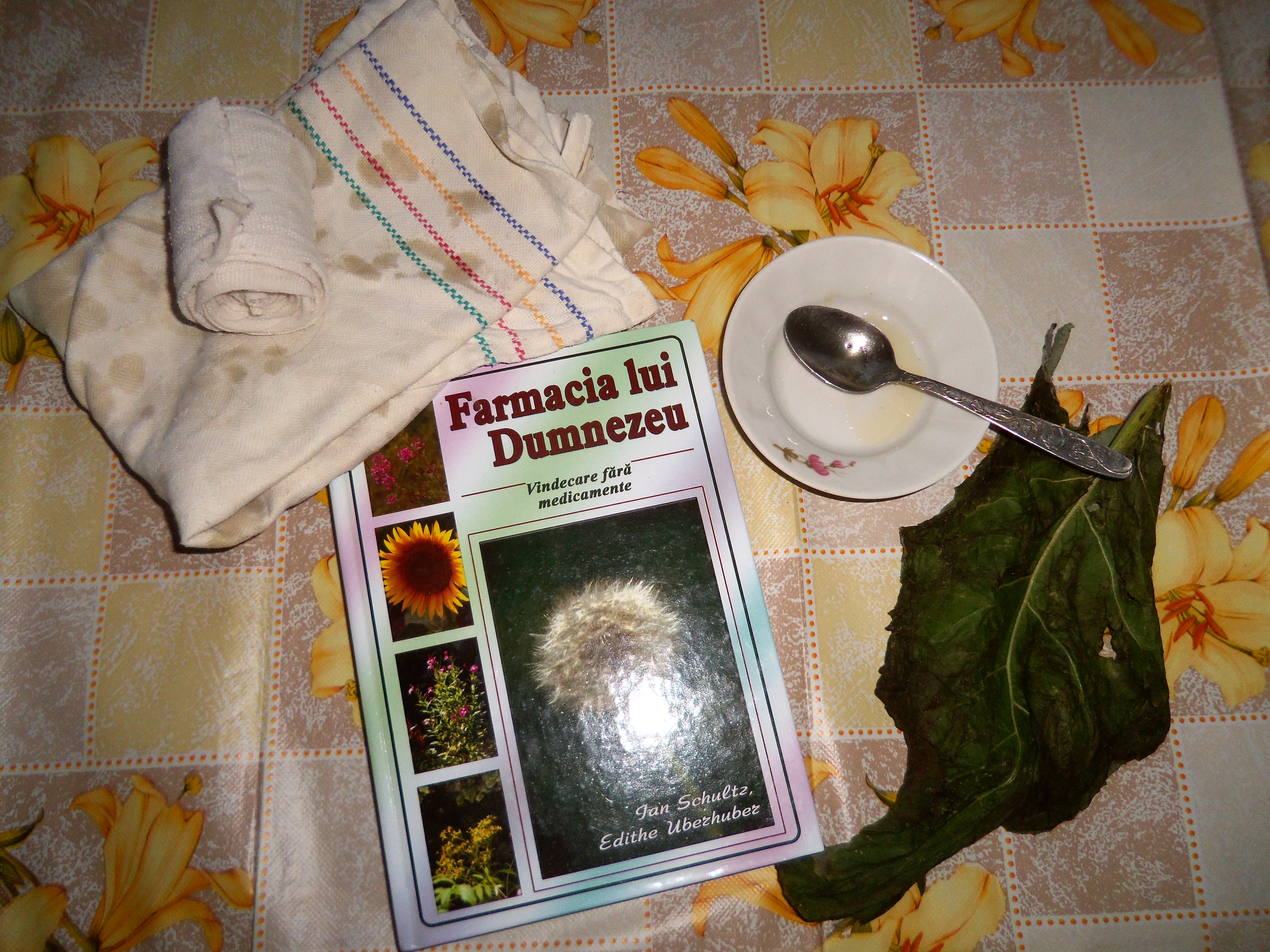
After smearing my knee with honey, she covered it with a very large green leaf from a tree in her garden. Though I asked her twice what it was, I can’t remember the name. Then, the leafy knee was wrapped by an ace bandage, which was then all firmly bound up by a large dish cloth. Then I was sent to bed. Or at least to lie down (I promptly fell asleep.) When I got up the next morning, the swelling had gone down noticably and the pain had decreased. We will wrap up again tonight and hope that Moldovan medicine keeps working along with the Vibram’s.
And now a big shout out to my angel in America – Robinmarie! Received a package from her today in training – the COD manager brought it to our cluster site from the PC office. I felt just like a soldier in Afghanistan: everyone gathered around me, longing for a taste of America, something to remind them of home. I’m the first one to receive a package here so I had lots of hands helping me open the box and had to shoo everyone away from the goodies inside. (Although the box of Girl Scout cookies didn’t survive the crowd…)
I have a new friend – Sophie – who will be joining me on my adventure. I’ve taught her a few words in Romanian already but she’s surprisingly shy about trying them out in company. Ah well, I know how she feels…
So – I know it’s HUGELY expensive to send things here, but it really does make a difference. It’s like being at summer camp for the first time and getting a letter from your mom. You want to hold it and turn it over in your hands and smell the contents because you know that it was once held by someone dear to you and you ache to see their face or hear their voice or hold their hand. I do fine most days, but I can sink myself into a bit of the blues if I dwell on home too much. I think about all of you, probably too much.
Thanks Robinmarie for being the angel you are! And you, too, Bart. I received two of your postcards today along with the package. Your poetry continues to bring beauty and inspiration.
I love people. Everybody. I love them, I think, as a stamp collector loves his collection. Every story, every incident, every bit of conversation is raw material for me. My love’s not impersonal yet not wholly subjective either. I would like to be everyone, a cripple, a dying man, a whore, and then come back to write about my thoughts, my emotions, as that person.* But I am not omniscient. I have to live my life, and it is the only one I’ll ever have. And you cannot regard your own life with objective curiosity all the time…
Sylvia Plath was 18 years old when she wrote that in her journal. What a beautiful meditation on resiliency, curiousity, and embracing life whole heartedly. It inspires me.
It’s funny, today I felt like I had this breakthrough to another level, just when I was starting to feel a little depressed about my seeming lack of progress in language acquisition and enculturation. It started with Diana, my LTI, praising me effusively in our check in session. She said I reminded her of her own mother, who lives in the northern part of Moldova and she doesn’t get to see that often. I am enthusiastic and determined, just like her mother, she said. It’s good to have me in class, she said, because it makes her feel like she is an effective teacher and that she has a connection with her mother so far away. She actually grabbed my hand and squeezed it (and she’s not a demonstrative person.) She said that I am learning at a fast pace and I should be speaking Romanian comfortably before I realize it.
Which may have been just the spark I needed to light my confidence. I came home and started stringing random sentences together for Nina, even though I was hesitant about my grammar and pronunciation. I just kept running through the tenses and conjugation and gender/plural combinations until I found the right one. Soon enough, Nina and I were having little conversations. Sure they were episodic and halted mid-topic when she exceeded my vocabulary, but at least there was a back and forth going on that I could sustain for four or five sentences. IT FELT FANTASTIC. Really. Like I was a toddler uttering my first grammatically correct statement and my mom was making noises I could understand. And then a breeze started blowing and the sweaty film that has stuck to my skin like saran wrap for the last week was whisked away and the birds were singing and the leaves were rustling on the trees and I finally felt myself relax into my body and just be present. It was the very first moment that I stopped feeling like a complete stranger in a strange land and had the first breath of settling in.
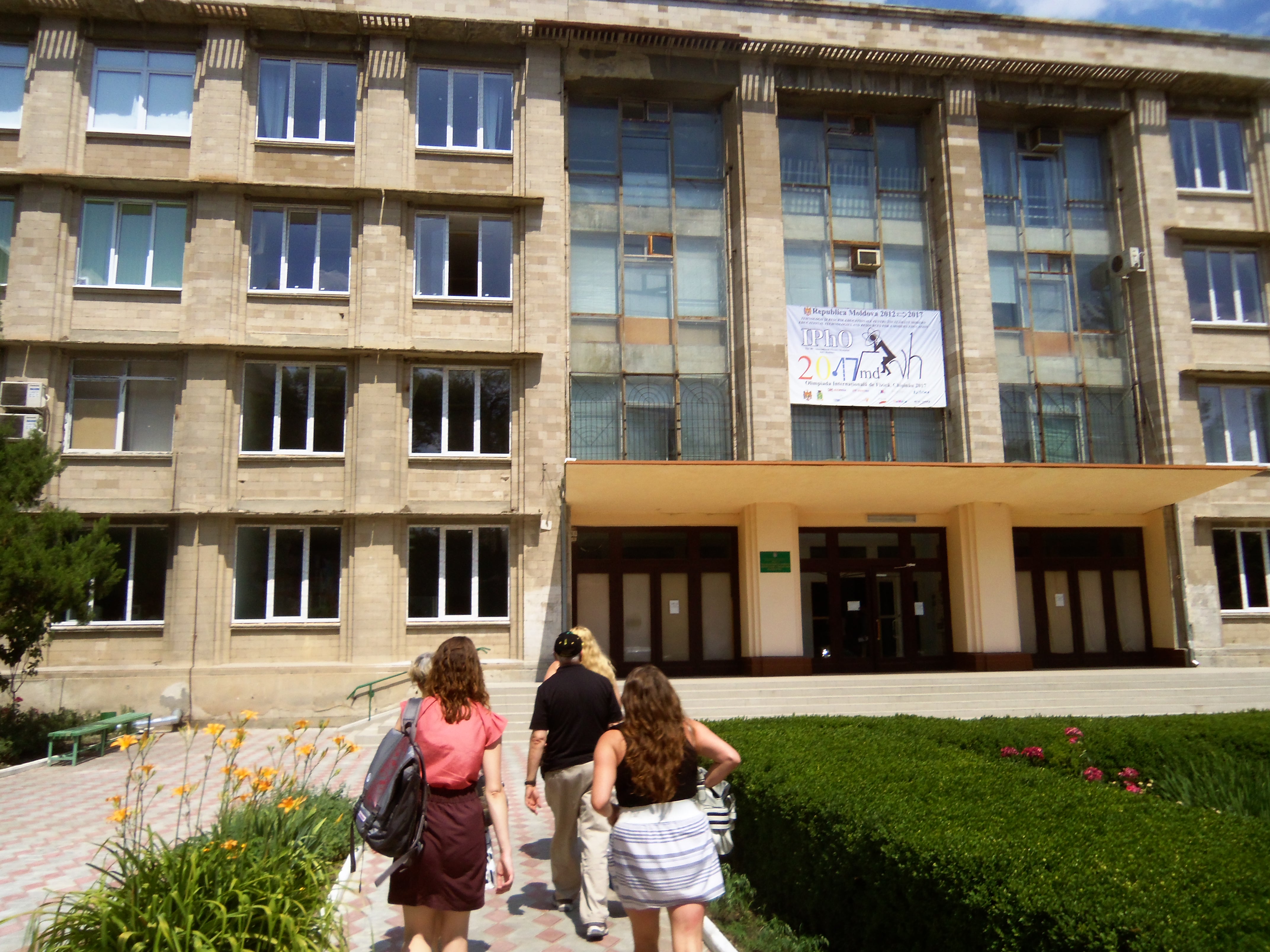
Entering the mathematics building State University Moldova
Our big project this week for Pre-service Training was paying a visit to an NGO in Chisinau called MilliniuM – the significance of the two “M”s representing “2000,” the year in which the organization was established, or registered, in Moldova. We interviewed its founding director and a Peace Corps volunteer who has been placed with the agency since last summer. Both the director and – of course – the PCV spoke English, so again we were relieved from having to draw on our mish mash of Roman-Engleza to communicate. (I’m still keenly aware of the future looming ahead, when I will be dropped off in a distant village on my own with no fellow Americans buffering the crushing linguistic tidal wave, keeping me afloat within their lifeboat of common conceptual experience.)
We spent an entire afternoon carefully crafting a series of multi-part, syntactically dense questions that I just had an inkling were not going to fit the situation we would find ourselves in. The interview we imagined ourselves conducting could’ve been written off on the expense account of any family foundation CEO or the Board Chair of a third generation non-profit sitting pretty on a diversified endowment. Instead, we found ourselves perched in a ring of hastily assembled mismatched chairs surrounding a pasteboard desk in the Soviet-era office of Vitalie Cirhana, a mathematics professor at Moldova State University. Conrad, (the PCV) was in shorts and flip flops; Vitalie was valiantly attempting to keep some air of authority amidst a battle with a motley crew of oblivious teen volunteers who invaded the office and commandeered all the computers in the midst of our session.
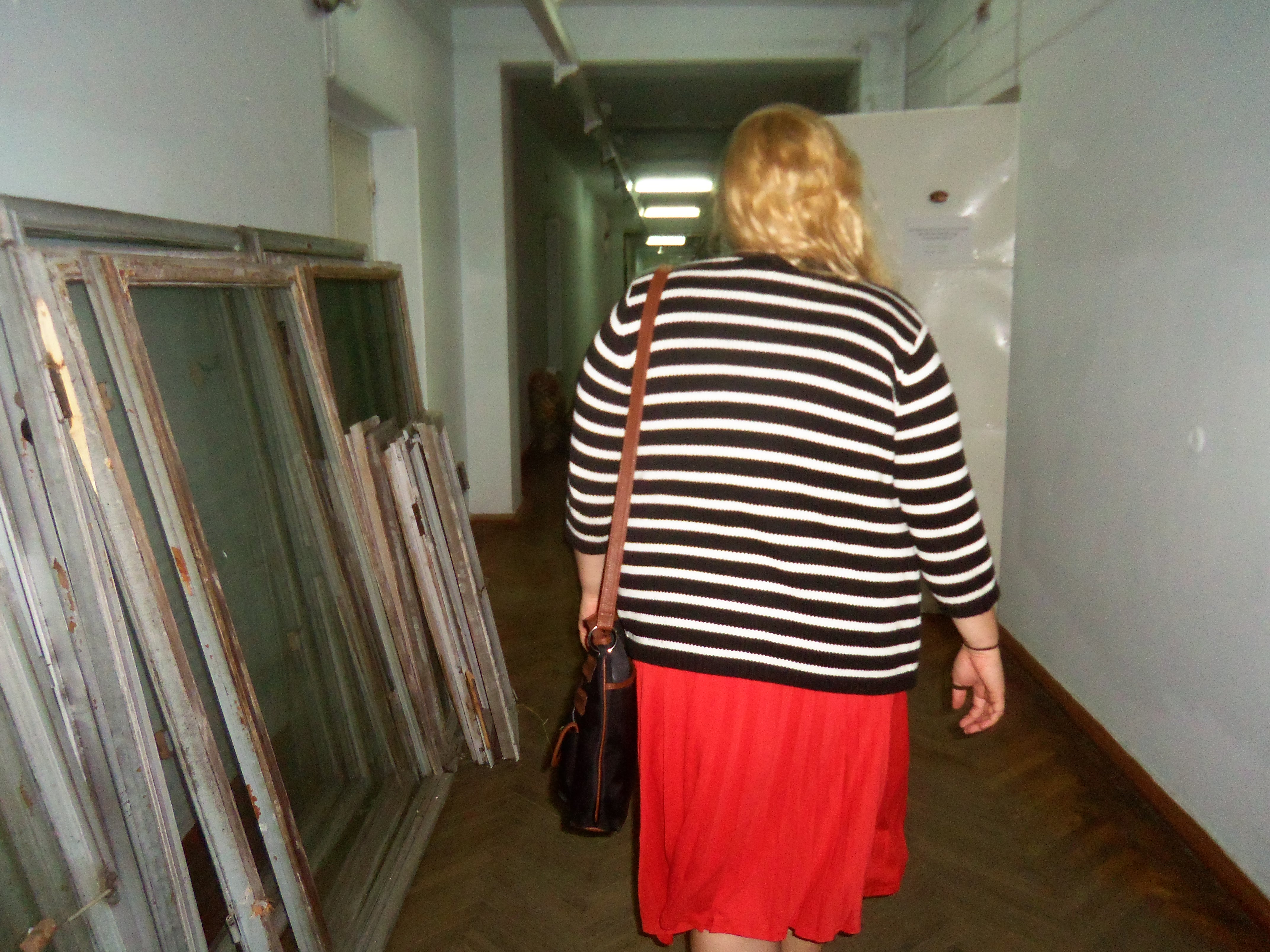
Hallway leading to Vitalie’s office
This is one of the beautiful realities – at least in my opinion – of the Peace Corps. Your placement will inevitably be ad hoc and entirely of your own making and nothing like anything you might have done before in the States. Conrad is an attorney who used to be the in-house counsel for a condominium association in Florida (though if you saw him, I swear you’d think he was a musician/hipster straight out of Echo Park. He doesn’t look a day over 25 and I’m sure he rides a fixed gear bike with no brakes into work.) Conrad openly admitted he knew nothing about running an NGO and that it had taken him the better part of a year to figure out what MilleniuM’s mission and goals actually were and how Vitalie envisioned it continuing to be viable and effective into the future. This gives me great hope for the comparative value I can bring to my future placement site, but also causes me to wonder if my executive level experience will really be of any practical use in this environment. I foresee myself coaching some well-intentioned mayor who holds down a full-time job in the city and farms his outlying plot on the weekends how to create a balance sheet for the village’s expenses.
European Union Embassy
One of the stark realities of this place that I was faced with today is the general dilapidation of the infrastructure here. Because I was overwhelmed and fascinated by the newness of my environment, I wasn’t making any evaluative judgments about it. Now that I’ve been here for a couple of weeks, the crumbling buildings, worn sidewalks, eroding pavements, and boarded up windows are becoming more prevalent in my consciousness. You can see that everything must once have looked quite grand – there are elaborately carved stone edifices and elegantly designed buildings that have not seen any maintenance in a couple of decades. Beautifully landscaped central parks are overgrown with weeds and tangled bushes; it is obvious that no one has mown the grass or trimmed the trees in recent memory. Though litter and refuse are not prevalent, there is no sense of overall care and husbandry of the environment. It almost feels like some sort of spontaneous recovery after a nuclear accident – a makeshift metropolis patched together from the relics of a once proud civilization. You can see the potential hovering like a kaleidoscopic watercolor painting just below the gritty surface sketch. If only. I mean, this is the first place I’ve been in the world – including Guatemala for effin sake – that does not have a Starbucks. Nowhere. In the whole country. (Is my shock quotient coming through?) Did you know there was a country in the world without a Starbucks??? What the bleep?
That’s Rodica – one of our LTI’s – in the corner of the picture, waiting to flag down a rutiera
There is vast potential here – that is what is so exciting. A representative from the US Embassy came yesterday to speak to us about the socio-political environment in Moldova. Though most of the younger PCT’s couldn’t really stay focused, I was fascinated by the information. They have been through so much and come so far in just two decades. I mean, here we find a former Soviet state grinding the gears of representative democracy into motion. Even though the going is episodic and halting, it is moving. And I get to participate – at least at the sidelines – for a couple of incredible years. I do feel lucky and really excited to be here at just this moment in time.
On a more somber note: we had our first casualty this week. A member of the 50+ group decided that the experience is not a good fit and he returned to the States today. We all liked him a great deal – he was a fun-loving, gregarious chap. Not the person I would’ve picked to throw in the towel. But another great aspect of Peace Corps is their absolute commitment to our well-being; if we decide that we want to go home, they book our plane ticket ASAP, no questions or criticisms. And I do admire the courage needed to admit that this isn’t the place one wants to be, after all the excitement and hoopla and bravado that most of us have displayed in coming here. Sometimes the reality just doesn’t match up to the ideal and that’s life. The statistic is actually close to 30% of every incoming group who don’t make it for the whole two years, for whatever reason. So we have about 22-23 more people who will head home sooner rather than later.
I am pretty determined at this point not to be one of them.
So it’s the middle of our second week, six left to go. We have settled in to our daily routines and are wearing pathways between our homes, the school, and the bar. We know who gets to school early and who is perennially late. Our language instructors are possessively proud of us and sang a lovely song for Leslie and Jan’s anniversary today at the break. The bar staff is so inured to our presence that they conducted a water fight over our heads this afternoon. We forgave them (and even felt a bit jolly that they’re not treating us like aliens anymore.) Today it was at least 98 degrees in the shade. They say, “Capi frijți!” My brain is fried.
It hit me softly in the stomach today that just one month ago I was sitting on a balcony at the Ritz Carlton in Laguna Niguel sipping a $19 martini and slurping up a plate of exquisitely prepared mussels with my daughter and grandmother, worlds away from my mental and economic circumstances at the moment. (How quickly life can change with jet propelled air travel.) I went to the market today and stood in front of the shelf of instant coffee, debating whether I really wanted to spend 40 lei on a jar. I decided that was too much; it wasn’t until I was halfway home that I realized 40 lei works out to about $4.50. I wasn’t wont to buy instant coffee at home, but I imagine it runs a bit more than that in the States. And it certainly cost a lot less than my over-priced martini.
When we first arrived, the Peace Corps gave us an envelope with 730 lei for our “walking around” expenses. This works out to just over $60. Since our board is provided, we use the money to pay the 6-8 lei roundtrip ticket price on the rutiera (which we take a couple of times a week), load minutes onto our phones, purchase internet time from our host families, and – of course – finance our trips to the bar. Let me tell you, I’m adopting a whole new awareness of money. There are no credit or debit cards to fall back on; Moldova is almost entirely a cash economy. You can’t even get a mortgage for a house. So I must be cognizant of the total sum of money I have available to me on a daily basis, a concept I haven’t had to entertain for at least a decade. I’m anxiously anticipating the advent of my next allowance, which will be deposited, unfortunately, directly into a bank account that will require the use of an ATM card to retrieve. I may be poor for awhile.
These are the sorts of incremental, incidental changes that end up altering my existential experience of being at home in the world. It’s like being slammed back into childhood, suddenly and with no reprieve. I can’t talk right. I can’t communicate my needs or desires or worries or doubts to the person I’m living with. I can’t order complicated food at a restaurant (we have managed to buy a pizza.) I’m somewhat terrified each time I get on the rutiera that I won’t recognize my stop and I’ll end up wandering the back alleys of Chisinau’s less desirable quarters stammering to wary strangers in a patched together dialect of verb infinitives and singular nouns. When I go into a store, all the labels are in Russian. Unless I recognize the packaging I have no clue what I’m buying. And I have no idea if the prices are steep or fair. I bought a credit card from Orange, the mobile phone company, to load minutes on my phone. I couldn’t read any of the directions and fumbled my way through the process relying on luck and tactical guesswork (i.e., randomly punching buttons on my iPhone menu.) The date is twisted here – the day listed prior to the month, the cold water is on the side the hot water should be and time is told military style. I am literally exhausted at the end of the day from translating the world around me and struggling through inane tasks that I could perform with my eyes closed standing on one foot while texting and cooking dinner back home. It’s all we long for at this point – to one day be multi-tasking, competent, self-assured grown-ups again.
So here is the speech that I’ve been working on for a day and half to present in my language class tomorrow morning (no notes, I have to speak it in front of the classroom):
Pe mama gazda mea o cheama Nina Covș. Ea este din statul Leușini din Moldova de vest apropriat de frontiera Română. Soțul ei Alexandu din Belarusia dar el este murit de la cancer intestinal mare deci ea locuiește singura. Nina este pensionara dar înainte de acesta ea a lucrat în clinica medicina estetica ca adminstrator.
Ea are două fiice, Natalie și Oaxana. Natalie are treizece și doi de ani și locuieste în Torino Italia cu soțul ei Domenic. Ei au trei copii. Alexandrina și Michella și Daniele. Natalie nu muncește. Domenic muncește în Elveția.
Oaxana are treizece și sașe de ani și locuieste în Torino Italia de semenea cu soțul ei Liviu. Ei au unu copil Federico. Oaxana nu muncește. Liviu muncește la Uzina Ferari.
Nina este energic și fericita. Noi suntem două prietene.
If you have any interest, copy it into Google translate (Romanian into English) and you can find out how embarassingly childish my vocabulary and grammar have become in just one week. It’s totally frustrating to have to compose such simplistic sentences, but believe me just this first grade effort is taxing me at this point. And this is after some thirty-five hours of INTENSIVE language classes in a small group of five taught by a native. We keep hearing from M25s and M26s (the groups that came in 2010 and 2011) that they now think in Romanian and translating those thoughts into English represents a concentrated effort. I’ll believe it whence I experience it…
Which causes me to reflect a bit on a topic that always surfaces during an election year (and actually seems to perenially occupy some sordid corner of the conservative media bandwagon.) All those immigrants – what to do about them? Those lazy, selfish, ignorant, greedy people who invade our country without permission to soak up our generous tax-financed social welfare benefits and spit out children on our dime. Yeah.
Enough said
Let me tell you, from the perspective of someone struggling to assimilate into a culture and country where I am fully supported by a solid infrastructure of educators, administrators, doctors, accountants, IT and security personnel who all speak my language: this is NO walk in the park folks!!! Imagine finding yourself in a place where none of the road or store signs, advertisements, maps, bus routes, menus, prices, applications, billboards, newspapers or ingredients on a food label are intelligible. How would you go about finding a job? Renting an apartment? Buying your groceries? Seeking medical assistance? Enrolling your children in school? I can’t tell you how impossible all these activities seem to be to me right now, despite all the background support I enjoy. Yet there are thousands of people all over the world who brave these immense difficulties in order to better their own, their children’s, and/or their families’ lives. With no language teachers or “host families” or stipend or medical kit to help them along. I am in awe – really – of the amount of sheer bad-ass courage it would take to be in this situation on my own. I really don’t think I could do it. So my hat goes off to all those people who accomplish this, whatever the legality of their circumstances may be.
Believe me, I can’t imagine going through this experience and being the least bit lazy or ignorant; it takes too much out of you. It’s too damn hard. I am exhausted at the end of the day just trying to keep myself oriented in the environment, figure out a few words in the conversations that envelop me, memorize the layout of downtown Chisinau and my neighborhood in Stauceni. Most people who do travel to places like this insulate themselves within an American tour company or are accompanied by a friend who speaks the language or have their Google translate app loaded up to fire on the iPhone. And they know that they will be going home within a week or a month at the most. Very few people drop themselves into this sort of situation purely for pleasure.
I wish those people who mouth off about the generalized traits of illegal immigrants could have a little taste of what they experience. Whether you believe what they are doing is right or wrong, give them a heap of applause for their sheer guts and perserverance, my friends. I can only hope to succeed half as well as most of them seem to do. And perhaps entertaining the thought of finding a legal way to incorporate such strong and determined people into our culture and economy isn’t such a bad idea…
At this point in the Peace Corps adventure, the two things predominant in the trainee’s daily experience are language classes and his or her host family interactions. Just because I find my host mom (mama mea gazda) to be one of the more interesting people I’ve met so far, let me tell you a little more about her.
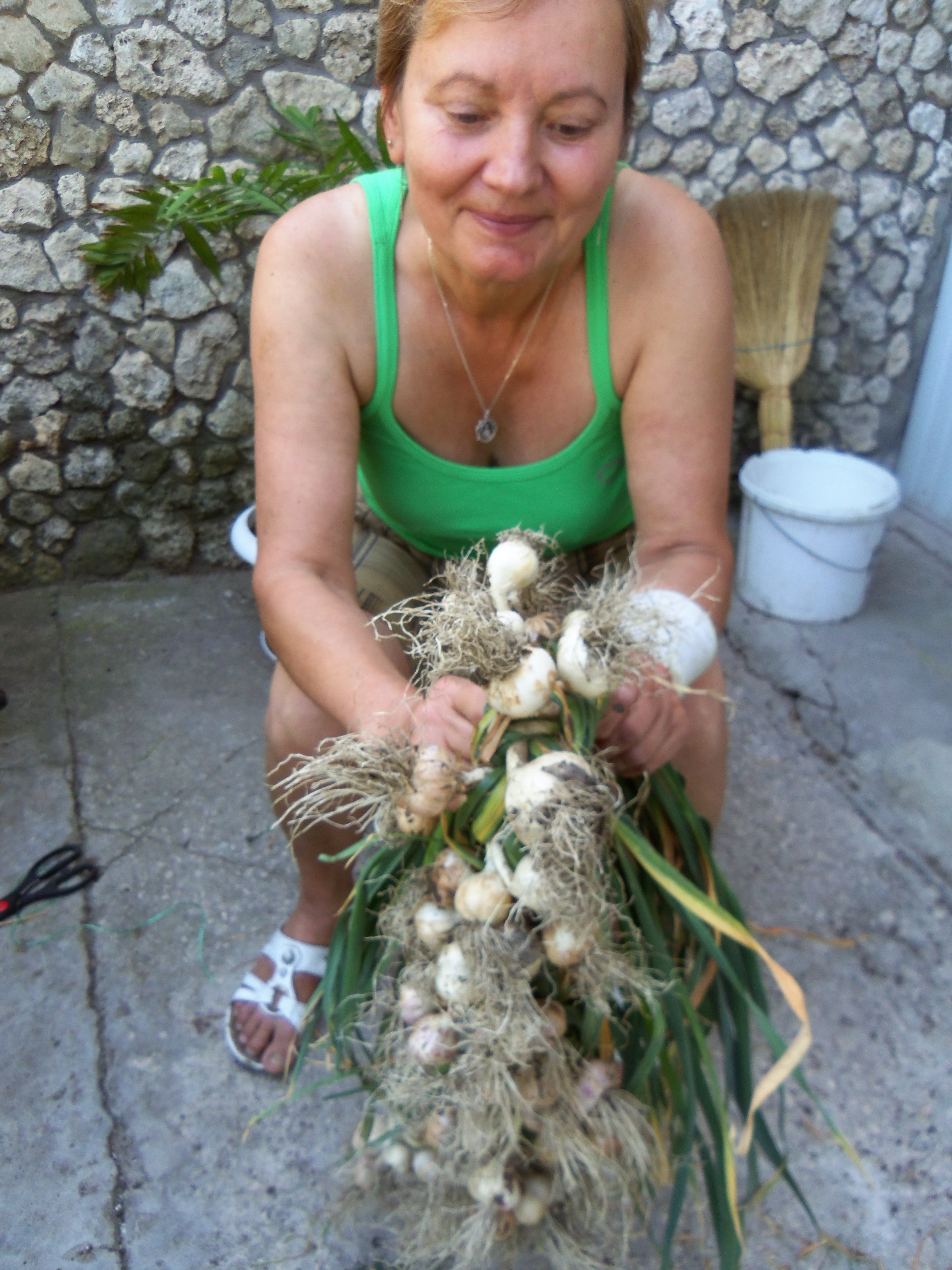
Niona braiding garlic from her garden
Nina, as far as I can tell, is not a typical Moldovan woman. She is sixty-one, but could easily pass for being in her late-forties or very early fifties. She spends most of her day in her garden or tending a neighbor’s who is currently in Germany. As such, she is quite strong and fit – no flabby triceps or sagging chest on her. She has not worn make-up in my presence, though I do see a few sticks of eyeliner, one lipstick, and a tube of mascara in her bathroom (I spy.) No foundation – she doesn’t need it.
On several occasions she has tried, rather animatedly, to communicate her former profession, which I finally figured out was as an administrator of a medical aesthetic clinic. Maybe women came there for facials and dietary consultations? She certainly seems to know a lot about massage, acupressure, nutrition and the like. (In the food department, I feel incredibly fortunate to have been placed with Nina. Many of the other trainees are eating Westernized, store-bought food or are fed quite a bit of meat, dairy products, bread, and white rice along with their vegetables. While I do get a very thin chicken breast most every day and she does keep a loaf of brown bread on the table, the majority of our meals have been composed of herbs and vegetables from the garden and/or whole grains like buckwheat or oatmeal.)
In the host family survey I completed for the Peace Corps prior to coming to Moldova, I indicated that I had been juicing for the past few months and had lost some weight. I told them that I was worried about gaining it back and would really like to be placed with a family that avoided fatty or processed foods. Well, I think this may have been conveyed to Nina as she seems to have taken on a personal mission to transform me before I leave her house.
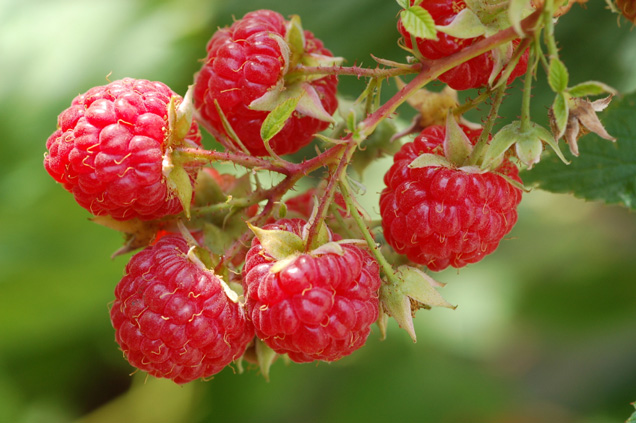
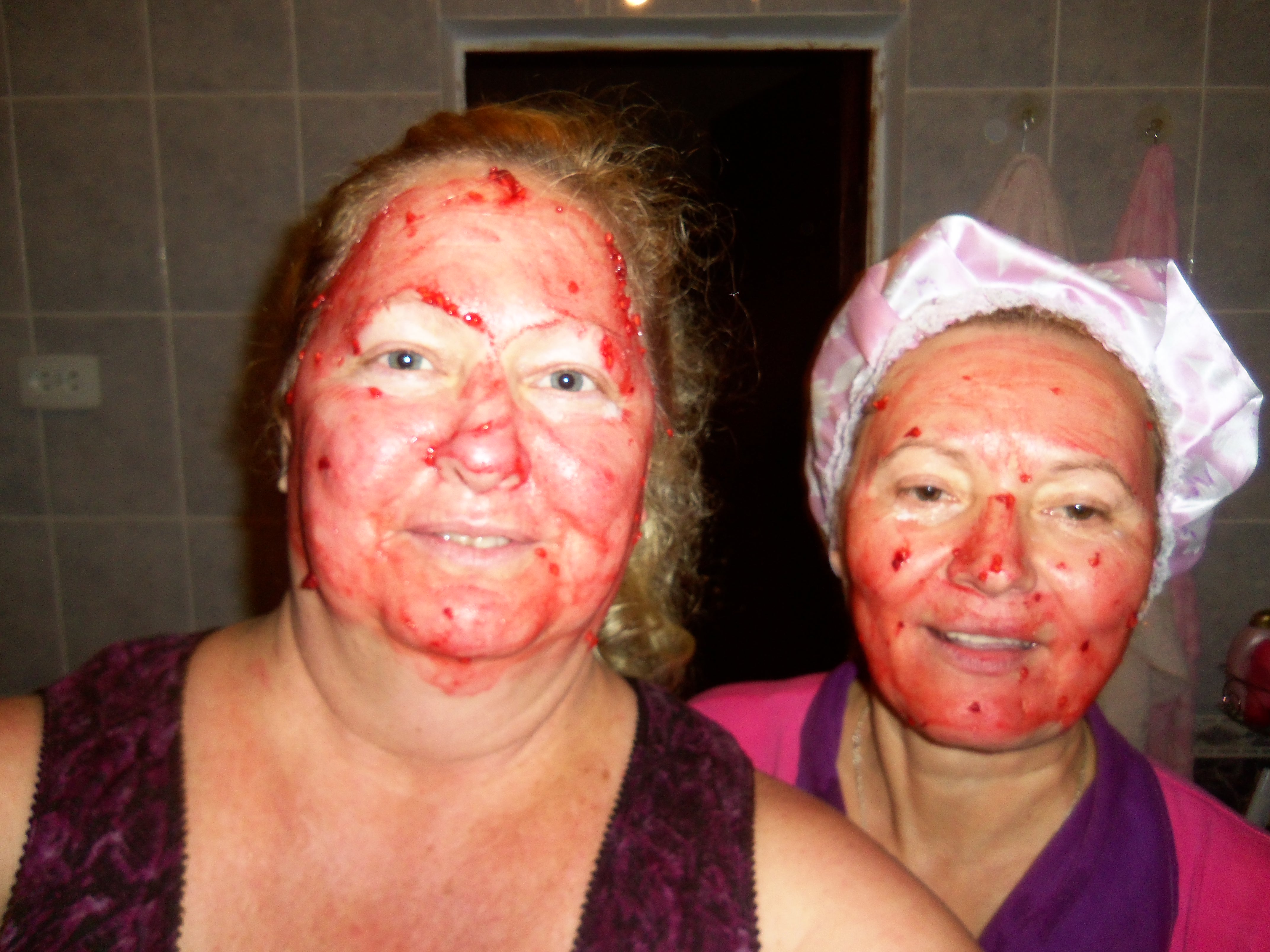
The other night as I was struggling to conjugate the horrid verb “to have,” she appeared in my room wrapped in a towel with a bowlful of mashed up zmeură (raspberries) and motioned for me to follow her into the bathroom. With an unintelligible (for me) stream of Limba Română as our soundtrack, she had me remove my shirt (I kept the bra on) and proceeded to slather us both with the raspberry/cream/honey/olive oil concoction. With our arms, hands, necks, chests, and faces covered in the pink slop, we stood in the bathroom, arms in the air, and I listened to her chatter away at me in words I dearly hope to understand soon. This was quite a comical experience to have with someone I only met a week ago and with whom I can barely communicate. This was another, very tactical briefing in cross cultural exchange. The thought of my mother conducting this exercise with some UCI exchange student from China or Korea about makes my head explode.
Admittedly, not my best look….
After we rinsed, we returned to me room where Nina very enthusiastically demonstrated for me her impressive limberness and agility. She performed a series of calisthenics and pilates-type stretches that I’m quite sure would have challenged my 26 year old daughter. Needless to say, I demurred from joining her in this activity. She seems determined, however, to enlist me in some form of exercise soon. I’m not quite sure where she gets the stamina, given her workload in the garden, kitchen, and around the house. Luckily for me (and this has been a very mixed blessing, believe me) it has apparently been too hot for her to challenge me to another “gymnastica” duel. It’s supposed to be in the high 90’s this week, so for now I’ve been granted a reprieve…
I’ve discovered over the past few days that my internet access at Nina’s home is intermittent and largely unpredictable. Mostly, it seems to work best at 6:00am, a time when I am not feeling so inspired to blog. So when I saw the bars appear in the lower left hand corner of the screen while I was conjugating my “to be’ verbs, I grabbed my computer and moved over to the corner of the room where the signal is the strongest. I am madly trying to get photos uploaded before the signal disappears again…
My view
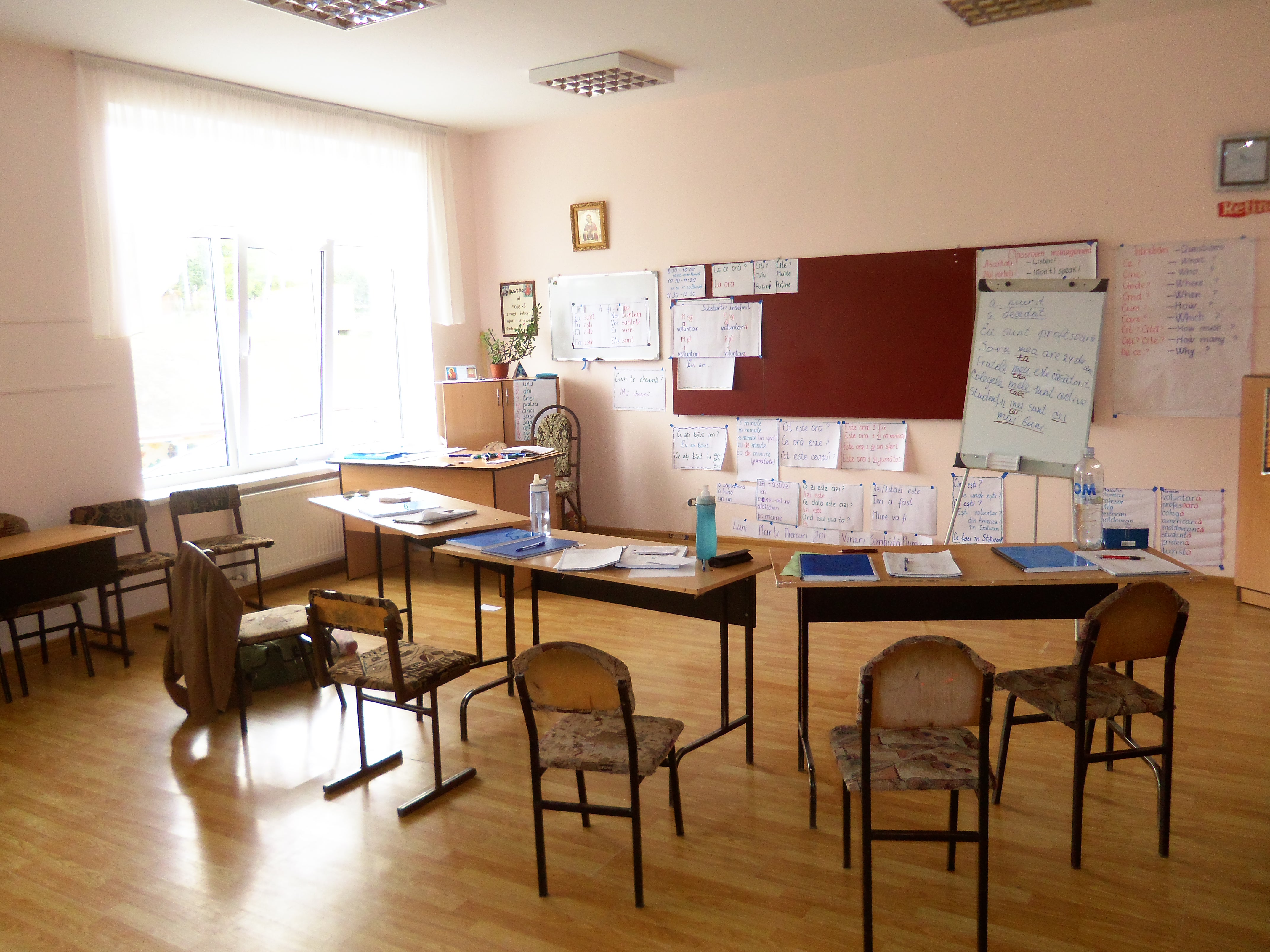
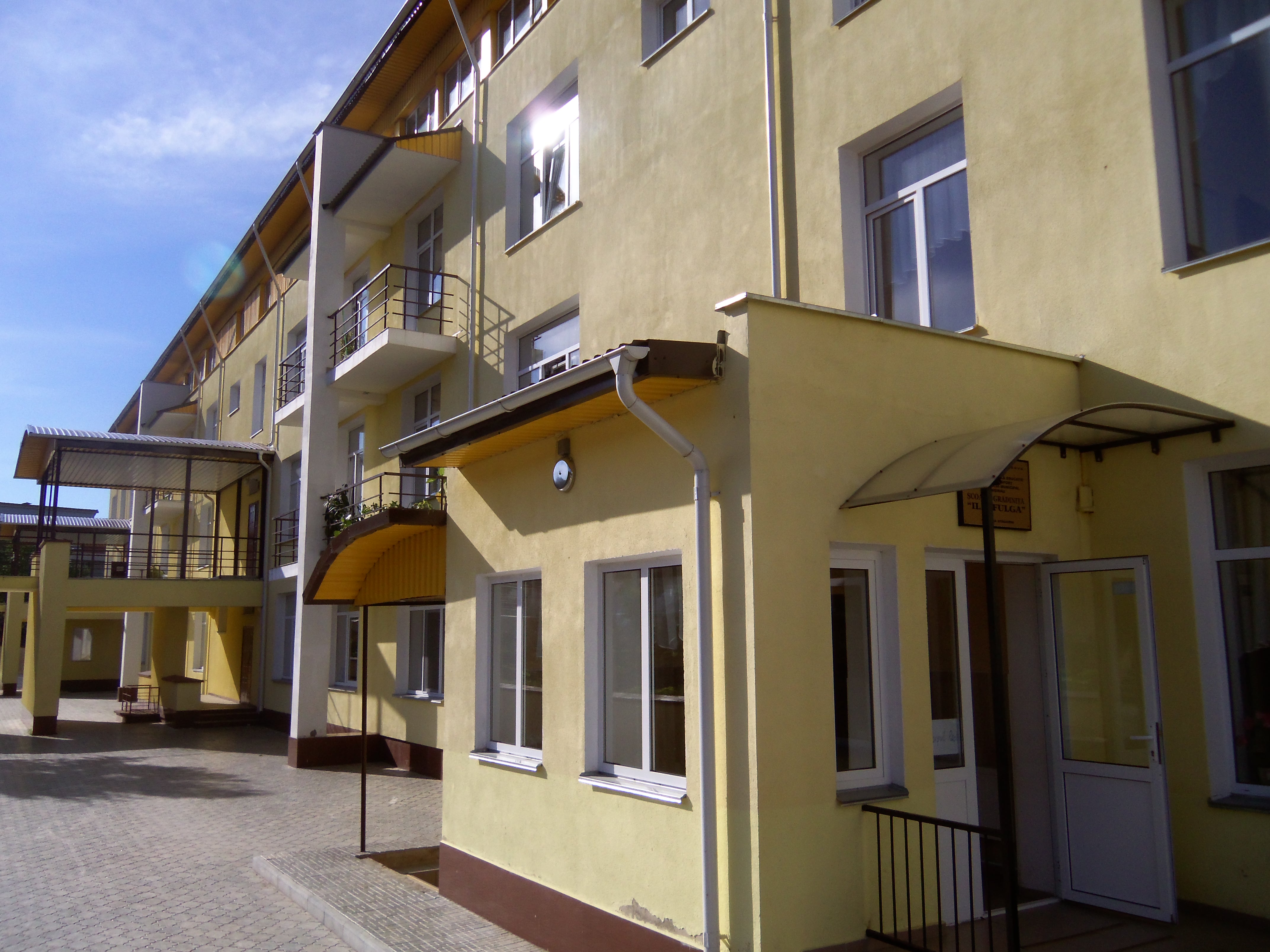
So here is the classroom where I spend the majority of my mornings. It’s actually quite pleasant (when it’s not a 100 degrees inside; Moldovans do not use air conditioning.) There is a year round kindergarten in session downstairs so our studies are set to the lilting sounds of children laughing and playing. Speaking of conjugating verbs. Oh MY GOD. Language lessons took a sudden jet-propelled thrust into DIFFICULT today: who in the world decided that substantive definite and substantive indefinite nouns should be modified differently? According to whether they are male, female, singular, or plural? Can’t we just toss a “the” or “these” in front of them and be done with it??? And then conjugate the verbs and adjectives, too, accordingly? I have lists two sheets long for conjugating just the male form of the verb “to be.” This is crazy hard to keep straight in my head.
Public well in neighborhood. Fill your cup. Noroc!
Today, for a bit more fun, I partnered up with Warren and Patty and we walked through our assigned quadrant of Stauceni to conduct our first experiment in “community mapping.” This is a tool we each will use at our assigned site for getting to know our community, its layout, socioeconomic and industrial composition, demographics, gender divisions and roles, etc. We literally walked the streets using my iPad (ok – we’re so American) GPS mapping tool to find our way down to the winery, bus stations, altamenteri, lyceum, premir (mayoral) residence, where we then stood around taking pictures and writing down notes and generally looking like completely here from space tourists. It was fun.
Then we went to the bar for a beer. We all spend quite a bit of time at the bar, trying to cop an internet fix (free Wi-Fi) and sip our cheap ass beer as slowly as we can in order to hang out for hours without appearing to be loitering. I tried buying a Perrier today because I thought it would look bad to get a beer for lunch, but it cost me 40 lei and a beer is only 15. Robyn bought a pot of tea and it was 25 lei. It’s like they’re forcing us poor volunteers to consume alcohol…
Warren and Patty in the bar
Tomorrow, we’re off to Chisinau again in the spa bus to “team build” with the other volunteers in a park. The weather shows thunderstorms, so this might be interesting as Moldovans don’t stop their activities just because of a little rain. ( I’ve seen blog pictures of picnics being conducted under hand held umbrellas.)
After a steamy, humid night where I awake every two hours or so to mop my drenched face and neck, I rise in the morning to brush my teeth, arrange my hair, and take the (very steep) stairs down to the kitchen. There, Nina has already prepared my breakfast, which has included such varied items as a garden salad, a bowl of cherries and bread, or oatmeal. I feel a bit like a princess, as she serves me and insists I start eating while she bustles about the kitchen. Usually she joins me after a couple of minutes, but sometimes she’s already eaten and she just keeps me company during my repast. Which felt a bit awkward the first couple of times, but I’m starting to get used to it. The thing is, Moldovans don’t see the need or understand the desire for “being alone.” Their word for loneliness and alone are the same; people just hang out together, even if they don’t talk or engage in the same activity. There is quite a lot of culture training around this issue for us volunteers and how to effectively integrate into our host families without having to sacrifice our “weird” American desire for privacy.
My desk
I then make the short walk to school by myself, attempting to be careful not to look or smile at people passing. This is another “weird” American trait; Moldovans do not seek to engage passersby with generic pleasantries; greetings and smiles are strictly reserved for friends. In fact, a single woman smiling to a man on the street is considered to have made an inappropriate invitation. This has been extremely difficult for me to remember and I probably already have a reputation in this town. Oh well. I won’t be staying here long. I usually get to school a half hour early and hang out with the other PCTs who are there. This group of people – my language training class – is supposedly the one that all PCV’s become closest to during their service, as we end up spending the most time together. There are a couple of them that I feel closer to at this point: Patty is 26 (Rhiannon’s age) and I am around her mother’s age, so we have been drawn to each other for obvious reasons. She is very introspective and concerned with her relationship with her host family, which has had its ups and downs. We talk a lot about fitting in versus being one’s self. Georgiana is gregarious and the accessorizing queen; she comes from a family of lawyers and is very analytical, yet relaxed and funny.
Our language class consists of endless repetitions and phony dialogues, which can get tedious but does, admittedly, expose us to the sounds and rhythm of the language. It has only been four days, but I am just beginning to get a feel for the words as separate entities when they are strung together seamlessly in a sentence. I must say it is a beautiful language – the common description is that hearing Romanian is like listening to an Italian speaking Russian. Even when the Moldovans speak English, they retain a lilting cadence to their verbiage that is quite captivating. The hardest thing is trying to make sounds that our American ear can’t even hear. They will repeat the singular and plural form of a word, for example, that sound exactly the same to all of us Americans. We have them repeat it over and over again, but to our dismay we cannot distinguish between the two. Perhaps we have just not formed the necessary neural pathways? Anyway, it remains a mystery we can’t seem to resolve. We just say it the same way in both cases and they accept our efforts.
I then walk home for lunch which, again, is all laid out for me on the kitchen table and typically consists of cucumbers, parsley, dill, butter lettuce, tomatoes, a thin piece of chicken, cherries, raspberries, and perhaps some placinta for dessert. Nina keeps up a running monologue which I cannot respond to, but, again, helps train my ear to the structure and sound of Romanian. After checking my email and Facebook messages (I am an Internet addict, I now realize), I walk back to school; up a VERY steep hill. I am getting some exercise. Yesterday and today, in the afternoon, we had a class with all of the Community Organizational Development Volunteers (there are 20 of us total.) They take the rutierai over from a neighboring village, which we will do next week and I AM NOT looking forward to; it’s already in the 90’s and it climbs into the triple digits, easily, aboard that sweat box. Anyway. We went over our Participatory Analysis for Community Analysis (PACA) which is basically a set of tools for how to do development within the Peace Corps environment.
Without getting into excruciating detail, let me just say the Peace Corps is an agency that has actually learned something in its fifty years of operation. They have very smart strategies for integrating volunteers into a community without us coming off as overbearing experts who have all the answers, first, by selecting the right people from the start . It is SO refreshing to be working with a group of really smart individuals; I don’t think I truly appreciated the rigorous selection process of the Peace Corps before now. Everyone I’m working with is very savvy – not just book smart, but “people smart;” they seem to know how to collaborate, listen, work within a team environment, and build on each other’s strengths. I don’t feel the need to step in and be “the leader” because everyone is a leader, yet no one is so self aggrandizing that they need to grab the spotlight. It is a joy to study and learn alongside them. Lessons move quickly and everyone “gets it” right off the bat; there is no having to go back and repeat or explain to a slower contingent.
Today, after class, we went to a neighborhood bar. It’s sort of an open, covered patio where they play “house music” and stout mugs of beer are just about a buck ten. (Good you didn’t come, huh? You know who you are…) Tipping is not an ordinary practice but we do leave 2-5% just because we’re such a loud and rowdy bunch. And we want to encourage a positive impression of the “Corpul Pescii Voluntare” in the village. It’s amazing that one can have an evening out at the bar for less than $5 American and then come home to a warm meal of fresh vegetable soup, complete with raw garlic right out of the ground. And not have to do any dishes. Life doesn’t get much better.
No matter what version of life in Moldova I may have concocted prior to arriving here, it cannot match up to its unfolding around me in brilliant, multi-dimensional actuality. It is difficult – from what I have experienced thus far – to incorporate the notion that these people are poor, or reside in a developing country, with the richness of the reality surrounding me. So far, minus the language difference and the refreshing absence of corporate retail and fast food establishments, Chisinau and Stauceni (the suburb/village where I am living) look like a slightly fuzzy version of LA and its environs, circa 1940 or so. Only the main roads are paved – and are liberally peppered with potholes – but the sidewalks are swept, the buildings seem maintained, the people appear nourished and well-groomed, and life is bustling – if not at a frenetic, American pace – definitely at one that evidences a reach for prosperity and productivity. It is definitely not Guatemala or Peru.
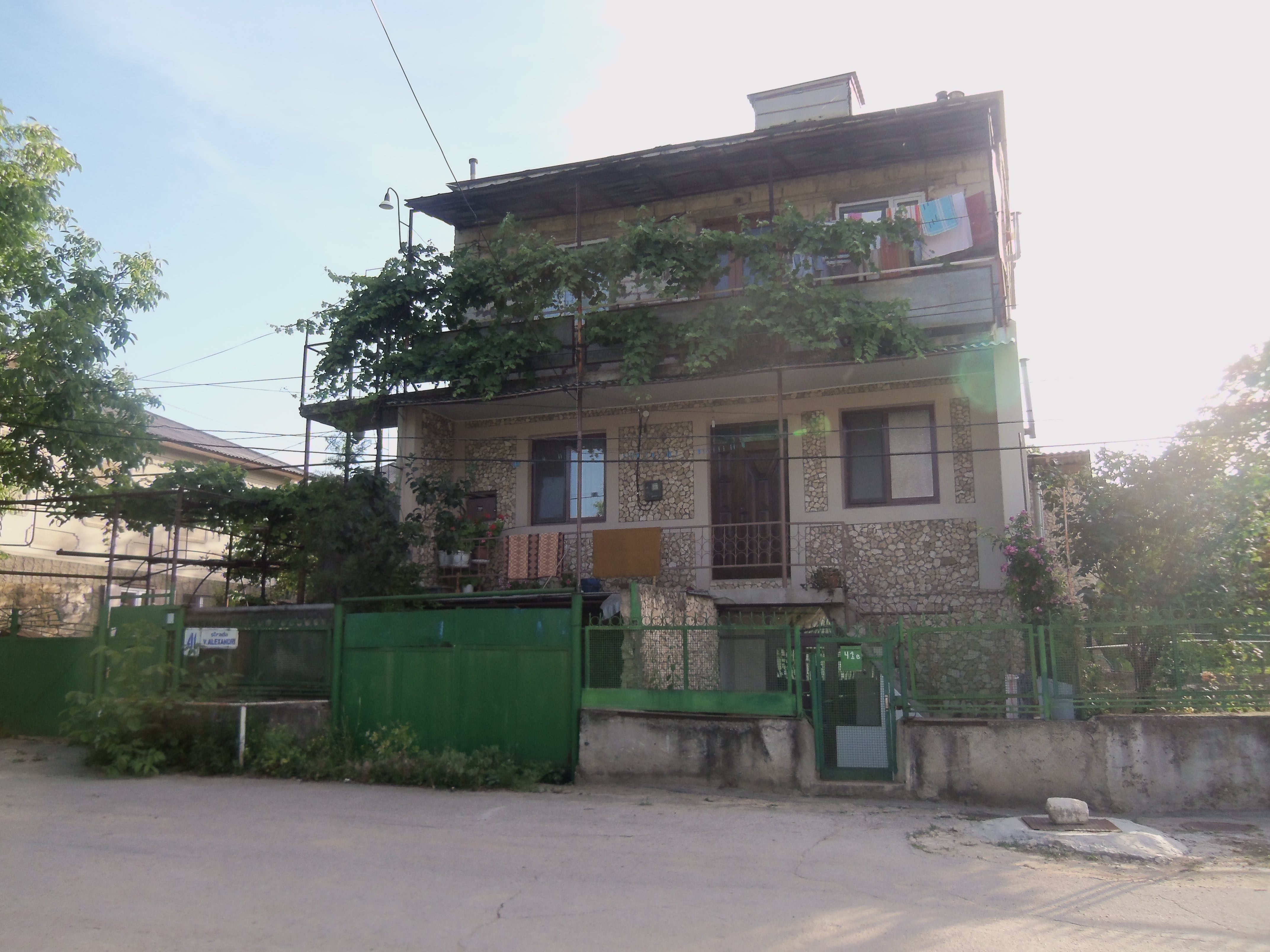
This is Nina’s (my “mama gazda”) house in Stauceni
I. Where I am: I have been assigned to live with a host mother – “mama gazda” – during my eight weeks of training in the village of Stauceni (I am not spelling this accurately, as I have yet to download the extra five letters of the Romanian alphabet to my computer. I do not have internet at this point in my home, so I have to wait until I travel into Chisinau next Wednesday to send this post, answer any emails, and generally get my virtual life fix.) Nina is sixty-one but looks my age or younger. She is a widow and a retired administrator with two daughters and three grandchildren who live elsewhere; where, I am not able to ascertain at this point due to the absence of a shared language. (More on this in a minute – it’s hard, folks.) She has a very nice house, two story – kitchen and dining room on the first story – and two bedrooms, a sitting room, and bathroom (!!!!) upstairs. One must take (very steep) external stairs to go from floor to floor.
This is Nina working in her garden
The most wonderful aspect of her home, I think, is the bounteous garden adjacent to it. Nina grows almost everything she’s fed me so far. I’ve had cherries, strawberries, dill, parsley, green onions, cabbage, several types of salad greens, luscious tomatoes, and crisp cucumbers. She makes her own juice, jam, and wine. Today, I sat and watched her make placinta (again, not the right letters) or pie as we know it, from scratch. She actually throws the crust up into the air to twirl and stretch it. She made three different kinds: cherry, green onion/cheese/dill, and cabbage, my favorite! Other than a carton of yoghurt I had at the hotel the first morning I was here, I haven’t consumed one bit of processed food since arrival. It’s amazing.
House in Nina’s neighborhood
Stauceni is quite upscale. Some of the houses (not Nina’s) are as big and nice as those in Turtle Rock or Northwood. The neighborhood is plush with towering trees, flowers, abundant gardens, wrought iron filigreed gates and fences, stained glass windows, and tiled porches. All of us in the Peace Corps van were agape as they dropped us off one by one at these veritable villas. One of the volunteers is staying in a four story house, where she shares an entire floor with the two daughters and the shower is as big as her entire bathroom back home.
Truth in advertising: I did freak out a bit the first night. To be left at someone’s doorstep whom you’ve never met, who doesn’t speak your language, and watch the only familiar faces that connect you to your country drive away does cause a bit of anxiety. I’ll admit that the creeping poison of “WTF am I doing here????” did flood my brain a bit. But Nina is extraordinarily warm and did everything possible to put me at ease. She showed me around the house, fed me, and then took me for a short walk through the neighborhood to another house she owns. Apparently, the woman who rents it from her, Lizbet, is in Germany. We picked a monster bowl of cherries and strawberries there and then returned home and went to bed.
Life as a bowl of cherries
The time zone difference is causing me the greatest difficulty so far. From Wednesday when I departed the USA up until last night (Saturday) I had not more than seven hours sleep total. My body wants to be awake when it’s daytime in California and sleep when it’s night there. Since this is almost the exact opposite of the time here, I find myself literally snoring in language class and inexplicably wide-eyed and energetic at 3:00am. I have never experienced this degree of sleepiness before, where I am absolutely unable to keep my eyes open and continually catch myself asleep in class. The Language Training Instructors (LTIs), Diana and Rodica, are both Moldovan and very understanding. But they are told to keep pushing us without let up, as we only have eight weeks to master conversational Romanian before being sent out to our respective projects. ) We are starting with the alphabet and “to be” verbs and my head is already filled up and pounding. This is exacerbated, I realize, by lack of sleep. Last night I slept fifteen hours, the longest I believe I may have ever slept continuously in my life. And I think I could sleep another fifteen tonight, only I have to resume classes tomorrow. Hopefully, this diurnal craziness will fade with the passing days.
So, let me say, actually listening to Nina spew forth Romanian at a rate equal to Rhiannon’s freeway driving pace is world’s away from listening to Pimsleur language lessons on an iPod. I had allowed myself to think that I was going to be able to pick this up effortlessly. Not so much. I have to sit with a dictionary in my hands as Nina and I try to converse and this obviously limits our range of topics. After ten or twenty minutes of this snail’s pace she gets impatient and resumes the eighty mile an hour rate again and I fall back to nodding my head, smiling and repeating “Dah, dah. Bine.” (Yes, yes. Good.)
II. What I’m doing: I am fully immersed in Pre-Service Training (or PST. The Peace Corps, like all government agencies, it seems, LOVES its acronyms. We actually have a class on acronyms.) Here is a partial listing of classes from my Calendar of Training Events (COTE):
– Food and Water Preparation
– Local Public Administration in Moldova
– Introduction to Community Organizational Development (COD)
– Expectations Session
– Small Development Area (SDA) Community Mapping
– NGO Sector in Moldova
This is just the first of eight weeks and does not include the morning language classes. We’re in class from 8:30 – 5:00pm Monday through Friday and 8:30 – 12:30 on Saturdays.
Our group cluster site – an elementary school in Stauceni
A group of nine of us COD trainees spend five days at what’s called our cluster site – an elementary school in Stauceni – then take public transportation (rutieras, more on this in a minute) into our hub site in Chisinau on Thursdays for training with the entire PCT group. The composition of my group: a married couple in their seventies who have lived and worked all over the world; three single women in their mid-twenties to early thirties who have variously graduated from law school, lived and worked at an orphanage in Mozambique,and obtained a MA in International Development; a man in his sixties who retired from public service work; two men in their late twenties, one of them born in Paraguay, the other also having worked/schooled in Africa already. It’s quite a cosmopolitan group; I’m probably the most vanilla member.
Riding public transportation was an abrupt introduction to the other side of Moldovan life. The saying is” “You can always fit two more people into any rutiera.” So far, I’ve ridden up and back to Chisinau; both legs of the journey I was standing in the aisle pressed up against my immediate neighbor and hanging on to the overhead pole for dear life. There are seats for ten people; the other twenty or thirty, along with their various bags, bicycles, or babies, must somehow fit into approximately twelve square feet of aisle space. I’m not kidding. (Actually, when someone has a baby they pass it over to a seated stranger to hold on his or her lap.) When the rutiera stops, one has about eight seconds to push one’s way from the back of the bus, between the limbs and breasts of a packed hoard of sandwiched bodies, before the driver is off again at fifty miles an hour, a relatively mild rate in the states which may not convey the danger this represents when the road is filled with potholes and you can’t really feel the feet that are holding you up anymore. Did I mention that the windows don’t open and that it’s the temperature of a Bikram yoga session inside? Sweat literally pours off your face and onto the shoulder of the person crammed next to you. And vice versa. We’re all very close here.
The weird thing is the degree of honesty and trust that is demanded by this form of transport. Or maybe it’s just Moldovans – I don’t know. Anyway, if you don’t have time to pay as you enter the bus due to pressure of people boarding behind you, then you wait to find a good handhold and pass your money up to the driver. It goes from hand to hand along with a notation of how many are being paid for (one, two, etc.) then the accurate change is passed back through a line of six or seven people to find its way back to you. Could you see this happening in LA? But yet, we’re told to be wary of pickpockets on public transportation here. I guess they only steal the money from your pockets or bag, but won’t take it if it’s out in the open. Go figure.
III. What I’m feeling: As I said previously, the first night in Stauceni was the hardest so far. I felt very, very far from home and everything I’ve known in life. Although Guatemala and Peru and Ecuador were undoubtedly more foreign, the reality that I have signed up to live here for at least two years caused me to have a minor mental melt down as I lay awake from 3:00am on. This anxiety has since faded, luckily, though I am assured by the Peace Corps staff and the more seasoned volunteers that it will return, time and again, to haunt me for at least the next few months.
And that’s the most reassuring part of this Peace Corps experience. There is a big Peace Corps building in Chisinau, behind locked gates, set among verdant trees and green grass, where one can find a bevy of volunteers congregated at any hour of the day or night. (Some sleep here when they travel in from distant sites.) It was a little intimidating to find a whole group of them staring down at us from the third floor balcony the first time we entered, but at the ensuing picnic they all proved to be gratifyingly approachable, talkative, and encouraging. Mostly, they reassured all of us newbies that the stage fright we’re experiencing is normal, that a year from now we will return to our host families and laugh about the initial days of our stay, chattering with them in Romanian about how nervous and awkward we both felt at our first meeting. All the volunteers I’ve met so far seem enormously satisfied with their experience and appear to be fully at home here in Moldova. They can navigate the teeming markets and warren of unmarked streets and tangled skein of public transportation routes like natives. (Funny aside: when one of the PC mentors boarded the bus conveying us from the hotel to Chisinau the first day, she began talking with the driver in rapid Romanian. I thought for sure she was Moldovan, until she turned to us and began speaking with a pronounced mid-Western twang.) It makes me very hopeful that I will adapt to this land and people and language, too. It is incredible to me now, feeling so very naïve and obviously American, to think that perhaps only a year from now I could be mistaken for a Moldovan. It is my greatest aspiration at the moment.
Hub site in Chisinau
The other thing that has all of us jonesing is the absence of Internet access. It is THE question at every open session: it is obvious that we are a new generation of PCTs who expect to have instant connection with family and friends back home. While Nina has WiFi in her home, she doesn’t seem to know what the “security key” is that I need to log on to the network. She handed me her laptop to see if I could figure it out; unfortunately her operating system is Russian to me. Literally, it’s written in Russian. It makes it twice as frustrating to know that the capability is right at my fingertips, but might as well be a thousand kilometers away for all the good it does me. So, given the state of things at the moment, I will be able to write daily but only post once a week, either on Wednesday or Thursday, depending which day we go to hub site. Though I realize that none of you is waiting on the edge of your seat for my next post (okay – maybe my grandma and mom are,) I did hope to receive an email or comment a couple of times a week. It’s okay to keep sending them, I just won’t reply right away. (UPDATE: I now have internet at my home!!! Will be posting as much as possible, given my homework and mandatory socializing activities.)
Know that I am counting on you to keep me connected to my former life…
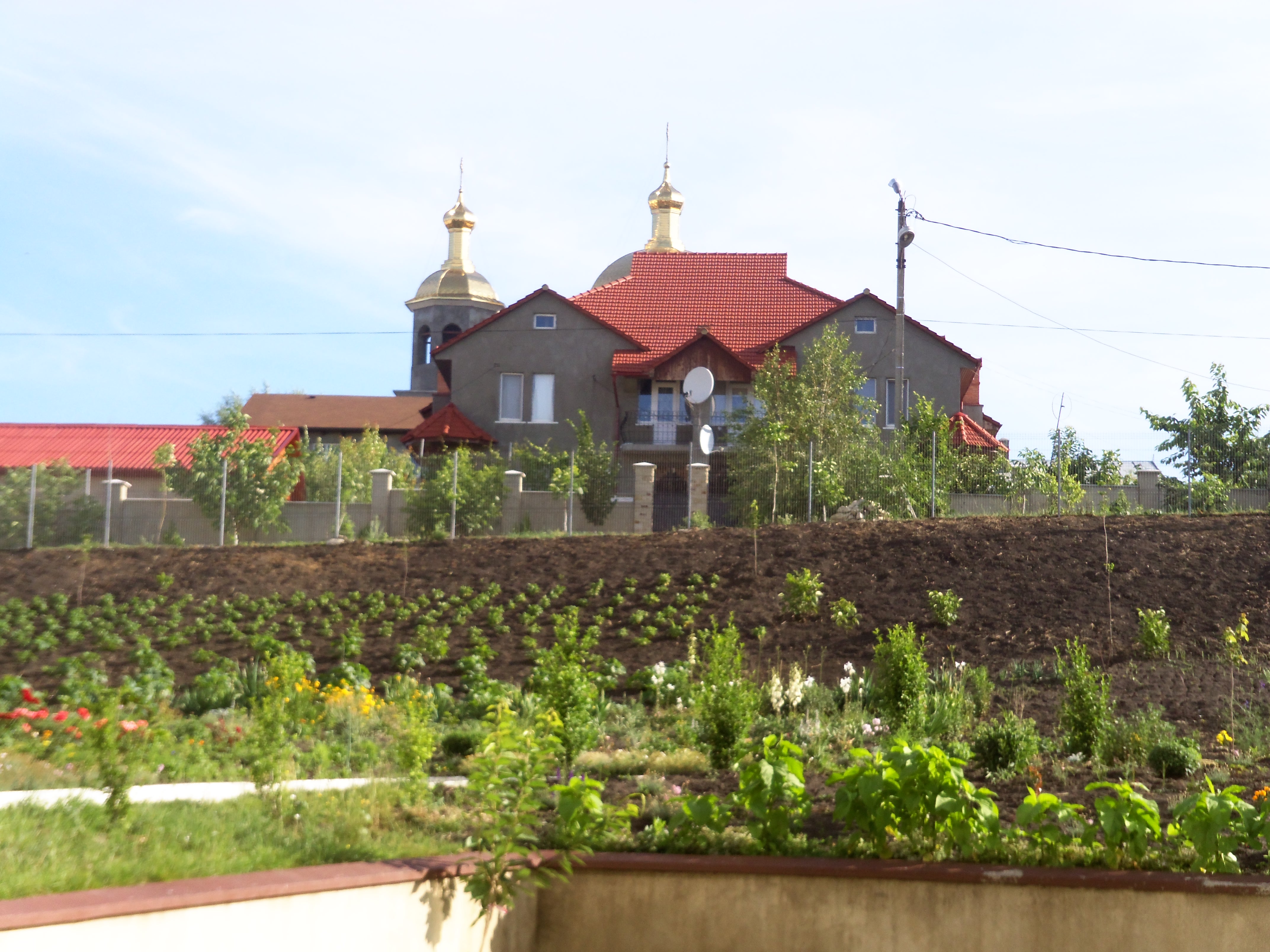
Greek Orthodox Church in our Stauceni neighborhood

 I have a new friend – Sophie – who will be joining me on my adventure. I’ve taught her a few words in Romanian already but she’s surprisingly shy about trying them out in company. Ah well, I know how she feels…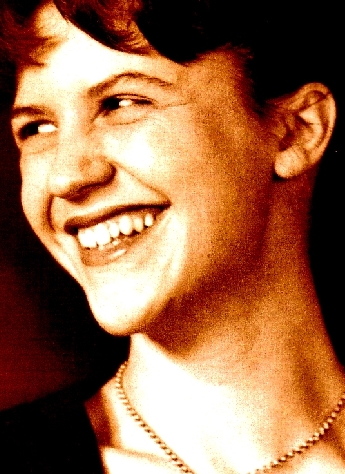












 From Now On I Live Mad