And the question is: why there, not here?

I hope I have been abundantly clear to all of you who have taken the time to leave a comment on one of my posts how much they are appreciated. Writing a blog is a little like standing up on stage (sitting at my desk) alone staring out into the blinding white lights that effectively erase the audience (the blinding white page on the monitor) and floating a monologue (pressing “publish”) that may or may not hit a resonant chord with my readers (comment/no comment.) Actually, I myself read many blogs that I think are wonderful but all too often I don’t take the time to comment as I’m not really sure I have anything pertinent to say. That’s bad etiquette on my part, given my first hand knowledge of what a boost it gives the writer to see that someone was moved enough to join the conversation.
Anyway, I received a comment on my last post – 9-5 – that posed a very incisive question, one that I’m pretty sure must have bounced through the minds of more than a few people who know me, but was never actually put to me in person: So why are you there providing volunteer services in a foreign land rather than here helping your own community/country/people? As the commenter truthfully pointed out, there are many poverty stricken, marginalized, under-served communities in the United States. And if all of us just focused on taking care of our own, perhaps there wouldn’t be the perceived need to fly halfway across the world to provide meaningful service to humanity?
This comment definitely made me sit back and go “hmmm.” Initially, I was impelled to react and, fingers poised above the keyboard, I sifted through the myriad arguments tumbling through my brain in an effort to decide which one to put first. But then I stopped. I realized that this was an important question that deserved thoughtful consideration, as (I confess) there have been more than a few times that I have asked myself the very same thing. So I’ve been mulling it over all day. And here’s where I’ve landed:
The Peace Corps’ mission has three simple goals:
1. Helping the people of interested countries in meeting their need for trained men and women.
2. Helping promote a better understanding of Americans on the part of the peoples served.
3. Helping promote a better understanding of other peoples on the part of Americans.

Perhaps because of their simplicity and clarity, these goals have not changed in the 51 years since the Peace Corps inception. They wholly contain the very essence of a volunteer’s service and manage to embody – for me, at least – the reason why our government (and we taxpayers) see fit to continue funding this seemingly idealistic enterprise through administrations of both persuasions and times of dearth as well as plenty. There is a method to this madness. Let me explain.

1. Helping the people of interested countries in meeting their need for trained men and women.

Yes, I highlighted that word for a reason. If a country or a people are ever going to progress beyond the perilous escarpment of hand-to-mouth survival, they must be able to realize the benefits of critical thinking.

“Critical thinking is the intellectually disciplined process of actively and skillfully conceptualizing, applying, analyzing, synthesizing, and/or evaluating information gathered from, or generated by, observation, experience, reflection, reasoning, or communication, as a guide to belief and action. In its exemplary form, it is based on universal intellectual values that transcend subject matter divisions: clarity, accuracy, precision, consistency, relevance, sound evidence, good reasons, depth, breadth, and fairness.”*

Surprise, surprise: critical thinking is not a universal entitlement conferred on all people at the moment of their birth. Rather, it is a hard won skill, usually gained through many years of exposure to a broad range of circumstances and/or – for a lucky and infinitesimally small percentage of the world’s population – through enlightened public education. Despite what for many appears to be a dismal state of the public school system in the USA, we still do promote the value of critical thinking. One learns that by experiencing the stark contrast with educational institutions elsewhere (a nod to you Patty.) As expensive as it is increasingly becoming, an American university education is still a world-class vehicle for learning to think critically if one applies oneself firmly to that goal. And it is precisely that kind of training that poverty stricken, marginalized, under-served populations throughout the world desperately need.

I subscribe to ten or twelve Peace Corps Volunteer blogs; I drop in on at least that many from time to time. One universal theme that runs in common through them all is a general surprise/disbelief/incomprehension/frustration/sadness about the “superstitions” that dictate so much of their host communities’ decisions, choices, and development. Couple those with a pervasive lack of comprehensive schooling, the afflictions of diasporas, warfare, governmental instability, and disease and you have a set of circumstances that Americans have not had to deal with since the aftermath of the Civil War.

I am not denying that desperate people exist in the USA. But I will proffer the argument that they have easier, more immediate access to meaningful, long-term assistance: there are a multitude of investigators, journalists, educators, attorneys, laboratories, foundations, government agencies, research institutions, think tanks and charities that have the resources to at least posit resolutions for problems within our borders. That is not the case in many other countries where Peace Corps Volunteers serve because those aforementioned resolutions are most often the expression of critical thought, a skill which many of them sorely lack and determinedly seek.

The first goal speaks to our commitment to partner with interested countries (they have to ask for our assistance – we don’t invade or force ourselves upon them) in creating those resources which can help them help themselves. This is the quality that my commenter assumes that all peoples possess but which, in fact, they don’t. However impoverished various American communities, neighborhoods, or individuals might be, they have the distinctive, enviable quality of being American – a benefit whose worth we don’t usually recognize until it’s put into stark contrast with alternative nationalities. I left America in a state of perturbed disgust; I am beginning now to acknowledge and appreciate many aspects of its intrinsic value which I patently assumed to be a universal entitlement.

2. Helping promote a better understanding of Americans on the part of the peoples served.

This is a loaded one. Really. Because many of us PCVs here in Moldova appreciate, having recently taken up residence in a former Soviet state, the implications of providing an alternative viewpoint to the one which was sanctioned and forced down Moldovans throats for many a decade. It is – literally – a battle between east and west to win the hearts and minds of a psychologically distressed population which has been traded back and forth like a pawn in a global chess game for centuries.

Have you ever really pondered the image of America that is most constantly, loudly, persistently, pervasively portrayed overseas? For starters, most everyone in Moldova thinks Americans are fat, gluttonous, greedy, obnoxious, loud, rich, lazy, surgically-enhanced pigs. Because that is what our media messages convey through all their various platforms: movies, television, magazines, advertisements, YouTube, games, Facebook, news and entertainment sites. We are not blanketing the world with love. Rather than creating bonds of similitude and friendship, we typically seed notions of competition and self-consciousness, which usually serve to distance people both from each other and themselves. We are not the caped-crusaders we like to picture ourselves to be. Actually, unfortunately, we have a distinctly evil grimace from most angles.

On top of that, we currently represent approximately 4.6% of the world’s population while consuming almost 25% of its energy. AND we export the inculcation of insatiability – we have it all and so the rest of the world should have it too. Never mind that there is not enough stuff (energy) to satisfy 6 billion individual desires for more meat and plastic and timber and gas and electricity and coal and steel and gold and caviar and diamonds and platinum and ……we could – and do, mind you – go on and on. We have fostered the concept that the world’s resources are infinite, rather than finite. We have role modeled wastefulness and ingratitude and greed. We have not paused even once to consider the larger implications of the “American dream.”

We may be heroic at home but increasingly, and unfortunately, we have squandered that reputation abroad. Considered as a portion of the nation’s economy, or of its federal expenditures, the U.S. is actually among the smallest donors of international aid among the world’s developed countries. Yet we boast the largest military expenditures by far, we have a president who has ordered the assassination of American citizens living abroad and we have yet to officially acknowledge the ravages of global warming, which are having far more detrimental effects on third world countries than on us.

Do you see why we might need friendly, altruistic ambassadors doing good deeds in foreign lands?

3. Helping promote a better understanding of other peoples on the part of Americans.

Interestingly, one does not relinquish the title, or responsibilities, of being a Peace Corps Volunteer once service overseas concludes. I will be known as an “RPCV” or a Returned Peace Corps Volunteer for the remainder of my life. And I will be expected to continue my service – to a greater or lesser degree, the choice is mine – by mindfully promoting a better understanding of the country of Moldova and its people through talking about my experiences to other Americans (watch out world – you might find me somewhat tedious at social gatherings after this!)
Joking aside, it is truly unfortunate that most Americans have little experience of cultures outside of our own. It is why terrorists are so successful in inducing fear and our own government is able to slowly chip away at our privacy and civil rights in response. It is why the preponderance of people (myself included) who learned I was going to Moldova had to Google it to find out where it was. The numbers tell the story: Of the 308 million-plus citizens in the United States, only 30% have passports. And most of those passports are not being used to gain access to third world communities for extended periods, I’m pretty darn sure.

Every single blog I’ve read from current and past volunteers who have served in such “scary” countries as Afghanistan, Albania, Azerbaijan, Columbia, Iran, Libya, Nicaragua, Turkmenistan, and Uganda have all sung hallelujahs to the hospitality, generosity, warmth, and caring of the communities that hosted them. Our current interim Country Director, along with all serving PCVs, was just pulled out of Tunisia for safety and security reasons. Despite this, he said that his partners and agency staff were “regular people just like us” who abhorred the violence being perpetrated in their towns and neighborhoods. Just like every single American isn’t a gangster, not every single person born to the Muslim faith or a tyrannical government is a terrorist. We have to get beyond our incestuous self-righteousness and really see and feel in our bones that most people have the same wants, needs, desires, and emotions as us if we are all going to make it into the next century.

So there is one long-winded, but definitely pondered response to the question of why I have chosen to serve in the Peace Corps overseas at this point in my life.

And, as a sidebar, I do wish to point out that for 20 years – until I was forced out – I worked in the non-profit sector making substantially less (as my husband and father would tirelessly remind me) than I could have working in the corporate arena. I have done my part for some of the underserved people in my own community. Have you?

*A statement by Michael Scriven & Richard Paul for the National Council for Excellence in Critical Thinking Instruction

9-5

Entrance to Pasărea Albastră

It really is time to write about what I’m actually doing here for Peace Corps Moldova. I know anyone reading my blogs might come away with the notion that I only traveled here on a cultural exchange mission – I don’t seem to have any substantive work filling my day. And the truth is that I really don’t. Sure I get up each morning and load my computer into my sturdy backpack (thanks mom!) and trudge up the hill to the “office.” I then unload my computer and sit at my desk and mostly study Romanian all day. That is, when I’m not seated in the dining room with the staff and kids eating a meal. Which I do 2-3 times daily. For 30-45 minutes each time. I get to hear a lot of Romanian being spoken and sometimes (not as often as I should) I try to jump in and join the conversation.

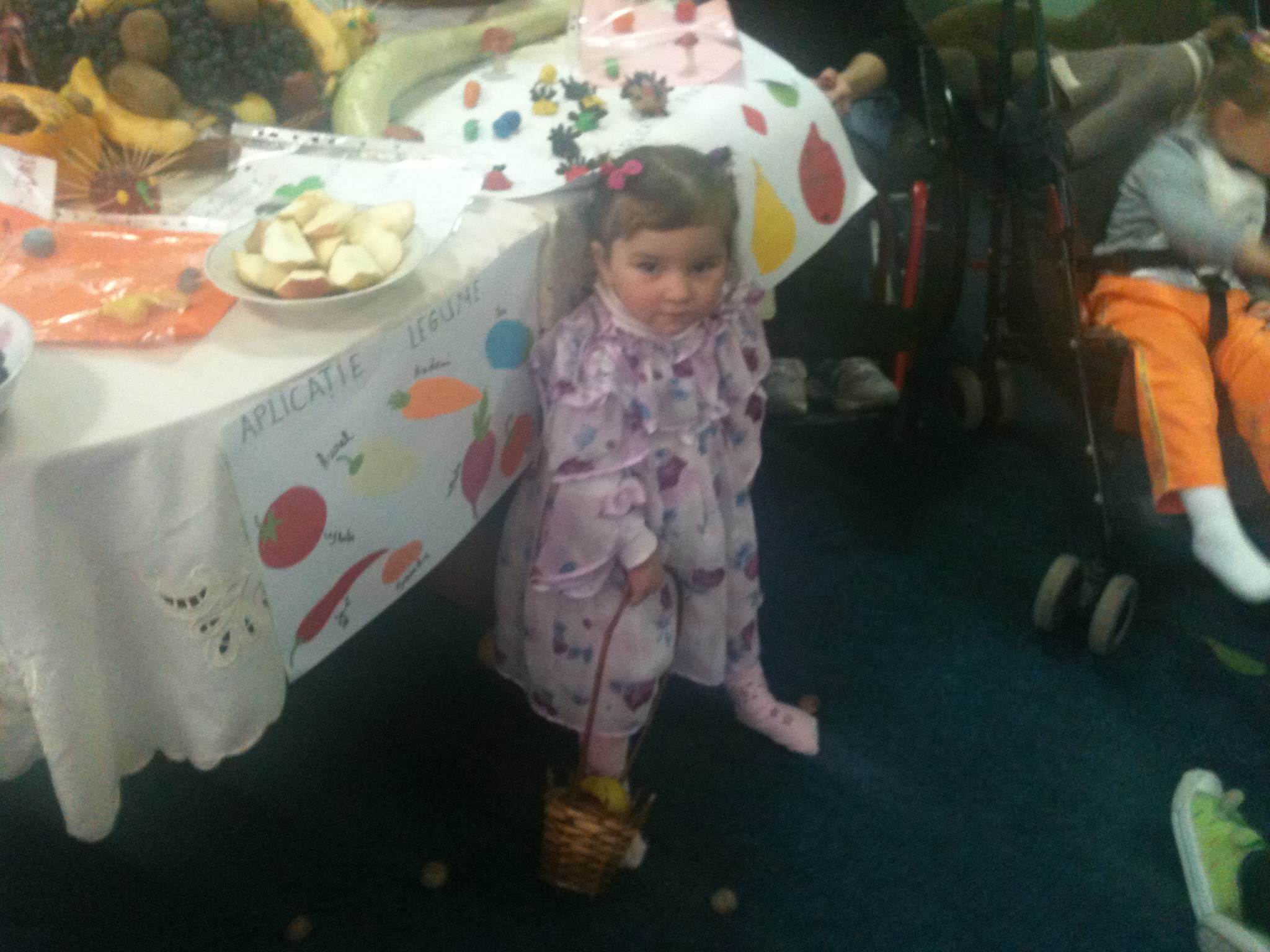
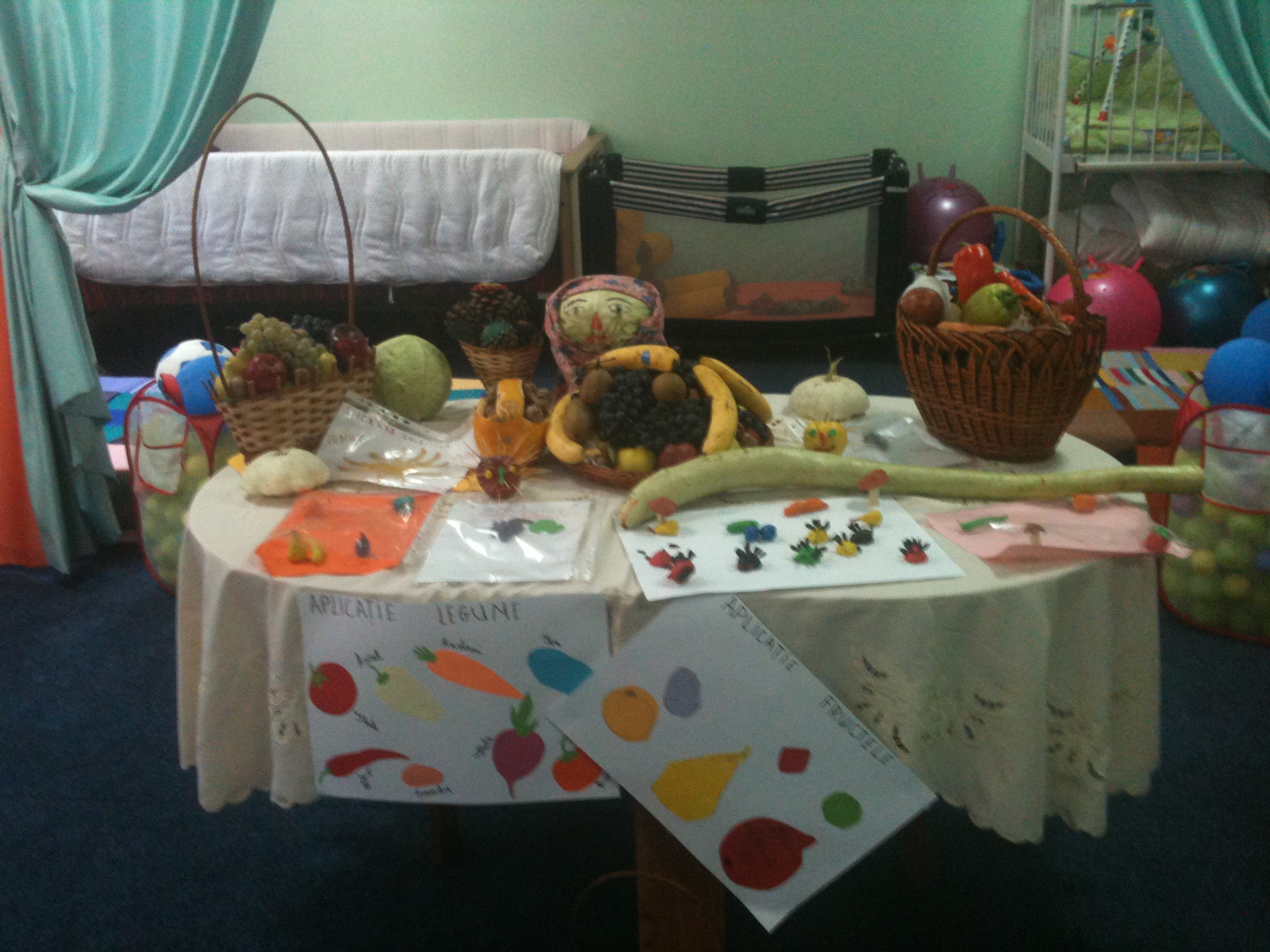
Table set for Harvest Day celebration

I know all about these women’s children and husbands and parents and siblings and favorite foods and sleep habits and even whether or not they wear pajamas to bed at night (that was a funny conversation.) I know the deals they get on cartofi and pâine at the piața and where the best place is in Hîncești to buy a torta. I hear about their frustrations with wages and government and the transportation system and the dismal prospects for finding affordable apartments in town. What is still hazy and ambiguous to me, however, is the details relating to the work I am supposed to be doing at the center and how I can really be of service to these people and their organization.

Daria has the wisest smile

When we were in PST, we received a lot of training on how to be a good Community Organizational Development Advisor. And all of it looked good on paper and made in sense at the time, in theory. But once you get to site and actually are faced with the bureaucratic complexities and inherent dysfunction of the NGO landscape in Moldova, it all becomes a bit overwhelming. Funding, operating, and sustaining a non-profit in Moldova relies on a set of circumstances much different than those I was accustomed to in the states. There, one generally seeks grants for “startup costs” either to begin a new NGO or to implement a new program within an existing one. And for that grant to be funded, one usually needs to have a pretty solid plan for making the NGO or program self-sustaining by the time the start-up money is spent, from government contracts or insurance revenue or corporate support from businesses attempting to burnish their image with consumers. It makes a lot of sense and generally works (at least when times are good and the economy is doing well.)
In Moldova, it doesn’t work this way. There are no government contracts or insurance companies or big businesses seeking positive public relations. I am still too new and unschooled in the realities of the post-Soviet economy and governance here to analyze the specifics of the problems, but it is pretty easy to discern from just looking around that there is little investment being made in any sort of commonwealth. Whether this is because of a lack of available revenue or because people don’t see the value in putting money aside for the public good, I don’t know. But I am getting firsthand experience of life in the sort of environment that results from not funding a social safety net or wanting to invest in public infrastructure. And let me tell you, it’s not pretty folks.

Staff, kids, parents, and volunteers!

So far, I am helping primarily through smiling a lot and being cheerful. This seems to bolster everyone’s spirits and keep them hopeful for the future. Because come January 1, we have no funds for salaries. My partner is currently applying for a grant being offered by a Swiss organization; this is round two of keeping the organization afloat. There are no prospects, at least for now, of the city providing funds or of being able to charge a reasonable amount for our services. However, if we can increase the client base and reach out to more communities, there is a possibility of being able to generate enough income to make the center sustainable.

Dining room mural, which speaks of the joy and hope children bring to our lives

This will depend on whether there are enough parents with disabled children able to find jobs and work, and make enough money to pay a fee for their children to receive services. It is a big IF in this country. Most families with disabled children have had to put them in orphanages in order to be able to work in the first place; keeping them at home is a relatively new concept for Moldovans. Traditionally, disabled persons are viewed as a liability and are discriminated against in civil society. There have not been many incentives or strategies formulated for families to care for them at home.

My partner Ana with Ion

Meanwhile, take a walk across town and try to avoid getting hit by one of the many late model BMWs or Mercedes Benz flying down the streets. Stroll by the McMansions behind wrought iron fences at the top of monument hill. Notice the kids chatting on iPhones in the seat in front of you on the bus into Chișinau. And see the D&G sunglasses that the young women display conspicuously atop their heads on even the cloudiest day.
My, my, my, my, my. I’m not really as far from America as I might think. Perhaps our values – at least some of them – are not that difficult to adopt, after all. And providing a different perspective on those values is something that I plan to make a BIG part of my Peace Corps service in Moldova.

And finally – one for you mom! Me in my office.

Life in Retrospect

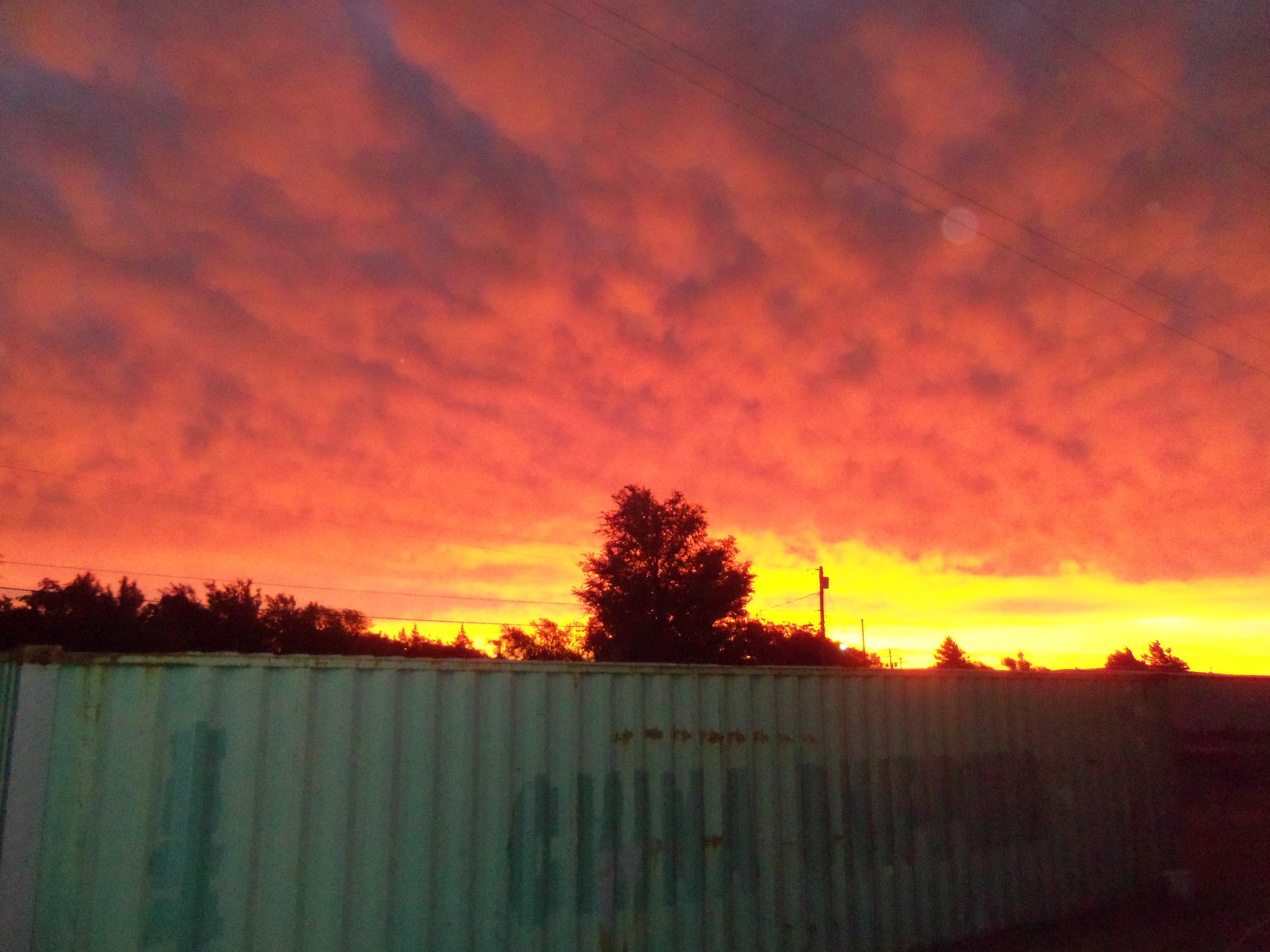
Sunrise Great Bend Kansas

Last year at this time, Mike and I were in the middle of a cross country trip across America, an impetuous odyssey we embarked upon like a pair of draft horses suddenly finding themselves loosed from reins, harness, and dray.  We were giddy, light, unencumbered, reminiscent of nineteen, only this time we had a late model vehicle and plenty of cash to fuel the experience.  As I remember it, it was four months of almost uninterrupted bliss.  I loved sleeping in tent, having no kitchen to keep, no floors to scrub, no schedule to mind.  We were free to travel the little chicken scratch roadways off the main arteries whenever the mood would strike us or stay for an extra day in a particularly picturesque local on a whim.  We walked miles and miles of trails, listening to water run over rock and birds cry in bottomless sky.  We cooked under trees and brushed our teeth beside lakes and stood silently before Technicolor sunsets.  We met interesting characters, treated ourselves to expensive restaurant dinners once or twice, and spent countless quiet nights huddled in camp chairs watching movies on a computer perched atop an ice chest set between us.  We lived for a month in a creaky cottage perched behind the dunes of a tiny beach town on Chesapeake Bay.  I have a multitude of pictures from that trip and I keep returning to them again and again and again these days, longing for the gratuitous expanses of America that taunted us just beyond the windshield for a magic season in our lives.

Our tent in Shenandoah on this same day last year
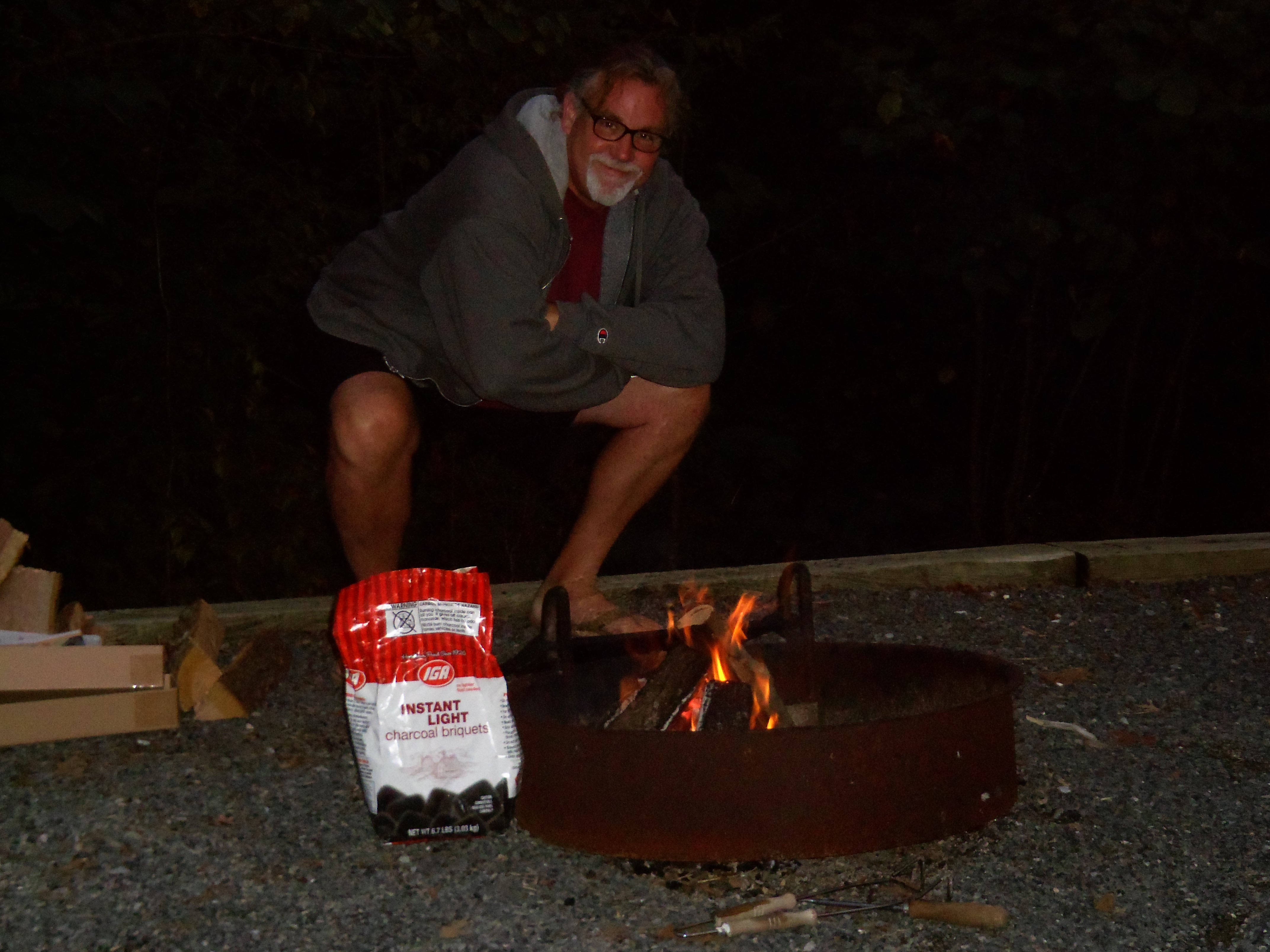
Mike makes fire!


Why is life so much kinder to us in retrospect? How artfully it soothes us by softly tinting and blurring our memories, embellishing and erasing as needed to make the captured occasion coyly play to our looping hunger for dramatic fulfillment. Life seems fuller, grander, more satisfying in retrospect, whereas our daily life in the present often seems fraught with cotton balls and mush. The soporific of ennui is so pervasive, pernicious, and stultifying, it dulls our senses and makes now less preferable to then.  We don’t know how to engage our boredom, where to find its chokepoint, how to lay our fists about its bland face.  We only feel ourselves increasingly short of breath, narrowed down, pinned in, suddenly beige and unsatisfied.  And that’s when we clutch about spastically, searching for a lifeline somewhere amidst the photographs forever bobbing in our wake, little pincushion reminders that every once in awhile we are granted a reprieve, jolted alive and awake for a period of time when it all made sense and environment, emotion, and intellect were all knit together in a warm and recognizable pattern that comforts us to look upon later.

Pensacola west

I shored up some more of these life savers again during the last two weeks – capturing scenes and freezing impulsive actions that will serve as nourishment over the long, lonely months ahead.  I could not explain to you why people I met four months ago have become so large and significant in my life.  Perhaps because those photos of America are receding now on the horizon, despite my desperate attempts to anchor them vividly in my mindscape.  The human mind searches for purpose, endlessly trying to trace patterns, establish significance, imprint meaning into experience.  This is the mechanism of memory – the why of remembering one thing over another.  Perhaps it is also why the memory of something tends to be so much richer sometimes than the actual experience was when it occurred: it has the opportunity to soak in and establish connections with other memories and become embellished by subsequent experiences and tie together all the loose, unarticulated longings that reminiscing can evoke.

America may be out of reach for awhile, but it is good to know that other memories are being formed right where I am now.

Poftă bună

my surprising fantasy…

So I guess when I find myself lingering over an internet news story illustrated with a picture of a Big Mac, it’s time to start to talking about food.  I’ve managed to steer clear of the subject pretty handily for the last three months, other than giving sidebar compliments to my Stauceni host mom for her “healthy cooking.”  It was healthy, primarily, for being composed almost entirely (other than a tablespoon of oil here and there) from items plucked directly from the ground outside her kitchen door.   I ate soup (or ciorba, as they call it) for breakfast, lunch, and dinner.  Cold, lukewarm, and sometimes hot.  This had nothing to do with the weather, but rather when she might have prepared it and how long it had been sitting in the beci since then.

Honey, I Shrunk the Plates

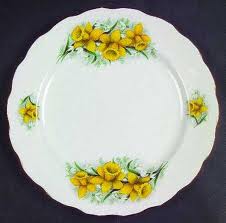
You’ve all heard of Super-sizing your meal, right? That’s what we do in America – take reasonably sized things and inflate them to gigantic proportions: cars, houses, airplanes, hamburgers, sodas, boobs, lips, waistlines.  Well in Moldova, they haven’t quite caught up yet.  Everything is micro-sized. Or maybe it’s actually normal-sized and I’m just myopic in registering things on this scale.  Honest to god, their plates are six inches across.  They look like saucers.  I thought they were saucers when I first arrived and I kept searching through the cupboards for the dinnerware.

Moldovan plate only slightly smaller than actual size

Small plates actually equate to small portions – who would’ve thunk?  Dietetic problems solved – bingo!  One starts to realize how much was being previously consumed after finishing the micro-sized portion and not yearning for more.  Now, this can be partially attributed to the relative blandness of the composite ingredients – there are not a lot of fat/carb combinations stimulating the production of insulin and keeping the engine of fork to mouth churning.  But I think, for me, the very act of having a smaller portion in front of me (and not being the one in control of the portions or distribution) has changed my experience of eating altogether.  Since I actually eat more slowly (the food is just not that exciting) there is time for my brain to register that my stomach is full and I can blithely refuse the second helping that Moldovans are seemingly obligated to offer (probably because their plates are so small.)

What’s Cooking

While Moldovan cuisine isn’t bad by any means, it isn’t built on a distinctive melding of complex flavors.  There doesn’t seem to be the potential for artistry or creativity that propel some other ethnic foods to world-renown status (the French and Italians pop immediately to mind.)  I know some of my fellow PCVs would argue this point, but to me one cook’s placintă tastes pretty much the same as the next person’s.  I like sarmale, but it’s comprised of basic ingredients –  meat of choice (usually pork,) rice, onions, tomatoes, broth, with some dill and bay leaves stewed on the stove for a couple of hours, then wrapped in grape leaves and steamed for an hour or so.  Tada.

Lunch

Their cheese (brinza) is made, oftentimes, from sheep or goat milk and has a very distinctive, shall we say pungent, taste.  It doesn’t melt well. Butter is expensive and used sparingly – primarily as a spread (along with mayonnaise and ketchup – yuk!) on white bread.   Their herbal potpourri is limited (but maybe that’s because I can’t read all the Russian labels?) Meats – the ones cured from their farm-grown ducks, chickens, pigs and rabbits – are VER Y lean and spare.  (These aren’t animals that’ve enjoyed a pharmaceutically-enhanced, hormone stimulated, grain fed existence. A whole chicken here doesn’t contain near the amount of meat that’s in a two-piece lunch meal from El Pollo Loco.)  There is no brown/wild /jasmine rice, quinoa, barley, bulgur, faro, millet, or wheat berries to be had.  There is white rice, corn meal, and buckwheat, white flour and semolina pasta.  And plenty of grapes, pears, plums, potatoes, green beans, cabbage, carrots, onions, eggplant, tomatoes, and cucumbers (tons and tons of cucumbers.)  No lettuce, or spinach, or bok choy, or radishes, or radicchio, or leeks, or broccoli, or Brussels sprouts, or fennel. Occasional mushroom of the standard white capped variety.

I guess what I’m trying to convey is that the cook’s palette is very circumscribed.  You eat locally here.  And you also eat they what they’ve eaten for the last two centuries.   There isn’t much imagination or variance that goes into the pot.  Mostly it’s some combination of vegetables in a broth or sauce with a bit of meat added (sometimes) as a flavor enhancer.  Some cooks rely on pasta and rice to fill up the saucer/plate (my first Nina shunned these staples, but my new Nina is a fan. I don’t eat with her much.)  Putting cabbage and potatoes in a pastry (placintă) is a national favorite.  So is wrapping rice/meat fillings in grape leaves (sarmale.)  Zeama or ciorba de pui (sour chicken soup) is eaten two to three times a week.  Cold, for breakfast.

Anyway.  I have found my lifelong gusto for all things culinary has abated here.  Food is fuel.  That’s about it.  Mostly, it bores me.  I do get a brief frisson when I know the kitchen is clear and I can go in and wield a knife on the cutting board, but the dearth of stimulating ingredients when I open up the refrigerator soon quells it.  How many ways can one slice and dice vegetables?  Without an oven or food processor or crock pot, I’m kind of running thin on ideas.

Poftă Bună

With all the aforementioned now said, I must emphasize that Moldovans – like most cultures – use food as a primary mechanism for displaying graciousness, appreciation, inclusion, and nurturance.  They want to feed you.  PST devotes an inordinate amount of hours to discussions about food.  Yes, they tell which  foods to avoid and instruct on boiling water and sanitizing cooking implements and warn about checking label dates.  But they also provide guidance on how to politely refuse a third helping (customary politeness dictates acceptance of the second one, but not all of us are polite.)  They suggest tactful means of explaining that one doesn’t need to ALL the food that has been prepared in order to convey one’s appreciation to the cook.

I think this treatment of food as a bounteous expression is most beautifully illustrated by the Moldovan phrase “poftă bună.”  The word loosely translates as „bon appetit,” however, in other idioms the word poftă can also mean to lust for or after.  (And ”poftim” is an interjection with a variety of useful applications, from ”here you go” to ”pardon me” or ”Wtf?” – my interpretation, not the dictionary’s.)
In America, we enjoy our food with the best of them.  But we don’t regularly wish anyone sitting down to a meal “eat with lust!” or “Go for the gusto!”  But Moldovans do.  If any Moldovan, from five to seventy, walks into a room where someone is eating they say “poftă bună.” When someone hands you a plate of food, he says “poftă bună.”  When a server delivers you a bag of potato chips – “poftă bună.”  When a newly arrived guest joins the dinner table, be prepared for the refrain.  It’s ingrained in them, just like “gesundheit” or “god bless you” after a sneeze is for others.

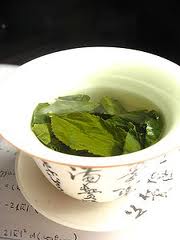
Chai

Anytime I bring a friend into the apartment, Nina immediately prompts me to offer them chai.  When I try to tell her it’s not necessary, the person either doesn’t like chai or has only swung by to pick something up, she conveys a grudging but reluctant understanding through a barely tempered glare of disapproval.  I am not acting graciously in her mind. Moldovans will offer you chai if you look in their front gate as you’re passing by.

Perhaps it’s a good thing that I’m just not that into their cuisine.  Otherwise I might weigh 50 pounds more at the end of my service.  And that is definitely NOT on my Peace Corps agenda.

Dance, World.

So today is the 11th anniversary of 9/11.  Not necessarily a time period that will garner huge headlines back home, but – because I coincidentally referenced 9/11 in yesterday’s blog – it was in my mind as one of those shared experiences that, unfortunately, create a separate cultural context for me and my fellow PCVs from that of our Moldovan counterparts.  And that’s a shame.  Because it is through fostering that sort of subtle, but seemingly insurmountable divide, that those who wish to “terrorize” us win.

Yet it also put me in mind of a wonderful cross-cultural experiment that one crazy American is carrying on throughout the world: Matt Harding dances and is encouraging people to join him in rollicking troupe performances at locations across the planet.  You can read his whole story here, and I really encourage you to take a moment and do so, because it is one of those heart warming tales that affirm our best aspirations and that will breathe fire into whatever little fantasy might lurk in the wee morning hours about taking your life and propelling into a whole new trajectory.

Matt, for me, is the quintessential expression of everything that is uniquely, wonderfully amazing about Americans.  His ability to spread joy and create a shared space for exuberant fun and laughter is the BEST weapon I know for fighting the effects of terrorism.  I think the United States government should sponsor Matt, and others like him, to travel the world and spread the infectious exhilaration that being silly and energetic and jubilant together can germinate.  I defy anyone to watch this video and keep a smile from leaking across your face.  To paraphrase John Lennon: let’s give dance a chance.
So, as my friend Patty likes to say, “Put on your dance pants” before clicking: Where in the hell is Matt?

Here are the lyrics to Trip the Light, the song that everyone in the world should get to dance to, together, someday:

If all the days that come to pass

Are behind these walls

I’ll be left at the end of things

In a world kept small

Travel far from what i know

I’ll be swept away

I need to know I can be lost and not afraid

We’re gonna trip the light

We’re gonna break the night

And we’ll see with new eyes

When we trip the light

Remember we’re lost together

Remember we’re the same

We hold the burning rhythm in our hearts

We hold the flame

We’re gonna trip the light

We’re gonna break the night

And we’ll see with new eyes

When we trip the light (x2)

I’ll find my way home

On the western wind

To a place that was once my world

Back from where I’ve been

And in the morning light I’ll remember

As the sun will rise

We are all the glowing embers

Of a distant fire

We’re gonna trip the light

We’re gonna break the night

And we’ll see with new eyes

When we trip the light (x3)

Right back at you, al Qaeda!

Private Idaho

This slideshow requires JavaScript.

One of the more difficult aspects of my service in Hîncești is having to live with a roommate – or sora gazda, as she is called here.  Nina is always gracious and warm to me, but it is still strange to move in with someone you just met and whose language and culture you are still learning.  The most difficult part about it is being in another woman’s kitchen and bathroom – very intimate and personal places for most women, at least in the United States.  I am still not comfortable leaving my shampoo and razor in the shower, or storing my towels in her bathroom cabinet, or intruding into the kitchen cupboards with baking supplies, or preparing a full-fledged meal when she is at home.  It feels as if I am encroaching on her habitat; after all, I’ve been here about six weeks now and she still has her clothes in the wardrobe and pictures of her daughter hanging on the wall in my room.  I feel more like a transitory guest here than a renter with a two-year contract; perhaps I will move beyond this feeling in time, but for now, I keep my activities very circumscribed when she is at home and mostly live in my room.

So, on the weekends when Nina travels to her village farm, I get pretty excited.  Almost like I’m a teenager again and my parents have left me at home alone.  Only instead of breaking out the bong and beer keg, I buy pasta, tomatoes, and garlic and do some cooking.  On Sunday, Lindsey came over and prepared a bunch of wonderful salads – egg, potato, and cabbage with carrots – that furnished a relaxing picnic by the lake. (Lindsey is an accomplished cook and loves to experiment in the kitchen; I have been the lucky recipient of a couple of her concoctions!)

Matt and Patty H joined us.  I spend a lot of time with these three so it’s a good thing we all get along. In fact, it is beginning to concern me the amount of time that we spend together.  It is too easy to find comfort in the company of the familiar – no matter their age, gender, or provenance, they are AMERICANS.  People who immediately understand a reference to Walmart shoppers or reality TV shows or soccer moms or Starbucks.  (Ok, Matt and Lindsey probably don’t know who Eldridge Cleaver is, but how often does his name come up, really?) You don’t realize how much these shared cultural allusions pepper conversation, standing in for extraneous explication, allowing one to abbreviate and link ideas more efficiently.  It’s truly gratifying just being with people that come from the same place you do – and now that place stretches the length and width of the nation.  I am amazed how much I have in common with people with whom I would never have imagined being friends.

The most trenchant experience, I’ve found, that Peace Corps provides is to continuously drop you in social contexts which you would never elect at home.  Some are more comfortable than others.   But in every case, you learn more about yourself: you attain new altitudes of tolerance, irritation ,adaptibility, diplomacy, patience, curiousity, and compassion.  It is a common experience for us to have different personas or  „masks” that we wear in different situations.  But here, it’s as if the change goes deeper.  Being thrown together with a group of people that would ordinarily never coalesce within my purview, and then sharing such startling and foreign circumstances with them, changes the channels of my emotions, my reasoning, and my needs.  I think differently, feel differently.  My inner space is expanding, accommodating more and simultaneously losing landscape quickly.  Things are mobile, transitory.  And I hold on to these Americans in a desperate effort to grasp those orienting touchstones slipping from my world.
Moldova is very different from other foreign countries, like Guatemala, or Peru, or Ecuador, that I’ve visited.  In those places, being from “America” (read the USA) made you special, as if there were an invisible halo surrounding you, or your fingers emitted sparkles, or your laugh tickled people’s funny bone.  In those places, the children would gather round me in puddles, lapping up my attention, fingering my clothing like it was made of stardust.  People smiled spontaneously at me on the street.  I felt a little like a Kardashian, celebrity as categorical referent.  Moldova? Not so much. In conversation, I have asked Mldovans about 9/11.  Disneyland.  Hollywood.  The Golden Gate bridge.  Nope. Nah, no ințelege.  Not a clue.  How do you find common ground with someone whose never hear of Batman?  Mickey Mouse?  Star Wars?

Sunday, I found myself lying on my back on the grass, watching the clouds roil above me and listening to conversation (eu ințeleg) drift over me.  The sun was diamond glinting the lake and birds were skittering through the reeds. Almost, I could have been lying by a lake in Orange County.  Just for a moment, a small enclave carved itself out from the turbulence of the past three months and gleamed warm and radiant.  And I realized that I was retreating into another safe haven, that I have made my site mates into my little private Idaho (another cultural reference.)  And the final step in my  integration will be to attain this level of comfort in the house where I live with the person that is my roommate.

When (if) I do, I will have achieved one important goal of this journey.

 
If all the days that come to pass
Are behind these walls
I’ll be left at the end of things
In a world kept small
Travel far from what i know
I’ll be swept away
I need to know I can be lost and not afraid
Remember we’re lost together
Remember we’re the same
We hold the burning rhythm in our hearts
We hold the flame
..
I’ll find my way home
On the western wind
To a place that was once my world
Back from where I’ve been
And in the morning light I’ll remember
As the sun will rise
We are all the glowing embers
Of a distant fire

Dancing the waltz

Anais Nin and Henry Miller

I will admit that I spend more time on the Internet these days (and I didn’t know that was even possible) since the work site I have been assigned to won’t open until September 1 and it’s back to being a bloody inferno outside.  Because I have so much time to surf, I fortuitously encounter different articles from divergent sources that somehow overlap or coincide, amplifying each other’s message and causing the information to echo through my brain for several days.

Here’s one example.  On Monday morning I received my weekly newsletter from Brain Pickings, a website I highly recommend if you want to be served a veritable smorgasbord of interesting information dipping into such varied topics as art, design, science, technology, philosophy, history, politics, psychology, sociology, ecology, and anthropology.  There was a piece culled from the third volume of Anais Nin’s diary, wherein she transcribed a letter written to her by Henry Miller. He is describing the synergy of altruism:

“For me it is no problem to depend on others. I am always curious to see how far people will go, how big a test one can put them to.

Certainly there are humiliations involved, but aren’t these humiliations due rather to our limitations? Isn’t it merely our pride which suffers? It’s only when we demand that we are hurt. I, who have been helped so much by others, I ought to know something of the duties of the receiver. It’s so much easier to be on the giving side. To receive is much harder — one actually has to be more delicate, if I may say so. One has to help people to be more generous. By receiving from others, by letting them help you, you really aid them to become bigger, more generous, more magnanimous. You do them a service.

And then finally, no one likes to do either one or the other alone. We all try to give and take, to the best of our powers. It’s only because giving is so much associated with material things that receiving looks bad. It would be a terrible calamity for the world if we eliminated the beggar. The beggar is just as important in the scheme of things as the giver. If begging were ever eliminated God help us if there should no longer be a need to appeal to some other human being, to make him give of his riches. Of what good abundance then? Must we not become strong in order to help, rich in order to give and so on? How will these fundamental aspects of life ever change?”

Miller manages to make so many points here pertinent to my situation in Moldova that I wonder if perhaps he’s been peeking over my shoulder some days from wherever his juicy spirit happens to be oozing right now.

Peace Corps Volunteers – in all countries where we serve, I would venture to say – are involved in a delicate dance with their host country nationals.  We are giving to them, of our time, our expertise, our education, our energy.  But they are reciprocating: they are opening their homes and work places, teaching us their language and customs, sharing their food and wine, welcoming us in to important life events and celebrations, such as weddings, baptisms, and funerals.  Think about how difficult it might be to have a stranger show up at your door one day for a two year visit – one who does not know your language or cultural norms, much less recognize or respect your little idiosyncratic daily routines.  You need to familiarize them with your town, where the market is, the bank, the pharmacy, who the neighbors are and which places maybe dangerous or unsafe after dark. You need to show them where they can buy a hair dryer and how to hand wash their clothes.  Perhaps they don’t know how cook.  Or make a bed.  Maybe they are messy – even dirty, tracking mud throughout your home when they keep forgetting to remove their shoes at the door.

Then think about including this person into all your most emotional and memorable family events, taking them to your sister’s birthday party, your daughter’s graduation, your niece’s wedding, your father’s funeral, and having to watch out after them the whole time so they don’t do something culturally inappropriate like slap your aunt on the back or hug your brother when they are introduced or collapse on the ground in a heap if they’ve danced too hard or had one too many vodkas.  One must possess a true wealth of spirit and a large portion of patience to continue giving of oneself through those (perhaps seemingly endless) two years.

I won’t go into detail, but I did hear one story from a volunteer who was disrobed, bathed and cleaned like a baby, put to bed in crisp sheets, and had the bathroom swabbed of her mess after a bout of giardia that had her spewing from both ends.  (Did I mention there was no toilet – only a flimsy trash can – in said bathroom?)  And this all took place within minutes of her meeting her host parents. And the father was just as solicitous and nurturing as the mother. So there is definitely give and take going on here.

And this odd waltz can take place precisely because of the manner in which Peace Corps operates: it is coordinated and supported aid that doesn’t involve giving money to the “needy” – it is all about extending a hand of service within an intimate context that allows both the giver and receiver to participate fully in the exchange and to take the lead at different times.  And that hand can be extended by anyone – rich or poor, educated or ignorant, male or female, old or young, privileged or needy.  We can all be generous in spirit, in caring, in listening, in sharing, in inclusion, in opening ourselves to each other.

So after having had this Miller piece slosh around in my head for a couple of hours, I happened upon the following story on the NPR website about a new study published in the Chronicle of Philanthropy:

Study Reveals The Geography of Charitable Giving

For those of you who can’t bear to leave my scintillating expository, I extract a few pertinent quotes here:

Ever wonder how charitable the people are who live in your state or community? It turns out that lower-income people tend to donate a much bigger share of their discretionary incomes than wealthier people do. And rich people are more generous when they live among those who aren’t so rich.

…. High-income people who live in economically diverse neighborhoods give more on average than high-income people who live in wealthier neighborhoods.

Paul Piff, a social psychologist at the University of California, Berkeley, says that’s consistent with what he’s found in years of research on income and giving.

“The more wealth you have, the more focused on your own self and your own needs you become, and the less attuned to the needs of other people you also become,” he says. “Simply reminding wealthy people of the diversity of needs that are out there is going to go a long way toward restoring the empathy or compassion deficit that we otherwise see,” he says.

The NPR article concluded that it is important people see need first hand by integrating into heterogeneous neighborhoods that are economically diverse.  And I would amplify that thought by saying this is true not merely because those who see need will tend to be more generous, but because it is imperative that we allow the osmosis, the synergy, the waltz of generosity to be fully and deeply expressed by both the giver and the receiver.  And that can only happen when we are not isolated from each other, when we become part of the fabric of each other’s lives, when our homes and neighborhoods and customs and idiosyncratic behaviors are no longer “foreign” to each other.  I love Peace Corps for illustrating the truth of this, each and every day, all over the world, amongst thousands of dancing partners.

There are merits to playing both roles, to attaining the flexibility and humility to both lead and be led. We Americans must realize that the money and material goods some of hold in relative abundance are not the only sources of wealth that exist in this the world.  And that, perhaps, a much greater gift is presented sometimes by standing in the role of receiver.

I know most of you out there are not going to run out and join the Peace Corps.  But realize that you can give by receiving, too.  By stopping to talk to that person asking you for money on the corner, allowing him to tell you his story.  By accepting the dinner invitation from the couple that bores you to tears and just keeping your heart and mind open for a few hours.  Perhaps through attending the dance rehearsal of your next door neighbor’s granddaughter and clapping vigorously and enthusiastically.  Or going to the ethnic festival in your community center and participating in the dances, eating the food, and intermingling with people from diverse backgrounds.

Try putting yourself in places you normally avoid, meeting people that unnerve you just a bit, stepping outside of your comfort zone and risking humiliation by joining in the waltz maybe once or twice a week, all in the spirit of dancing.  Go ahead: I challenge you.  I’m doing it.

(And I’d love to hear any comments on what it felt like …)

Floored

Floored

There is no other way to put it.  I wandered down the road just above my apartment building and found this:

Hîncești Lake

I don’t know what else to say.  (Of course, I always have more to say.)  I wrote in my journal:

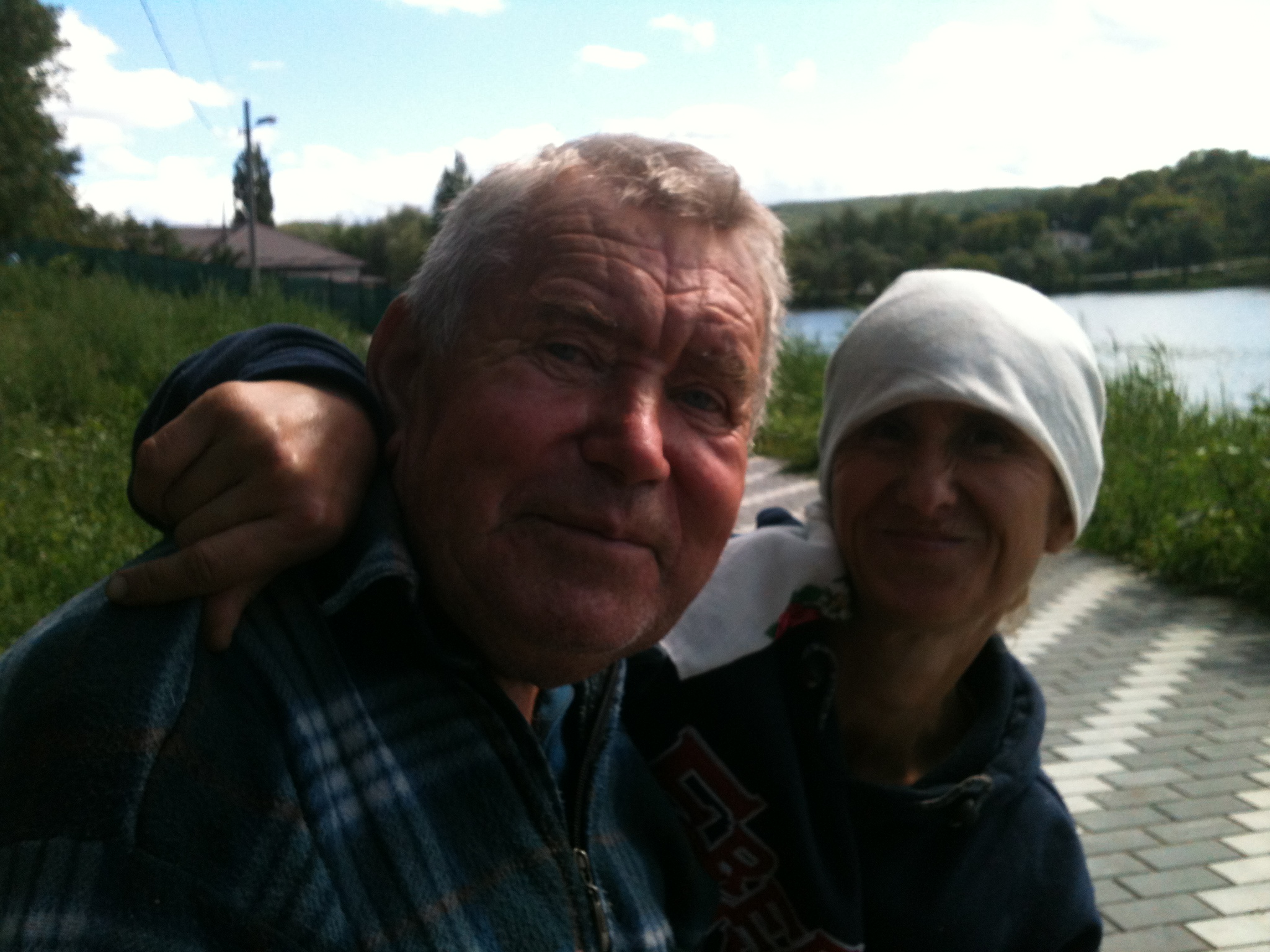
What did I do to deserve this?  I finally, finally found the place where I can be completely at home here.  The language, the culture, the buildings, the corruption, the sadness, the confusion, the disparity, the discomfort – none of that intrudes here.  Though I did have a half hour conversation with two seemingly homeless, mentally ill folks who sat down on the bench next to me and shot me questions in Ruski-romanian .  They really wanted to know when we could hook up again…

Friends at the Lake

I appreciated the opportunity to converse really slowly and repetitively with people who were happy to play along.  I am blessed.

As I was soaking up the last of the afternoon rays I got a text from my site mates, Matt and Lindsey.  I made my way to the bar next door to my apartment and spent a relaxing couple of hours with them, comparing notes on how lucky we are to live in Hîncești.  Patty was walking by and heard my laugh (mom, are you listening?)  and then we were four.  Patty just moved to site today, having completed her 10 week English Education Training.  Took her oath this morning.  Now the whole M27 group are officially Peace Corps Volunteers!

Matt
Patty and Lindsey

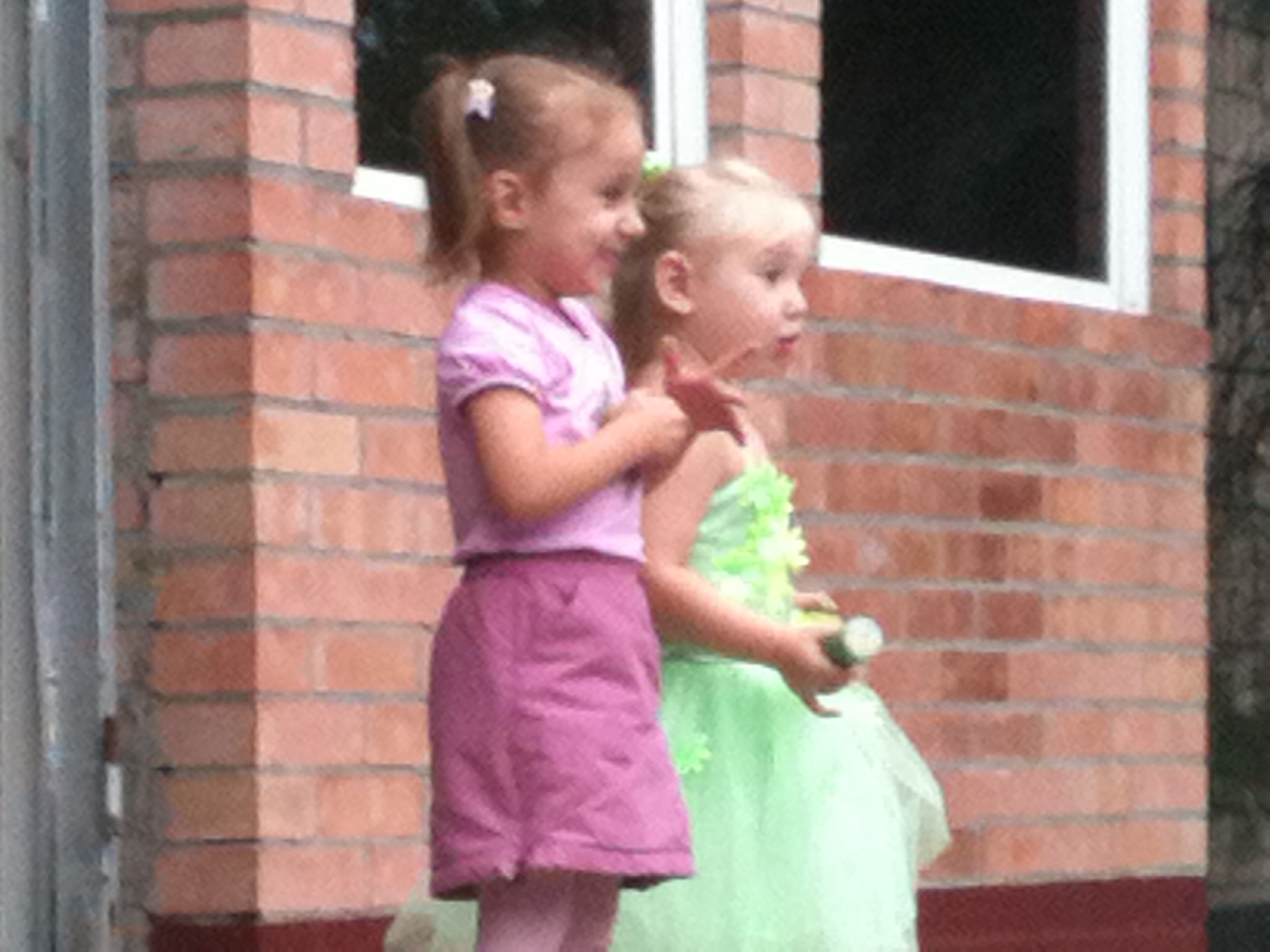
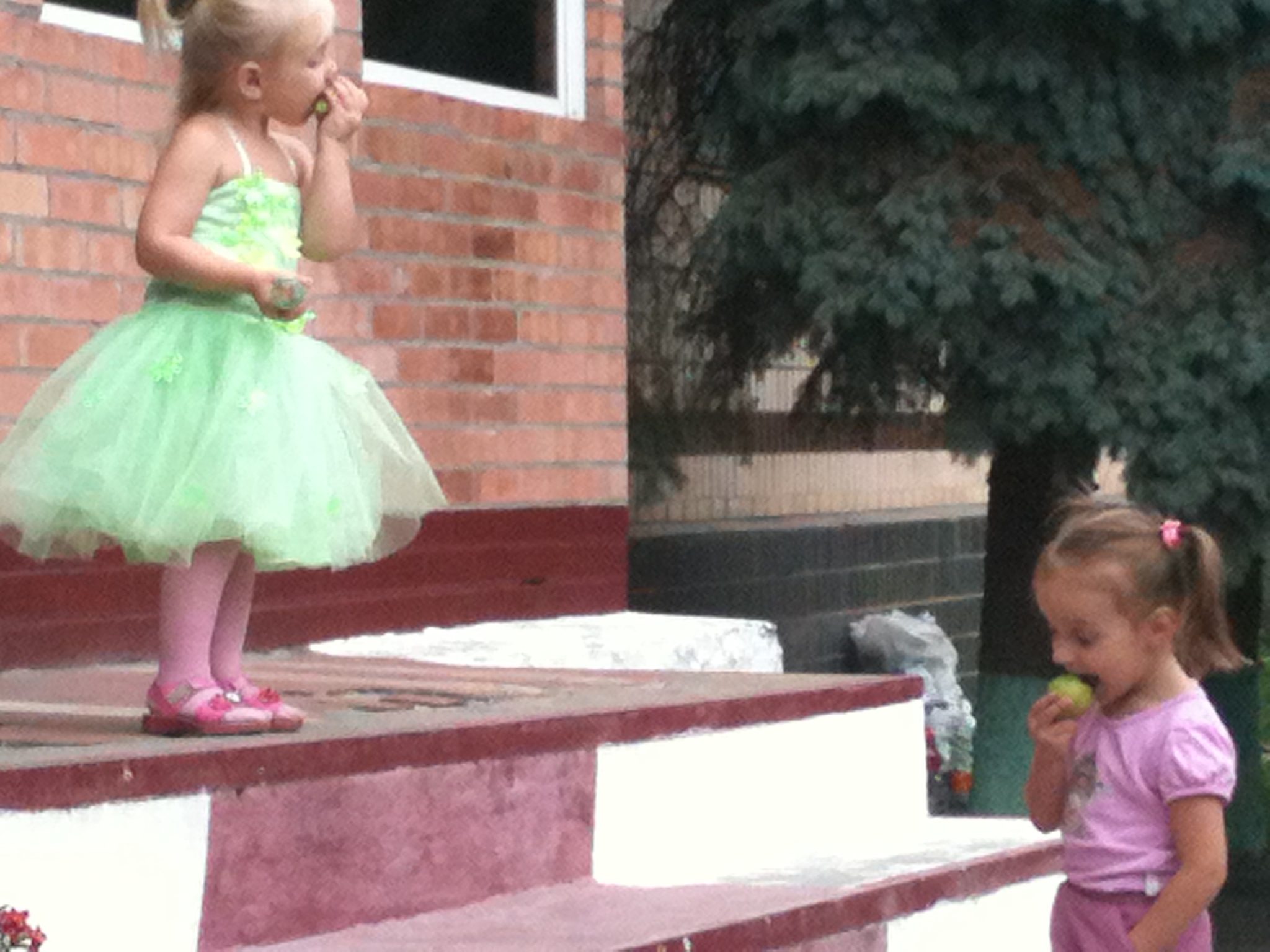
I don’t know what these adorable little girls were doing in the bar, but they certainly provided a whimsical touch:

I felt a bit like her, finally having put on my tutu and ready to dance for the world.  I have some good friends, a great host sister, an energetic work partner, and a bustling village in which to live for the next two years.  The Peace Corps is proving to be everything I wished it would be…I am so blessed!

Prima Zi

Proud parents

This last Sunday I arose with some little trepidation (I’ll admit it) and put the last stray items into my luggage in readiness to move to my final destination.  It has been a long journey that brought me to this point, all the way from my sallying cry in the dark so many years ago.  It was not registering completely that this trip in Terry’s van would probably be my last ride in a personal vehicle with all my luggage in tow while I’m in Moldova. (When you leave the country at the end of your service, for some reason you have to find your own way back to the Peace Corps offices and the airport.  Hence, most people leave most of their things here, only taking back the REALLY important stuff….)

When they arrived – Ana, my work partner, and Eduard, her husband, and Terry, the driver – we had to haul my luggage out from the apartment all the way around the building to the front to the car, because of course I couldn’t manage to open the gate into the parking lot.  (This was the beginning of the end of my ‘healed’ knee.)  On the way to Hîncești we stopped at a store called Metro, which I heard about but didn’t quite believe existed.  I was wrong.  Costco has married WalMart and moved to Moldova.  Here is a huge warehouse store with everything from dish soap, to washing machines, to socks, to watermelon and cheese.  All under one tin roof.  For a nation of bus riders.  That’s right.  You know how much you buy when you visit a warehouse store….well imagine transporting all of that home on a jam-packed rutiera.  I don’t get how this works.  But Moldovans are diligent and proficient at getting done what needs to get done, with very little technology most times.  It makes me yet again realize how much consumption we take for granted in the USA.  Ana and I have hesitant conversations, comparing the price of laundry detergent.  We find a bag for 20 lei cheaper and send her husband to put back the more expensive versions we had just picked up.  Terry careens madly through the store, flirting with every woman he sees.  (More on Terry at later time – he really deserves his own post.)  I am feeling vaguely comfortable with Moldovans, not an American in site.  We stuff all our purchases in the van with all my bags and climg aboard for the wild toad ride to Hîncesti. Terry pilots the van somewhat like a flying carpet.  We seem to be zipping a couple of inches over the actual road. Is this better than a rutiera? I think.

I had barely set my bags down and hadn’t even unzipped a suitcase before Nina, my new host sister (I have to call her that as she is my own age – it feels too weird to call her my “host mom”) tells me that we are going to a masa in the small village of Boghaceni in celebration of a four month old baby boy born to a couple for whom she is the “Nona.”

Culture break: A Nona is sort of like a godparent for married couples.  It is a non-relative whom a couple asks to serve as a guide and mentor for them during their married life.  It can be a couple or a single man or woman.  Generally, the person or couple is quite a bit older with some life experience under their belt.  They will help the new couple make big decisions, teach them about parenting, offer advice and comfort during difficult times, etc.  I find this especially perceptive in NOT having it be a relative, as many times married couples can encounter difficulties with parents and in-laws that require some sound guidance to help them through so they don’t make a mess of things.

So we cross the street in front of our apartment building and begin waiting for a ride to this village.  Now ruteiras come by every ten-fifteen minutes or so, but most folks are impatient and try to flag down passing cars that are going the same way.  Of course, Peace Corps advises volunteers against this practice, but everyone does it anyway.  It is a good way to meet Moldovans and practice your language, I guess, but I haven’t tried it on my own.  Now that I’m with Nina, I guess I’m ready to hitch hike (I actually don’t have a choice.  She’s madly flagging down every car that whizzes by.)  A couple of cars stop but they’re either going a different way or they can only fit one person.  We end up in a rutiera just as it starts to rain.

And then it’s pouring.  (Luckily at this point I had not learned of the horrible accident that just claimed the lives of ten people in a 17-seat rutiera that was carrying fifty persons. It’s brakes failed on a curve and the mayor of a town and his wife were among the fatalities.)   I am not looking forward to the walk from the rutiera to this masa, as I left in such a hurry I didn’t grab an umbrella and hadn’t changed out of my sandals.  After about an hour, I hear Nina yell for the driver to stop.  We’re out in the middle of nowhere.  I am confused.  After we disembark, a young man comes up to greet us.  His car is parked right there where the bus stopped.  Oh thank the lord, I don’t have to walk.  We get in his car and proceed down a dirt road that is quickly melting into mud.  He is driving fast, trying to beat the disintegration of traction.  A couple of times I find myself wondering if walking would’ve been better, but the road turns out to be miles long.  The house that we’re going to comes into view ahead – it’s way up on a hill to the right of us and as we slowly drive by it is apparent that the car is not going to make it up the slippery slope of mud flowing down that is probably a road in dryer times.  We exit the vehicle and ponder the slope.  Nina is in high heels, I am in sandals.  The young man grins, grabs my arm, and says: Sos!  (UP!)  Here we go.

Well, this is the second stage of total knee failure.  I am slipping and sliding and clutching at the branches of bushes to my left with my free arm.  Up ahead of me, Nina is slogging on galliantly alone with her umbrella held high and her wedgies sinking inches deep into the mud. Up and up and up.  We finally attain the summit and walk for another few minutes through flat muddy soup and stop in front of a locked gate. The young man – his name is Sergio, I’ve learned during our little ambling duet – pulls out his cell phone and calls his parents, the people we’re visiting.  Are they not here?  Are they still miles away in a rutiera?  If they’re home and they know we’re coming, why is the gate locked?  We wait.  And we wait.  And we wait.  Recall that it’s raining.  Pretty hard.  Me without umbrella.  In sandals.  In mud.  After about 10 minutes, we hear the hearty hey ho of a man approaching the gate.  He is laughing and chattering away in Romanian as he unlocks the gate.  I learn soon enough why it took him so long.  We have another half mile climb up yet another muddly slope to the house above.

We pass through orchards full of pear trees and grapes hanging off the vine.  There are more tomatoes (roșii) and watermelon (harbuz) than we saw at Metro.  Another orchard with plum trees, the fruit being the actual size of the prunes that they will become later upon drying in the sun (pruna.) Some corn that looks sere, droopy and tattered from the (former) lack of rain.  Finally we pass what smells like the outhouse.  Good, we must be getting close, I think.

Why am I here again, when I could be back at Nina’s place, dry and unpacking?  Oh yes – the all important „integration” (I didn’t mess up on the quotation marks, btw, that’s how they do it in Romanian.)  Not soon enough, we arrive at the front door where three older woman, all wearing kerchiefs and aprons, one with missing teeth and a wandering eye, one small, anxious boy, and one lithe young woman holding a forty pound baby (no kidding) stand waiting to welcome us.  We remove our shoes and enter into safe harbor.  Thank the lord, we’ve made it, I think.  Now I just have to get down again.  I guess I’ll worry about that later.

There is a mass of food – a masa – spread out on the table before us.  We are given some bread and wine and salt, the traditional Moldovan welcoming gesture and invited to sit.  Nina gives the married couple (Sergio turns out to be the husband) some money and a gift for the baby.  We begin to eat.   For the next two hours it continues to rain outside while we repast indoors.  Wine, food, talk.  More wine, more food, more talk.  Many toasts to America and my health.  The people comment on how well I speak Romanian.  The old man says Barak Obama’s name several times, as it is the only English words he knows.  Nina pulls out her Avon catalogues and goes into a protracted sales pitch which, suprisingly, holds both the men and the women rapt.  Even the little boy is held captive.  Perfume samples are passed out to all.  She’s good.  After about an hour, I note that Sergio is trying to refuse more wine as he reminds them he has to drive us back to the bus stop.  Thank the lord, I think.  He’s only successful about half the time in not having his glass filled.  Oh well, I think.

The masa

When it’s finally time to go, Sergio runs out ahead of time and returns with a nice pair of galoshes for both Nina and I.  Thank you god, I think.  Though there may be no tread on the bottom of these, at least my toes will stay clean and the cuts on my feet will not be infected  with typhoid.  We wash our own shoes in a bucket of rain water kindly provided by the clouds overhead.   And then we ski down the hill.  That is the best term for our meandering sliding progress.  The old man is holding Nina’s arm and Sergio has mine.   I am clutching him in the hopes of avoiding an embarassing face plant.  This is the penultimate stage of knee damage.  (I still have to walk to work tomorrow carrying 20 pounds of books and computer on my back.  That did it in completely…)

The ride back to the highway is a testament to German autobuiders (I think  we’re in an old Audi.) The car weaves wildly on torrents of mud from one side of the road to the other.  Sergio hunches with great concentration over the wheel, smearing his left hand against the inside of the windshield every minute or so to clear the condensation.  One windshield wiper is working valiantly. A car passes us on the left. Seriously? I think.  Nina pats my knee and smiles winningly.  I wonder if she’s going to pull out the Avon catalogue.

When we get to the road, Sergio stops at the bus shelter and leads us inside.  Then he runs back out to the highway.  What a gentleman, I think, waiting to signal the passing rutiera for us. Within seconds he has flagged down a late model Taurus (compete with leather seats and Dolby sound) and he gestures us to climb in with the three burly, bald Russian occupants. Great. Everything the Peace Corps warned me about.  Gangsters, I think.  Note the gold chains and silence. Completely unconcerned, Nina pulls out her phone and checks her voice mails.  The entire way no one talks.  The driver dials a number but gets no answer.  Apparently the human trafficer connection has taken the day off, I think. When we arrive at our apartment, Nina tries to give the driver 20 lei.  He refuses gruffly.  Well how about that, I think.

The grandparents (bunicii)

Later that night, I put brand new sheets on my bed.  I unpack all my bags for the first time since I loaded them up in Fullerton so many eons ago.  I find things I forgot I brought.  I Skype with Rhiannon and Nicole back in the States.  I take a shower and get into my jammies.  It’s still raining outside.  Nina is already sacked out, fast asleep.  The winds whistles and a steady patter of rain drops is like a metronome tick-tocking right outside my window.  A smile spreads slowly cross my face.

My first day in Hîncești, I think.  This might turn out to be a bit of the adventure I’d hoped it would be…

The Big City

Famous portal entering into Chisinau

Time has sped by the last 10 days…with PST over and all my M27 friends departed to site, I thought I was going to have an easy, quiet time in the TDY apartment in Chișinău while I received daily treatment for my knee.  Not so.  It was probably the most busy (and entertained) that I have been since arriving in Moldova.

Let’s begin with the diva knee.  So, I am sent to this NICE apartment right next door to the Peace Corps office with all my bags (suddenly I have even more stuff than I came to Moldova with) after the swearing in ceremony.  There are three bedrooms there, all empty, and a great big kitchen with a microwave, even.  So I’m excited.  I trot off to the market and buy some groceries and cook my very first meal since leaving home.  Then I spend some time reading and I take a bath and I make up a bed and settle in and soon am fast asleep.  RRIIIIINNGGGGG….ring…it’s the telephone.  9:30pm the PC doctor is calling, not to check up on me but to announce the impending arrival of another volunteer.  (I guess she didn’t want me to freak out when the front door opened.)

Well, this volunteer’s arrival marked the start of the week of the revolving door.  In seven days there were eight other people in and out of the apartment for various reasons.  They all stayed for at least a day or two and somewhere in there I heard every single one of their stories, all of which fleshed out for me a more complete picture of Peace Corps Moldova.  It’s complicated.  Just like most other things in life, I guess.  It made me appreciate how unique each person’s service ends up being: even though we‘re all in the same country, we are not having the experience.  Which means that it is impossible to judge anyone else’s outcome or decisions – whether they ET (early terminate) or extend for an extra year or do their proscribed two years and flee back home.  There are a million different reasons for walking many different roads here.  I suppose that’s true of all the PCVs around the world.  But here is a video of my new friends Maria and Katie playing on the teeter totter outside our apartment:

This is the one of the main reasons PCVs say that they love their experience.   We know how to make fun happen with whatever comes along…

My other new friend Maria – in traditional Moldveneasca costume!

Back to the knee: every day I would walk over to PC offices and my own driver would whisk me off to a state-of-the-art medical center (called MedPark – looks exactly like Kaiser in the US) where a lovely aide would spend half an hour giving me various treatments involving magnets, electricity , and sonar.  Another volunteer was getting the same treatments, so we had a chance to chat everyday for an hour or two as we rode there and back and underwent our treatments.  She related a lot of useful info about her year’s worth of time here and she was very funny and entertaining.  My knee felt better and better every day. Life was lovely. (Then I screwed up my knee again my first day at site – more on that experience later…)

I was also invited by a group of the M26s for an evening at an American couple’s house in the outer limits of Chisinau.  He works as an IT specialist for the American Embassy and his wife loves to cook but has no one to eat it all.  So every Thursday they host a buffet meal in a varying theme for any American ex-pat who wants to attend.  The best part of all was their pets – a BIG Sharr Mountain Shepard (never heard of it before that night) and a cat that both craved attention.  And all of us animal-starved people were ready to slather it on.  I felt like I had received a mental health intervention just petting and cooing at them.  Man, I miss my dog.

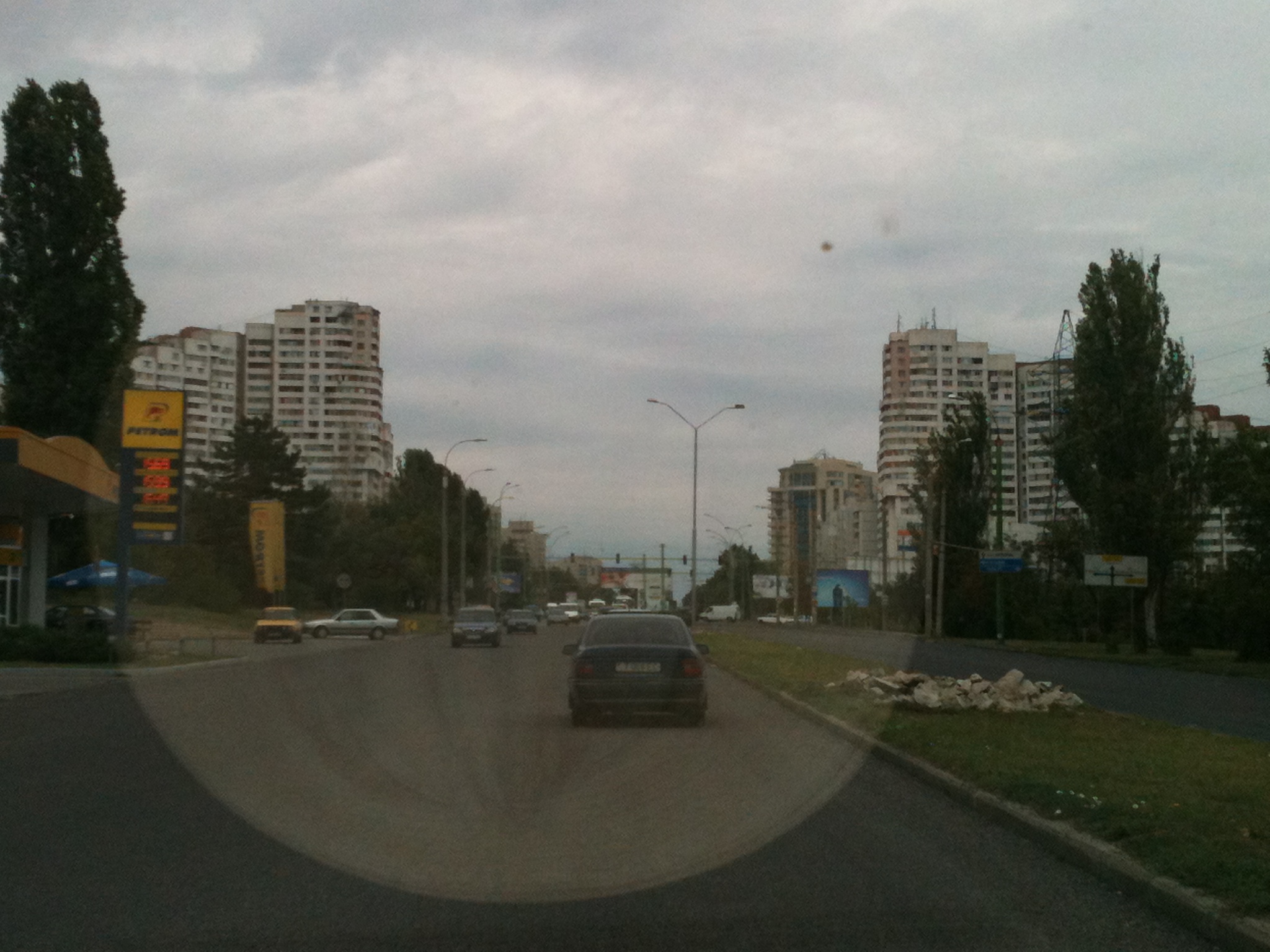
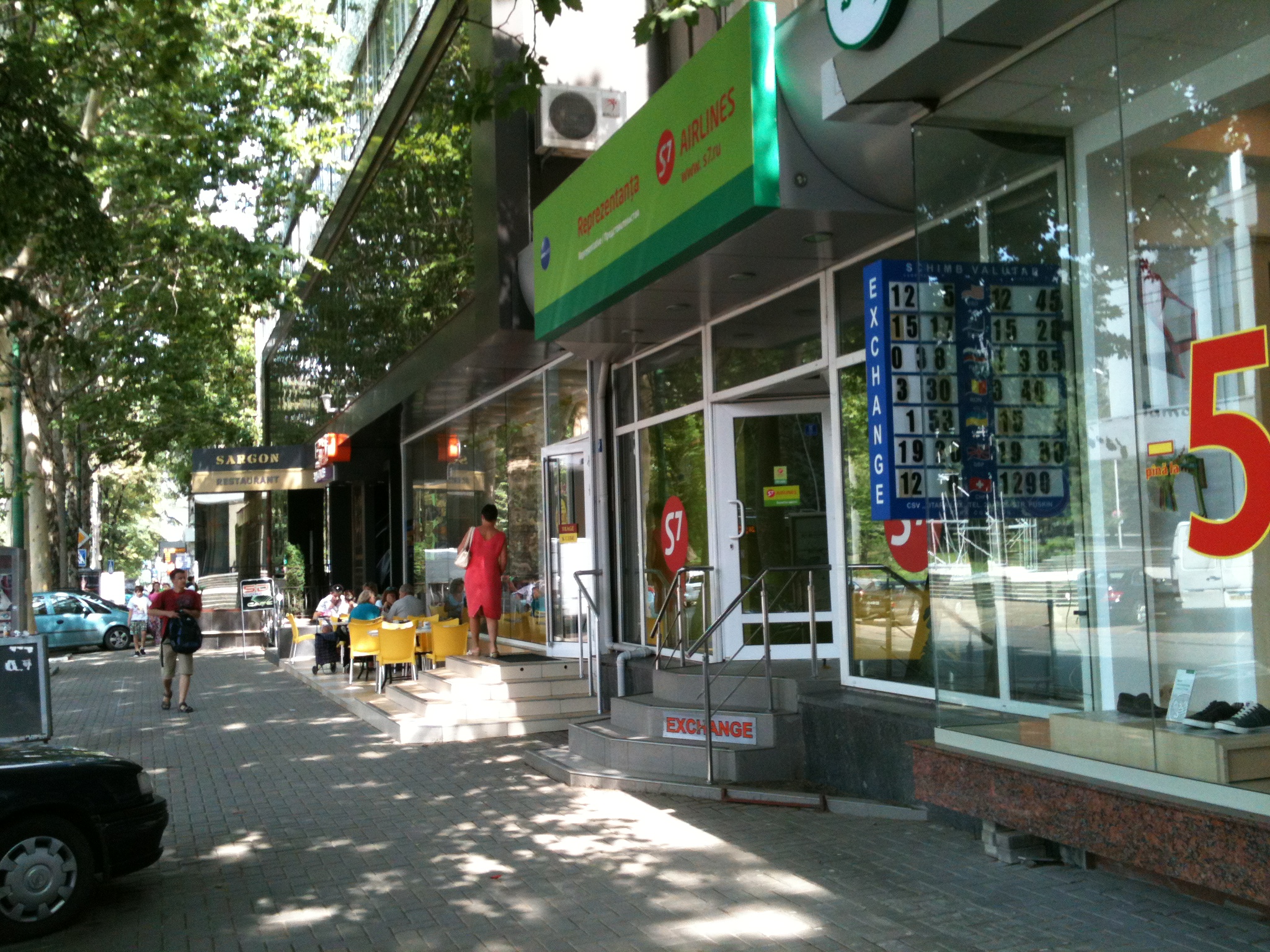
On my last day in Chișinău my lovely friends Elsa and Carl, who are stationed in the city, took Darnell and I out for a day long excursion through the parks and museums and fashionable districts.  We had a lot of fun and I got to see a side of Chișinău that I hadn’t seen before.  There are stores – like Abercrombie and Salamander – that one would see in the US.  There are multi-storied, densely packed buildings that house a warren of vendors selling an eclectic variety of products: one floor will be shoes, one floor fabric, another bed linens and bath accessories, one all toys, etc.  It’s like having a whole mall, but packed into one building.  Very efficient.  There are lovely parks with giant chessboards where people stand around watching a game like it’s a tennis match or something.  There seem to be hundreds of couples getting married.  They speed by in cars decorated with masking tape and colored plastic bags and honk horns and scream madly to passersby.  More pictures of Chișinău:

Darnell and Elsa
One of hundreds of wedding limos driving through Chisinau on Saturday
Parliament Building
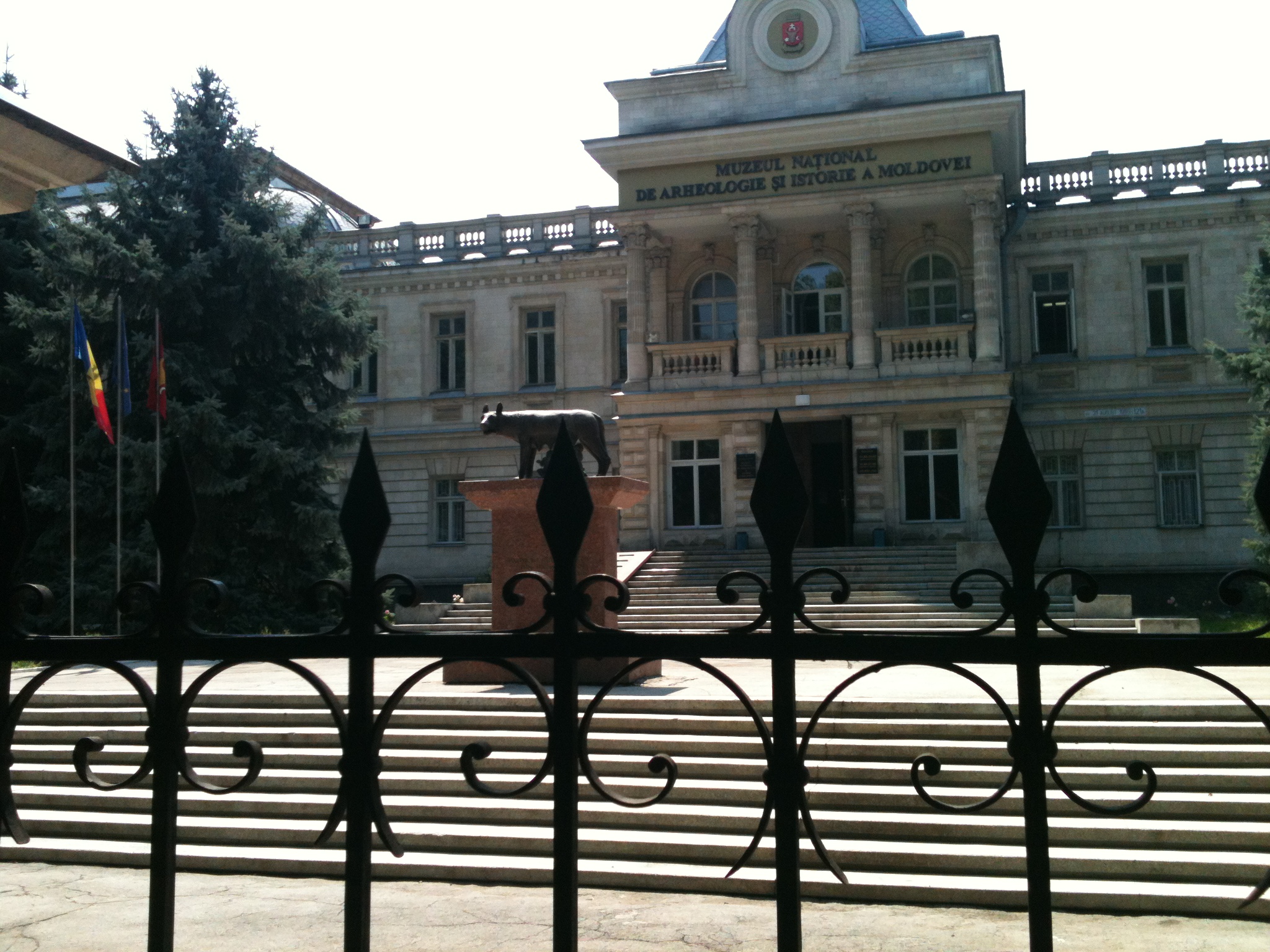
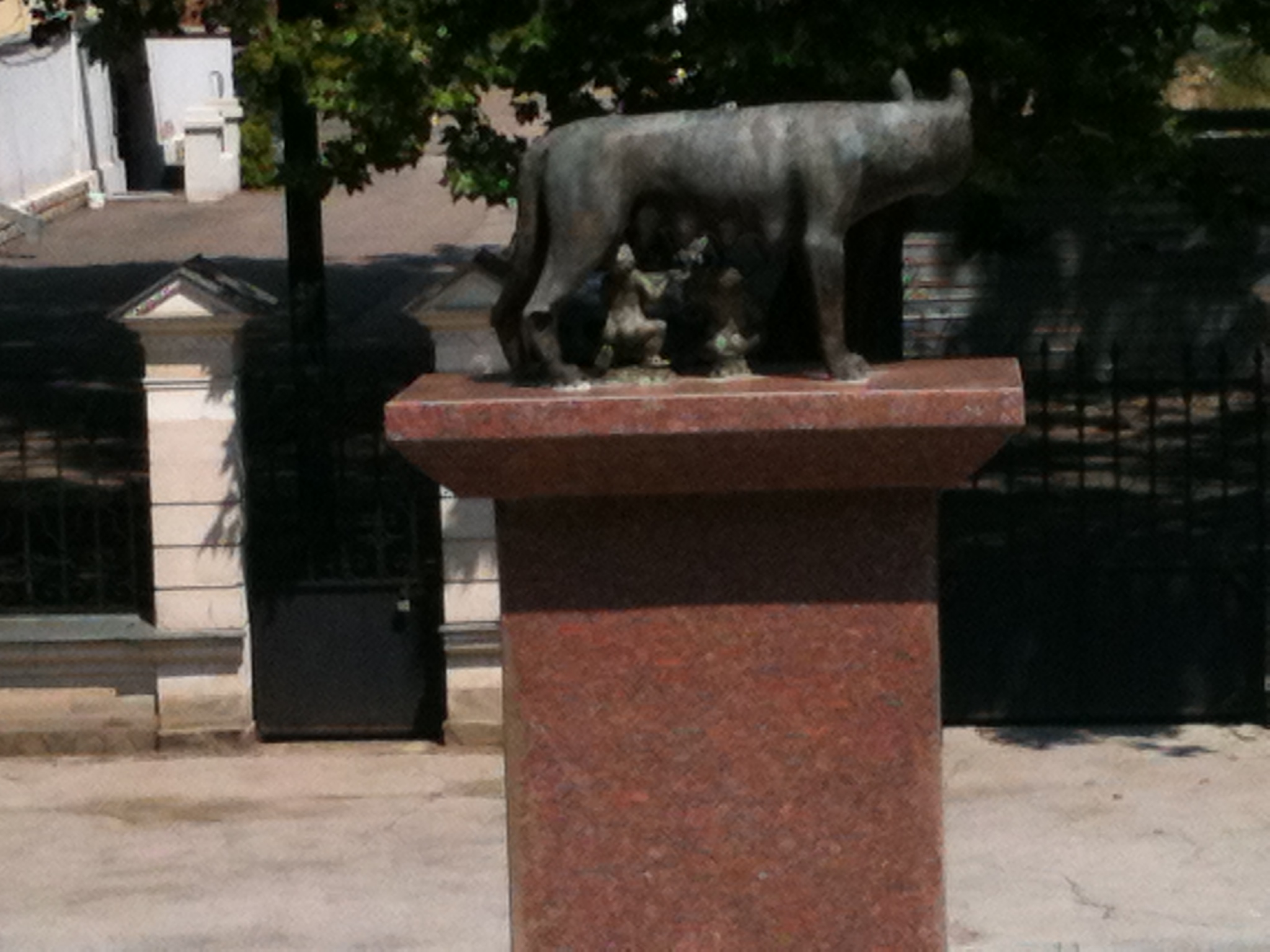
Romulus and Remus in front of the Museum of Archeology
Game of Chess anyone?
Cinema
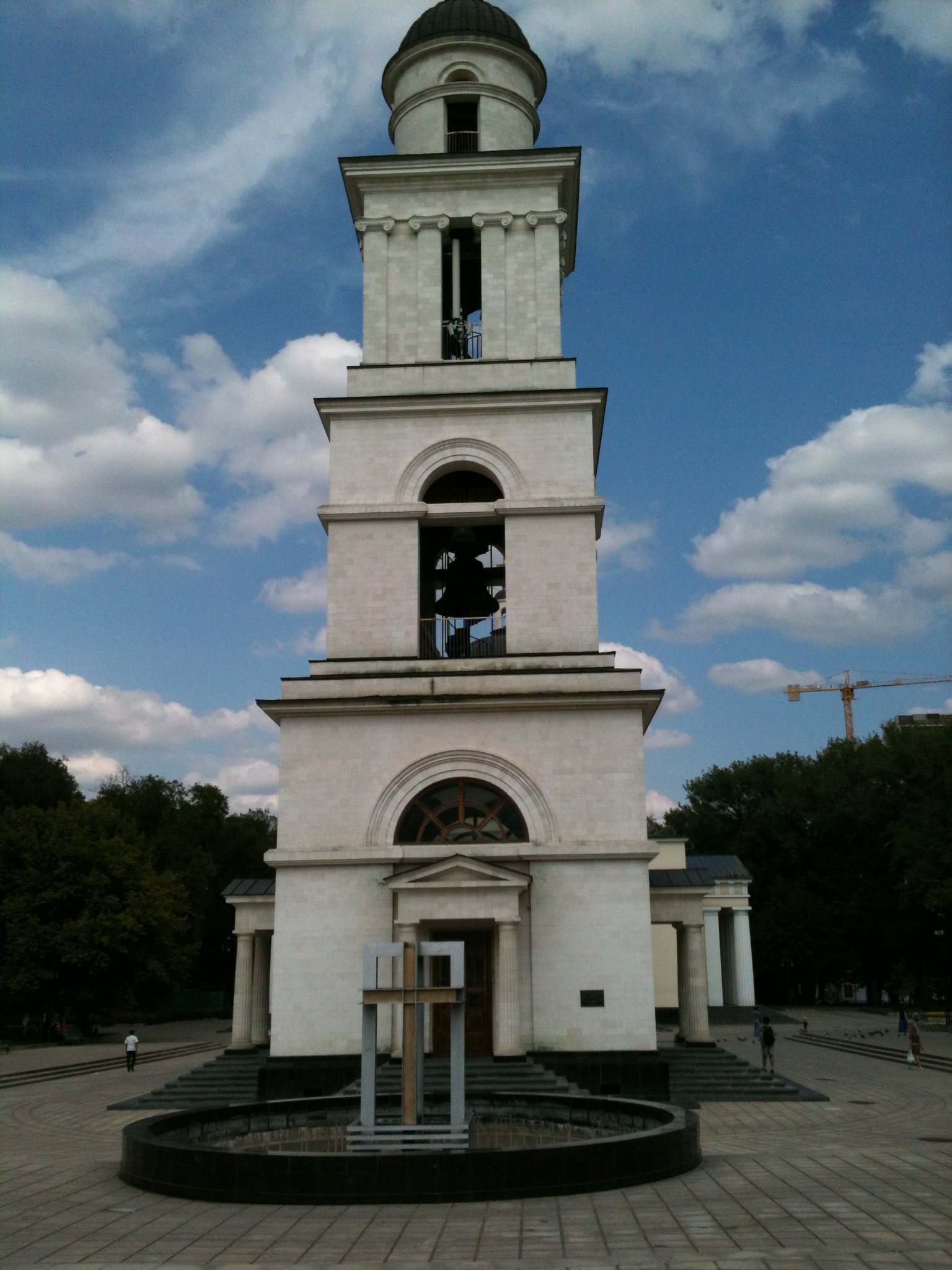
Biserica in the Park
See the tiny police car
City street
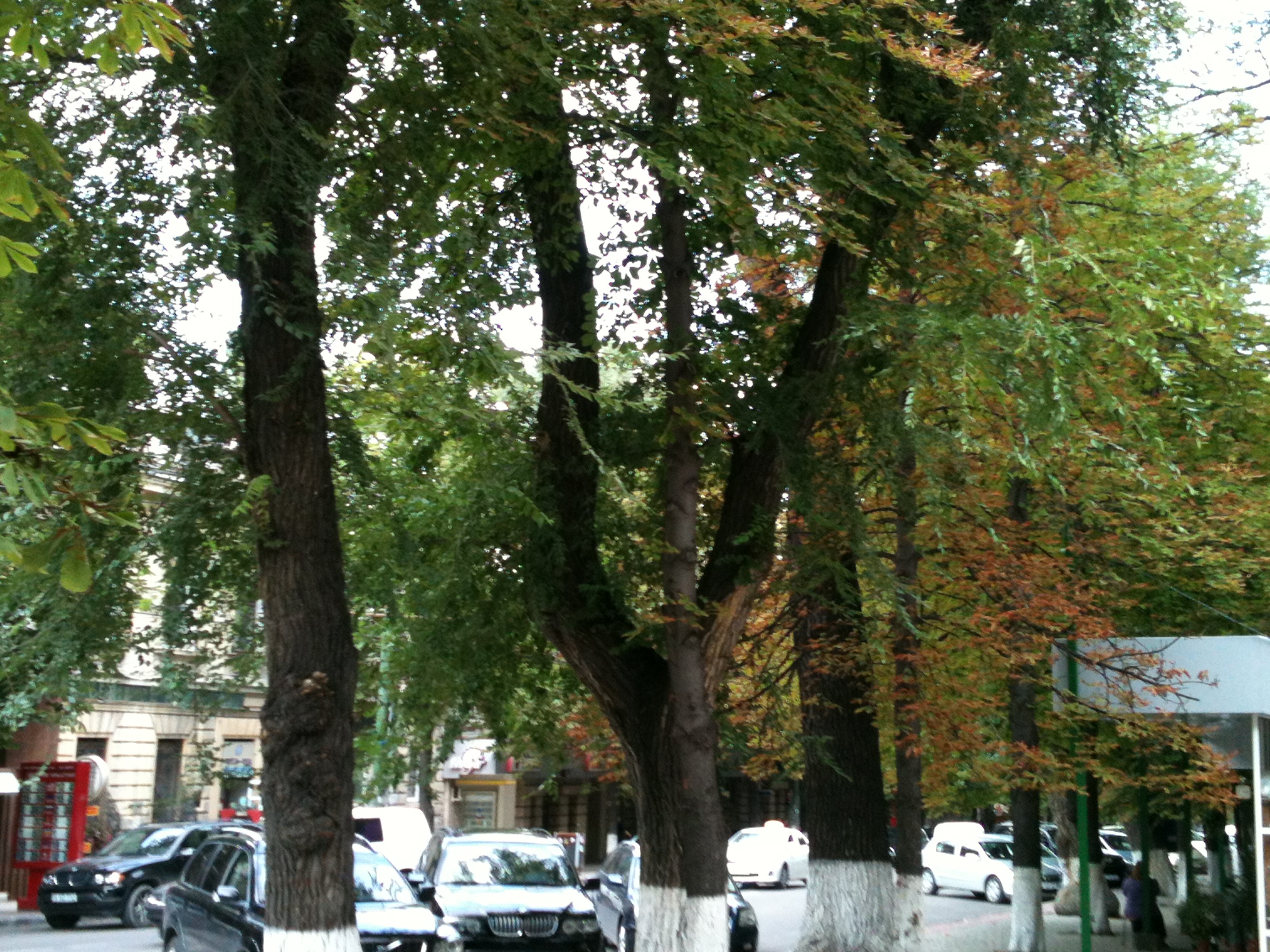
More city street – lovely trees