Life IS Full of Heroism

I must confess it was disheartening for me to visit NPR’s web page today and learn that George Zimmerman had been acquitted of the murder of Trayvon Martin (by a six-woman jury, no less) not because I was hungry after some kind of revenge in a situation where the legality and justifications for Zimmerman’s actions are so hotly contested, but because of what seems to be an increasingly prevalent fear percolating below the surface of so many Americans’ interactions with each other during the course of daily life.

The verdict prompted a lively debate on NPR’s website, generating more than 400 comments at the time of this writing.  The top-rated comment on the story was this one by B Free:

“One thing I don’t understand is what was the young man supposed to do when approached by an armed guy on the side of the road? Black, white, whatever, if a guy with no obvious authority stops anybody on the side of the road in an accusatory manner, exactly what could they say to put them at ease?”

Responses included observations like this one, from commenter Brian Watkins:

“Since the guy was twice his age… maybe a “Hello, how are you tonight sir?”, “just on my way home, is everything ok for you? is your car ok? you need some help with a tire?” … that’s the SAFEST things to SAY. Then when confronted, respectfully chat. I don’t know… those are the best things I can come up with.”

 To which I say, poftim. Barring the obvious elephant in the room – that Zimmerman was armed with a GUN and his demeanor was confrontational – I do believe that simple pleasantries go a long way toward easing awkward social situations.  In most uncomfortable circumstances, I find that a smile does much better than a growl.  However, here is what Watkins goes on to observe:

“America is scared all the time, so everyone is a threat to each other. This is the difficulty we have to live with being a diverse country, but regressing to simple pleasantries is the safest thing to do. To prevent this from happening to more youth, I advise all to stay closer to home and not be out when it gets too dark. It’s dangerous anyhow… it’s harder to identify people at night.”

To which all I can say is, wow.  Americans are basically scary people whom one should be afraid to encounter after dark, so hole up in your homes in order to be safe?  And this is a consequence – a ‘difficulty” – of living in a diverse country? And we need to “regress” to pleasantries in order not to be shot walking home from the neighborhood convenience store?

Is this what it’s come to?

Coincidentally, I was talking with another PCV just this morning about a recent vacation she took with her mom to several European countries.  Her mom suffered a mishap on a bike in Croatia and a local eating at an outdoor café saw it happen and came to their assistance.  He offered to drive my friend to a nearby pharmacy to help her purchase some first aid supplies; she gratefully accepted.  Her mom chastised her later, warning her that the guy might have had ill intentions of rape, robbery, and other mayhem and that my friend was foolhardy for trusting a veritable stranger.  On another occasion, they found themselves hopelessly lost in a Parisian suburb. Despite her mother’s fierce objections, my friend stopped to ask directions of a group of young men gathered on the street, who proceeded to get in their own car and gallantly lead them through the confusing maze of streets and back out onto the main highway.

She and I reflected on an integral lesson which usually occurs to most travelers who have spent some time out in the world; most people are not harboring an inherent desire to hurt you. In fact, many, many people will help you, begrudgingly or not, when asked. Travel in foreign countries often involves getting lost, or needing assistance with language or purchases, or just finding the best spot to eat in town.  To get the most out of the experience sometimes requires putting your trust in a stranger.

How have so many Americans lost this ability to see others as potential allies rather than threats?  And especially in our own neighborhoods?

I have commented on this blog before how increasingly important I am finding the second and third goals of Peace Corps service to be: 2) helping promote a better understanding of Americans on the part of the peoples served, and 3) helping promote a better understanding of other peoples on the part of Americans.   I feel like my daily interactions with Moldovans and other visitors to this country are ending up to be much more meaningful and impactful than the professional skills or work experience I bring.

It was with no small measure of pride that we posted this observation made by a young Moldovan who walked the entire southern route of Turul Moldovei:

“I think that volunteerism is important, and I talked to some people about volunteering and they said that this thing in Moldova has been lost and now American Volunteers help us to understand that we can give the community help that brings us pleasure to help them. I liked very much to be a volunteer, I really get a lot of pleasure, pleasure to have fun, pleasure to work, pleasure to give happiness.

I want to be a volunteer and know when Turul Moldovei ended I am trying to do more.”

Living where I do, at an internationally sponsored NGO that hosts many volunteers from European countries, I have the pleasure of meeting diverse people who use their own vacation time and funds to come to Moldova to help strangers.  For the past two weeks there have been three young women from the Netherlands here, aged 18 to 28, who have gone into the homes of house-bound elderly to empty buckets of feces and bottles of urine, scrub down cockroach infested kitchens, haul water from wells, air out mattresses and blankets, sweep mud-encrusted floors, massage arthritic feet, and then shed tears of joy to have had the honor to do so.

What if, instead, the lesson they learned was to stay close to home, to distrust diversity, or to ‘regress to pleasantries’ to keep safe?

My primary desire in sharing my experiences here is to provide a small window on a faraway place, a country most Americans (and Europeans, it turns out) have never heard of.  I hope my voice can find a place among the incessant fear-mongering that hammers away at our trust, at our empathy, our vulnerability, our ideas about the strangers we meet along the way.

Exercise caution in your business affairs, for the world is full of trickery. But let this not blind you to what virtue there is: many persons strive for high ideals and everywhere life is full of heroism.”

Desiderata

Amen.
The Episode with the Kitten

The other day, an hour or so after another momentous thunderstorm, I was walking up the muddy river that serves as a road in more temperate conditions when I happened upon a weeks-old kitten perched precariously on a rock jutting just above the rushing water. Yapping dogs lined the road’s perimeter, but apparently none of them were ready to brave the water in order to munch the wee morsel.

Steeling myself against sentiment, I shooed away the dogs and continued on to the store.  I have had little patience with PCVs who adopt animals here: unless one plans on making a permanent home in Moldova, how fair is it to subvert an animal’s natural instincts by accustoming it to hand-feeding, doting attention and a warm, dry sanctuary?

Ten minutes later, on the way back, a thinly bleated chorus of mews wafted up to greet me.  The kitten was no longer in the road but I could hear it crying close by.  Again, I steeled myself.  You must not interfere, I told myself sternly.  There are hundreds – most likely thousands – of stray kittens and puppies born each year in Moldova that will not survive a month, much less their first winter.  If I had not happened down this path at just this moment I would never know about this one.  But the mewling seemed to get louder and more desperate as I left it behind.

I recited all the logical reasons why rescuing a kitten was not a rational move on a my part: I live within a community where pets are not cultivated (the one dog that hangs around the center is not allowed indoors, nor provided any food other than kitchen scraps. I am the only one who pets it;) my income is barely sufficient to feed myself;  I am away from site for days at a time; I cannot afford to spay or obtain vaccines; it probably has a ton of worms and fleas; yada, yada, yada. All these valiant attempts at hardening my heart steadily weakened as the calls grew more piercing and urgent in my wake.

So I did what any other smart PCV would do: upon my arrival back at the center I posed the question to another volunteer who happened to be staying the night with me.  “Tell me, should I rescue this kitten?” Of course, Georgiana immediately leapt to the call of an animal in need.  Arming ourselves with a bag and a pair of sturdy gloves, we set off back down the road to retrieve said kitten.

Only what we found was TWO kittens, cowering under a low carpet of bushes, soaked to the skin and shivering, almost skeletal with hunger.  Great.  One of them – a tabby with the big mouth that I had already seen in the road – was readily amenable to being picked up and placed in the bag.  The other, a Russian Blue, was decidedly not.  It scampered even further into the bushes, spitting and hissing for all its 2 ounces worth.  Oh well, I thought, I really didn’t bargain for more than one anyway. But Georgiana was now on a mission; she determinedly flattened the bushes right after it and caught it within seconds.

Damn.

***

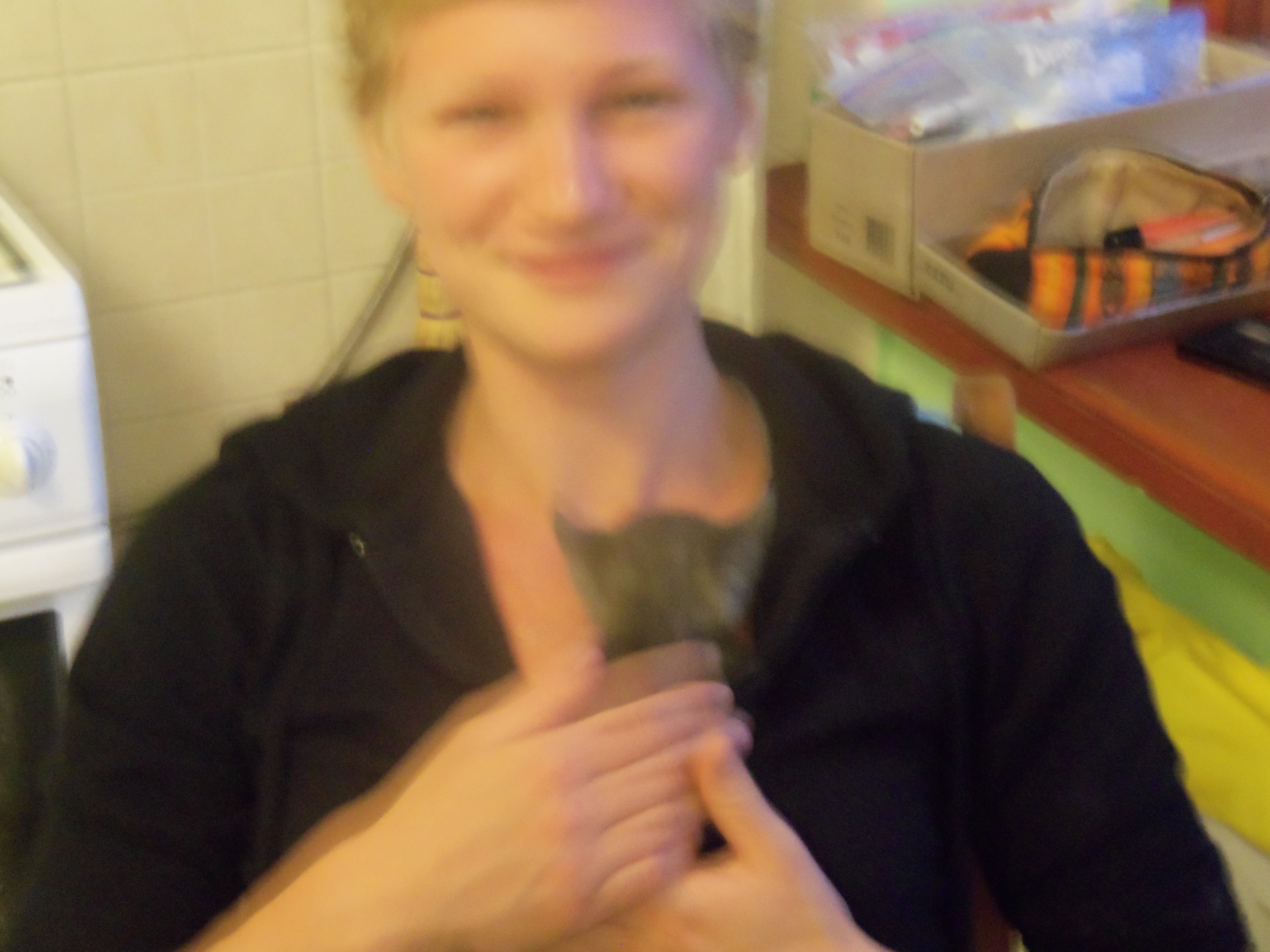
Soon after finding them a box and warm blanket, we introduced them to the three young Dutch volunteers that are currently staying at my center.  One of them, Leonie, immediately fell in love. She had one or both of them curled up into her neck for the remainder of the day, and took them both to sleep with her that night.  Poftim.

I began formulating a convincing argument for why it would be good for HER to adopt two Moldovan kittens and take them home to Holland.  She was easy to convince.  Soon, she was researching transport options and firing off emails to an aunt back home who had successfully adopted several cats and dogs during her life travels.

The next day, the tabby disappeared. Leonie accidently stepped on it while taking off her muddy shoes after a run. It appeared to be unharmed and scampered off into the bushes.  But later on when she went to bring the kittens in for the night, it was gone.  This caused her a great deal of anguish and not a few tears; how can I admit to be slightly relieved that we were back to the original one I had first envisioned rescuing?  It was doubly sad that it was the tabby – the one that fostered my sympathy in the first place with his persistent cries.

However, now there’s Jane.  That’s what Leonie has named the Russian Blue, the one now so attached to people that she sets up a fuss whenever you walk away. And it looks as if she will be staying with me, after all.  Though a process does exist for adopting animals and exporting them to other countries, it is complicated, tedious, expensive and time-consuming; certainly beyond anything Leonie can manage in her remaining week in Moldova.

***

For a time, I watched a television show called How I Met Your Mother.  There is a character on the show, Robin Scherbatsky, who fantastically kept five dogs of various sizes in her tiny New York apartment.  Despite Robin only being home perhaps one episode out of 20, these dogs appeared placid and happy, not requiring food, or walks, or attention, apparently going to sleep for long stretches of weeks whilst Robin cavorted about New York with her friends.  Her furniture stayed pristine, big clumps of hair did not collect on the carpet and numerous throw pillows on her living room couch remained miraculously intact. Those of us who live with dogs – especially without the benefit of large suburban backyards or rural fields to set them loose in – know that five dogs in an 800 square foot apartment is a recipe for certain disaster, if not complete and irrevocable destruction of all one’s favored belongings.

This is one aspect of modern media that contributes to our continued naiveté in approaching the mechanics of our lives.  I remember my daughter pining for Carrie Bradshaw’s life in Sex and the City, a part-time newspaper columnist who inexplicably could afford Manolo Blahnik shoes, long lunches at high-end eateries, and a darling apartment in Manhattan.  When I would insert my (unsought) opinion that the likelihood of an actual columnist’ salary supporting such an extravagant lifestyle was pretty unlikely, she would froth and foam at my nitpicking lack of imagination.  Couldn’t I just appreciate the story?

I should no more adopt a cat in Moldova than Robin Scherbatsky should cram five canines into a New York walk-up.  But we continue to fool ourselves by referencing the glut of misleading, manipulative entertainment and advertising that does its concerted best to get us to watch, buy, and consume by convincing us that we are all better people for doing so.   We tell ourselves the stories that we fervently wish to believe about life.  And here I go with mine.  I still don’t think I’ve done Jane any favors in the end by bringing her into my life.  But, at least for this episode, she seems happy and I feel just a tad bit better for having ‘rescued’ her from an uncertain fate.  Catch me next season to see how the story progresses….

Image
Leonie and Jane – inseparable!

Image